Agira rises over Sicily’s inland valleys as a close-knit hillside town rather than a single monument with a village attached. Houses climb the slopes of Monte Teja toward the remains of a medieval castle, and lanes repeatedly open onto long views of the Salso and Dittaino valleys. ISTAT’s estimate for resident population on 1 January 2026 is 7,529 for the entire municipality, including its territory beyond the historic centre. That distinction matters when planning a visit: the old quarters are compact enough to explore on foot, but the municipality also includes a broader rural landscape. Visitors come for layers of archaeology, churches, food traditions and a sense of local life that remains visible in the streets.
Agyrion: evidence, history and a foundation legend
The ancient settlement known as Agyrion or Agyrium is not a blank on the map: local archaeological accounts describe remains of the Greek city and a mint dating to the fifth and fourth centuries BCE, and a Hellenistic necropolis has been recorded within the modern town. The Greek historian Diodorus Siculus identifies Agyrium as his birthplace; his surviving work also preserves stories that connect the area with Heracles and Iolaus. Those myths belong to the ancient cultural memory of the place, not to a verifiable account of its founding. A local tradition that Agira existed before the Trojan War should be read in the same way. The evidence supports a long-lived settlement and a significant ancient community, but it does not prove a legendary foundation date or a single founding hero.
Agyrion later entered the Roman sphere, and classical authors refer to the city. The town’s layered history continued through Byzantine, Arab, Norman and later Sicilian periods. The current castle ruins crown the high ground where local heritage accounts place the ancient acropolis. The visitor portal describes the surviving towers as a Swabian-era castle, while also noting a popular tradition of Arab origins. The remains suggest a medieval fortification with a complex past; claims about a precise first builder remain uncertain. The hilltop setting is the clearest part of the story: military position, settlement and outlook all meet there.
Walk the old quarters slowly
A useful walk links the castle area with the older church districts below it. The Pro Loco’s guide describes Santa Maria Maggiore as a church whose structure dates to the twelfth and thirteenth centuries, with two naves and pointed arches. In the nearby quarter, the church of Sant’Antonio Abate and the Norman-period church of Santissimo Salvatore reveal further layers of religious and civic history. The guide identifies an Aron ha-qodesh, a stone Torah ark bearing a 1454 date, inside Santissimo Salvatore. Its presence recalls Agira’s medieval Jewish community and offers a rare architectural trace of a history that is often reduced to Christian monuments alone.
Farther down, Santa Margherita’s original foundation is associated with the thirteenth century; the church was rebuilt after the 1693 earthquake, with work linked by the local guide to architects Giovanni Battista Vaccarini and Stefano Ittar. The lanes of the Rocche quarter, with their stairways, small landings and tightly set houses, reward unhurried walking. The visitor portal calls Agira a “crib town” for its stacked rooflines. From the upper terraces, clear days can bring views toward the Madonie, Nebrodi and Etna, as well as the artificial reservoirs Pozzillo and Sciaguana. Religious buildings may have limited opening hours, so check locally before building a route around an interior visit.
Faith, food and the town’s working history
San Filippo d’Agira is central to the town’s public calendar and identity. The local tradition tells of a monk who evangelised the area and performed miracles; the hagiographic narrative is part of a living cult, not a substitute for independently documented early-medieval biography. Two celebrations, in May and August, draw the statue and relics through town in processions. The August gathering also connects Agira with Żebbuġ in Malta, a town with which it is twinned through shared devotion. These are community events as much as spectacles: they bring residents, returning emigrants and visitors into the same streets.
Food is another way the town speaks for itself. The crescent-shaped cassatella di Agira, a baked pastry with a tender shortcrust shell and sweet filling, has a strong local identity and is promoted by the visitor portal and municipal festival calendar. A local guide also documents an older economy shaped by cereal cultivation and, during the industrial era, sulfur mining. Those are historical strands rather than a current employment breakdown; the sources consulted do not provide a recent sector-by-sector account. Today, local visitor listings point to accommodation, eating places and guided experiences, while the wider area retains agricultural landscapes. The Sicilia Outlet Village is a separate commercial destination near the motorway, not part of the historic centre.
Beyond the ridge: lake and remembrance
The Pozzillo reservoir gives a visit a contrasting landscape. Its protected natural site extends across the territories of Regalbuto, Agira and Gagliano Castelferrato and includes Mediterranean habitats that change with the seasons. It works best as a separate half-day outing, with access and activities checked in advance; the conservation designation is not a promise that every shore or path has visitor facilities. Another nearby excursion is the Agira Canadian War Cemetery. Veterans Affairs Canada records 490 Canadian graves there and explains that the site was chosen in 1943 to gather the graves of Canadians killed in the Sicilian campaign. Its quiet grounds offer a solemn counterpoint to the town’s festive calendar.
How to arrive and what to plan
Interbus lists Agira as a destination and places it 35 kilometres from Enna; the carrier’s stop and ticket information is the right place to check a current connection from the provincial capital. The airport service information for Catania also lists Agira among Interbus destinations, but schedules and stop arrangements vary. By car, the A19 Palermo–Catania has an Agira exit; from there, local roads lead toward the town, while the hilltop centre is best explored on foot. Check bus timetables, road notices, church openings and any event dates before travel. The historic lanes are steep, so comfortable shoes and time for pauses make a real difference.
 Agira on video: an old-town walk, local hospitality and San Filippo traditions
 Storie Enogastronomiche’s short film turns from monuments to hospitality, presenting Case al Borgo as an example of relational tourism in Agira. The channel’s description centres on the people involved in welcoming visitors and on cultural exchange as part of the travel experience. It is a useful counterpoint to a conventional sightseeing film because it asks how a small town receives guests and keeps local knowledge in circulation. The video dates from 5 October 2017, so it documents a project at that time; it should not be used to assume present-day availability, facilities or booking arrangements.
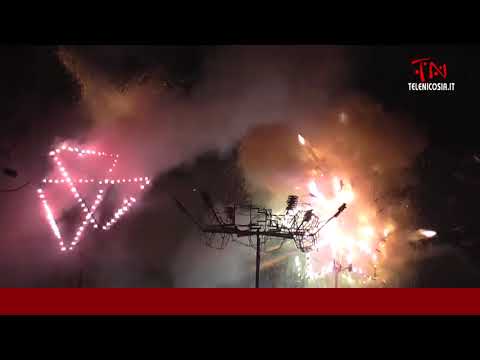 TeleNicosia’s report records the Maltese “girandole” fireworks held in Agira on 11 August 2018 during the summer celebrations for San Filippo. The piece connects the spectacle with the town’s religious festival and its longstanding relationship with Żebbuġ in Malta, whose community brought the pyrotechnic tradition to the event. It is best read as a record of one particular edition, not as a promise that the same programme takes place every year. For a visitor, it gives a vivid sense of how devotion, exchange between communities and public celebration can share the same evening.