Calascibetta looks across a narrow valley toward Enna from the high ridge of Monte Xibet. Its old streets climb and fold around the rock, giving the town a different character from the provincial capital opposite: quieter lanes, a concentrated medieval centre and an unusually close relationship between the built town and the archaeological landscape around it. ISTAT’s estimated resident population on 1 January 2026 is 3,948 for the whole municipality, not only the hilltop centre. The distinction matters here because many of the most striking sites—prehistoric tombs and rock-cut settlements—lie outside the residential core and need a separate visit.
A ridge occupied in different periods
The archaeological evidence in Calascibetta’s territory is older than the present town. The municipality records Bronze Age tombs at Calcarella and Malpasso, while the Realmese necropolis contains 288 rock-cut tombs associated with the Pantalica tradition, used in the ninth century BCE and again in the sixth. That evidence documents people living and burying their dead in the surrounding landscape; it does not mean the modern settlement already existed in its current form. The municipality’s historical account places an early fortified quarter on Monte Xibet in the Arab period and describes a later Norman expansion under Count Roger. The exact sequence should be read as the town’s institutional historical synthesis, while the surviving archaeological sites offer distinct evidence from different periods.
Realmese is especially revealing because an ancient paved section of the royal trackway toward Gangi survives there, partly cut into the rock. It ties a burial landscape to the long movement of people and goods across inland Sicily. Nearby, the Municipality describes Canalotto as a late Roman–Byzantine rock settlement. At Cozzo San Giuseppe, the Sicilian regional heritage authority reported the identification of a highland site near the Realmese necropolis in 2021, a reminder that fieldwork continues to change what is known. Cave rooms, sanctuaries and tombs should not be flattened into a single “prehistoric village”: each place has its own date, evidence and access conditions.
Church, castle and a town within a town
In the centre, the main church of San Pietro and Santa Maria Maggiore contains an unexpected archaeological layer under the floor. The municipal account dates its completion to 1340 and says Peter II of Aragon named it a Royal Palatine Chapel in 1342. It was built over remains of the earlier castle known as Marco; the excavated fabric and a partly visible rock church can still be seen within the church complex. The result is not simply a medieval church but a structure where sacred architecture and fortification occupy the same footprint. The church’s three-nave basilican layout and carved column bases add another chapter, shaped by later remodelling.
Beyond the main church, a slow walk through Via Soprana, Via Faranna and the smaller lanes reveals old courtyards, stairways and religious buildings rather than one continuous museum route. The municipal catalogue lists the former Jewish quarter among the historic places of interest. The site catalogue also records churches such as Santa Maria della Catena and the Carmine, older palazzi, votive crosses and the Norman bell tower of San Pietro. Some interiors have limited or changing access; check the Comune’s current notices before planning to enter. The town rewards a route that leaves time to look at thresholds, stonework and sudden views over the valley.
Archaeology outside the centre
Plan at least one separate excursion beyond the ridge. Realmese is an open-air archaeological area along the old Calascibetta–Gangi trackway; its 288 tombs were excavated in 1949–50, and the municipal visitor page says finds are displayed at the Paolo Orsi Regional Archaeological Museum in Syracuse. Access is on foot and the site is not accessible to visitors with reduced mobility, so it calls for sturdy footwear and an honest assessment of conditions. Calcarella, roughly a kilometre southwest of the inhabited centre according to the municipal description, has rock-cut Bronze Age burials in a deep ravine. Canalotto’s cave settlement takes a different form, with rooms associated with late Roman and Byzantine occupation. These are not interchangeable attractions, and visitors should verify access before driving out.
For context before or after the field sites, the Museo Varisano in Enna presents archaeological material from the surrounding territory in a regional sequence. It is a useful nearby cultural stop rather than a substitute for the landscape itself. Calascibetta’s broader rural setting also preserves traces of mills, washhouses, water sources and former sulfur workings. The town’s official account treats these as evidence of older work and infrastructure; it does not provide a current employment breakdown. The present visitor experience is shaped by heritage, local services and seasonal religious celebrations, while the economy should not be reduced to tourism alone.
Community calendar and practical arrival
Calascibetta’s annual rhythm includes the Holy Week Via Crucis, the feast of San Pietro in early August and the Madonna del Buon Riposo gathering in early September. The municipality records the latter as a meeting place for rural communities and explains that its story includes both religious practice and older local rites. A tale about a miraculous stone becoming too heavy for miners to carry is part of that local tradition, not a documented archaeological event. Check the Comune’s events calendar for dates and current arrangements; the programme can change from year to year.
SAIS Autolinee lists direct journeys from Calascibetta to Enna and to Enna railway station, making the provincial capital the practical public-transport gateway. From Enna, visitors can connect to the wider Sicilian bus network; check the booking system for the actual date, departure stop and return trip. By car, follow the signed local road from Enna toward the ridge town, then park outside the narrowest lanes and continue on foot. Calascibetta is steep, and the archaeological sites beyond town require additional planning. Allow a day for the centre and select one outer site rather than trying to see all of them between bus connections.
 Calascibetta on video: from the lanes of Via Carcere to its prehistoric landscape
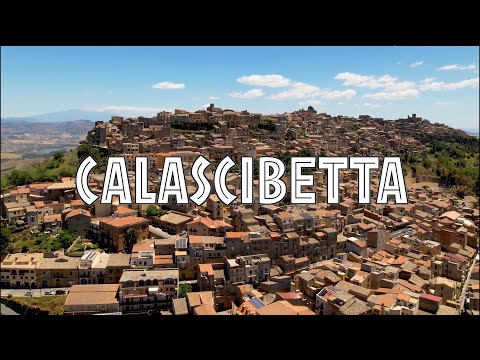 Sicily’s Journey presents Calascibetta as an inland-town itinerary, describing visits to museums, churches, lanes and archaeological sites. The video’s description says the day begins at the Museo della 500, a local collection, before moving into the town and its wider cultural setting. That combination is useful for travellers deciding whether to reserve time for more than the central streets. It is an independent travel feature, not an official inventory; confirm current openings and site access with the municipality. YouTube lists the publication date as 31 August 2025.
 Mirco Mannino’s film is the most focused archaeological companion in this set. Its description divides the visit into a stone quarry, the Realmese necropolis and the Byzantine village, with timestamps that let viewers compare the distinct places rather than treating them as a single ruin. The sequence is helpful for understanding the spread of archaeological interest around Calascibetta, but it cannot replace the municipality’s access notes—Realmese and some rock sites involve walking and may not suit every visitor. The video was published on 2 May 2020.