A village above the Ionian coast
Castelmola occupies a ridge in the hills above Taormina, where the settlement meets a steep, open horizon. It is a small municipality with its own civic life, not simply a viewpoint belonging to the larger town below. The latest figure published by the Sicilian regional administration is 1,076 residents for the whole comune on 1 January 2025; the same official list places the centre at 501 metres above sea level. From its public viewpoints, the eye moves from Taormina and its castle to the Gulf of Naxos, Mount Etna and, to the north, the Calabrian coast. The panorama explains the first impression. The squares, churches and short lanes reveal how people have occupied this exposed ridge over time.
History told with care
Local and regional tourism accounts connect the hill with the ancient name Mylai and an Iron Age settlement. The Metropolitan City of Messina’s guide says Castelmola may have served as Taormina’s acropolis. That qualification matters: it does not establish a precise founding date for the present village. The origins of the Castle of Mola are also described as uncertain. Its remaining walls, commonly identified as Norman, give the ridge its most visible historical outline, but they cannot prove every story associated with the place. Ancient occupation belongs to the area’s historical narrative; the medieval fortification and later civic history are easier to locate in the surviving streets and buildings.
Castelmola’s administrative story is closely tied to Taormina. The metropolitan tourism portal records that it was incorporated into Taormina in 1928 and regained municipal independence in 1947. Those dates help explain why a small hilltop community has its own town hall while remaining an immediate neighbour of one of Sicily’s best-known destinations. The old centre keeps a medieval character in its interlacing lanes, stone details and entrance arch, although later changes to roads and public spaces are part of its present-day form too.
Start at the mosaic square
Piazza Sant’Antonino is a natural first stop. The Comune dates the square to 1954 and describes a geometric mosaic of white stone and dark lava beside the former church of the same name. Trees, stone seats and belvederes make it a place to pause and orient yourself, not only to take a photograph. The municipality lists the square as free to enter and accessible to visitors with disabilities. It identifies the SP10 as the road approach to the village.
Nearby, the Church of San Nicolò di Bari brings several periods together. The current building was constructed in 1934–35 on the site of an earlier parish church, which the Comune says probably dates to the sixteenth century. The facade combines different architectural references; inside, a rectangular nave leads to a rounded apse and four marble side altars. Look for the rose window, carved side portal, wooden choir and manually operated organ, as well as the eighteenth-century walnut pulpit. Entry is free according to the municipal page, but steps make the church inaccessible to wheelchair users. Check locally for opening times and services.
The former Church of Sant’Antonino, facing the square, has taken on a civic role. Built between the fifteenth and sixteenth centuries, it was deconsecrated in 1953 and later restored as the municipal auditorium. The Comune lists civil ceremonies, conferences and meetings among its uses. Entry is free, though access includes a stair that is not wheelchair accessible. Above the lanes, the ruins of the Castle of Mola are the next landmark to seek out. The municipality lists the site but gives no regular visitor timetable, so treat it as an outdoor stop and check current access notices.
A local taste and a changing visitor economy
Castelmola’s almond wine is more than a souvenir label. The current history published by Antico Bar San Giorgio recounts how Vincenzo Blandano welcomed travellers at his small Piazza Sant’Antonino establishment in the early twentieth century and developed the sweet almond-based wine associated with the village. The business still lists a bar, restaurant, pizzeria and almond wine. This is a specific local story, not proof that every household depended on tourism or wine-making. It does show how hospitality, a panoramic public square and a distinctive taste became linked in Castelmola’s modern identity.
The centre is best explored without rushing: follow the short streets between the square, the churches and the castle ridge, leave time for a meal or drink, then return to the belvedere as the light changes. The metropolitan tourism guide also identifies a route from the Annunziata area toward Monte Venere and the Scalazze, near the Grotta dei Monaci. It is a locally promoted option, not a guarantee that each section is currently open or clearly marked. Check trail conditions and daylight before setting out.
Getting there and seeing what lies nearby
ASM Taormina’s Green Line links Castelmola with Madonna della Rocca, central Taormina, Taormina-Giardini railway station and Ospedale San Vincenzo. The operator’s 2026 timetable lists departures from Castelmola Piazza Sant’Antonio and marks Sunday and holiday services separately; some runs have a different endpoint. The service makes a car-free visit possible from Taormina and connects with rail arrivals, but schedules can change by day and season. Check ASM’s current timetable before travelling. By road, the Comune points visitors to the SP10. Taormina and Giardini Naxos make natural companions for a day out: pair the hill village’s lanes and views with the coast below, while allowing Castelmola its own history and pace.
 Castelmola on film: village walk, ridge views and almond wine
 At just over a minute and a half, this drone-format film offers a quick sense of Castelmola’s position above Taormina. It complements the walking tour: the aerial perspective suggests the relationship between the settlement, the ridge and the wider coast, while street-level details remain for a visit on foot. The title identifies the subject and format; the clip is not a narrated history and does not establish when the castle was built.
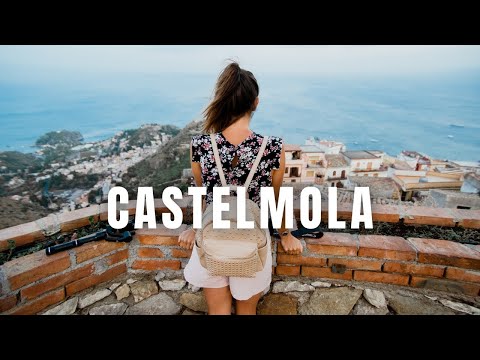 Enrico Usseglio Brancard’s 2017 road-trip video is a more personal stop in the village. The creator describes walking its lanes, looking toward the Sicilian coast and pausing at Bar Turrisi for almond wine or a granita. That makes the film useful for the feel of an informal visit and for seeing how Castelmola fits into a wider Sicily itinerary. It is an older travel record, so use it for atmosphere rather than relying on it for current business hours or transport information.