Above the Ionian coast, the road to Bova climbs into the southern Aspromonte and ends in a town whose steep lanes make its geography part of the visit. The Municipality places the historic settlement at about 820 metres above sea level and gives the whole municipal area as 46.74 square kilometres. From the upper streets, the view crosses the Amendolea and Palizzi valleys toward the sea; on clear days, the wider panorama reaches the Sicilian horizon. Bova is a small community, but its importance is not measured by size alone: it is one of the principal living centres of Calabria’s Greek-speaking heritage.
A town where language is part of the landscape
ISTAT counted 454 residents in the entire Comune di Bova on 1 January 2025. That figure covers the municipality, not only the hilltop centre. Italian is the language of public administration and the main written language of municipal services, so this guide’s local-language edition is Italian. Yet the name Chòra tu Vùa, also written Vùa, points to a second cultural register. The Greek-Calabrian language, often called Greko or Grecanic, remains part of the identity of Bova and other communities in the Bovesìa, including Gallicianò and Roghudi. It is a living minority language, not a decorative trace of antiquity: local cultural institutions document its vocabulary, oral traditions, music and place in everyday memory.
The Aspromonte National Park’s visitor centre in Palazzo Tuscano interprets that heritage across three floors, from language and history to music, craft and food. It also houses the Franco Mosino collection, described by the Park as roughly 5,000 books on the Greeks of Calabria. Near the entrance to the village, the Gerhard Rohlfs Museum uses documents, photographs and audio-visual displays to introduce the language and the work of the German linguist who studied it. Check opening hours and appointment rules before travelling; the published schedules can change.
What the evidence says about Bova’s past
The town’s official history reports prehistoric flint tools and pieces of obsidian around the castle rocks, as well as pottery fragments associated with early Greek settlement. These finds point to human activity across more than one period; by themselves, they do not prove an uninterrupted town here since prehistoric or classical times. Greek colonies were established along the Ionian coast of Calabria between the eighth and sixth centuries BC, but Bova’s precise foundation remains uncertain. The story that a Greek queen climbed from the shore and founded the hill town is a local legend, which the municipality itself labels as such.
The surviving shape of the old centre is easier to read than its earliest origins. The heritage office describes a settlement laid along a steep slope, with narrow streets, noble houses, defensive walls and towers, and the ruins of a Norman castle above it. The Cathedral of Santa Maria dell’Isodia, identified by the heritage authority as a sixteenth-century building, marks the upper town; the Sanctuary of San Leo is another central stop. Municipal history records the Greek rite in Bova until 1572 and the archbishops of Reggio holding feudal authority until the abolition of feudalism in 1806. These dates explain layers in the town’s religious and civic history without reducing its Greek-Calabrian identity to a single origin story.
How to spend time in the historic centre
Start on foot and allow time for the climb. The lanes pass stone facades and palazzi associated with families such as the Nesci and Mesiani, then open onto small squares and viewpoints. The remains of the castle are the high point, both literally and visually; the heritage office notes how the settlement’s buildings and routes follow the contours of the hill. San Leo’s sanctuary and the Cathedral reward a slower visit, while the open-air Sentiero della Civiltà Contadina places tools and signs of rural work among the streets rather than behind glass. It gives context to the agricultural and pastoral life that shaped the surrounding area.
For a more focused visit, combine the open-air route with the language museum and the Park’s visitor centre. The cultural route is especially useful for understanding why Bova matters beyond its architecture: the local language, family memory, religious practice, music and food traditions belong to a broader Grecanic area. The town’s food culture is part of that story. Regional visitor material describes lestopitta, an unleavened flatbread, alongside meat, cheeses and ingredients such as bergamot. Bergamot is associated with the wider Ionian landscape and its agricultural economy; it should not be mistaken for a crop grown only within the hill town itself.
Getting there and exploring nearby
For a public-transport journey from Reggio Calabria or the northern Ionian coast, regional trains stop at Bova Marina on the Reggio Calabria–Catanzaro Lido line. Bova Marina is a separate coastal town, not the hilltop village. From its station, Autolinee Federico publishes a route linking Bova Marina with Bova Superiore, but the connection is limited and its online timetable may not match every train. Check both operators before setting out and leave time for the final ascent. By car, the practical approach is along the Ionian coast and then inland on the mountain road; allow for a winding climb and confirm current road conditions. Bova’s steep, narrow lanes make sturdy shoes useful; visitors with mobility needs should check access at individual sites in advance.
Bova Marina makes a worthwhile separate stop for the state-run Archeoderi Museum and Archaeological Park at San Pasquale. Its remains include a synagogue in use between the fourth and sixth centuries AD, with a mosaic floor bearing a menorah and other symbols. Do not confuse that coastal site with Bova’s hilltop castle or its own museums. Other Grecanic communities, including Gallicianò and Roccaforte del Greco, offer a wider view of the area, but the roads are mountainous and visits should be planned around current access, weather and transport. Bova is best approached as a place to walk, listen and learn: its strongest attraction is the way a dramatic setting and a living minority culture meet in an inhabited town.
 Bova on film: the Grecanic language, the Pupazze and the castle
 This 2025 report records the Palm Sunday preparations as a present-day community practice: workshops, volunteers selecting olive leaves and younger residents learning how the figures are made. Interviewees also interpret the Pupazze through the story of Demeter and Persephone. That is valuable evidence of how participants explain the ritual today, but it does not establish an uninterrupted ancient pagan origin.
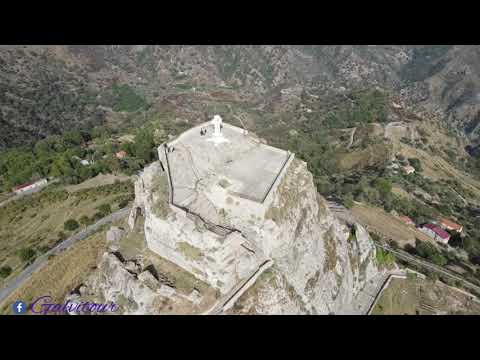 At just under a minute, this drone clip is a visual pause rather than a narrated guide. Its subject is the ruins identified in the title as Bova’s Norman castle. It can help viewers appreciate the elevated position of the remains, but it offers no historical explanation or dating; use it as a preview of the landscape and rely on heritage interpretation for context.