Trévoux counted 7,013 municipal residents in 2023. The old town climbs above the Saône, where a short walk can move from river views and quays to medieval lanes, a former court and the remains of a hilltop castle. Its appeal comes from an unusually coherent story: Trévoux was once the political centre of the Principality of Dombes, then a place of printing, metalworking and fine wire production. The historic fabric gives that past a human scale.
A principality with its own court and print culture
Under the Bourbon dukes, Trévoux became the capital of Dombes in the fifteenth century. The principality passed through periods of political dependence and independence before joining France in 1762. Its institutions included the Parlement de Dombes, a court of justice rather than a modern elected assembly; the preserved courtroom is one of the town’s most distinctive interiors. The privileges of the principality supported coinage, legal administration, gold and silver drawing, goldsmithing and printing. In the eighteenth-century world of scholarship, the Journal de Trévoux and the Dictionnaire de Trévoux circulated far beyond the town. The municipal museum interprets those connections through objects and craft techniques.
Stonework, apothecary jars and a specialised craft
The medieval castle’s octagonal keep still marks the upper town. Below it, the former Parlement, the Maison des Sires de Villars, medieval houses and surviving sections of the urban enclosure form a walkable heritage route. The Carré Patrimoines combines an architecture and heritage centre with the apothecary of the former Montpensier hospital, while the museum Trévoux et ses Trésors explains the area’s history of coinage, metal refining, printing and jewellery. In the nineteenth century, Trévoux became known for making diamond wire-drawing dies: a die guides metal through a tiny opening to reduce it to wire. The town’s history says the trade reached international markets and that a local firm still preserves the know-how.
Planning a visit by the river
Give the steep lanes time, and link the castle, courtroom and museum in a single walk before returning to the Saône waterfront. The town has visitor services, shops, cafés and accommodation, with Lyon close enough to make Trévoux a practical extension of a regional stay. For rail travellers, Saônibus line 1 links Anse TER station with Reyrieux and stops at several points in Trévoux; the bus guide identifies weekday operation and connections, but timetables can change. Road access follows the Saône valley. Check museum and courtroom opening arrangements and the latest bus departures before travelling. The planned high-level bus service to Lyon is a future project, not a current connection.
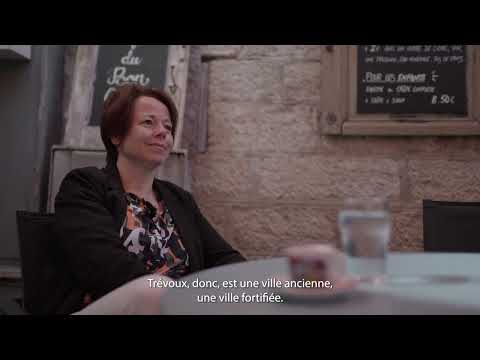 Trévoux on film: medieval town, Dombes courtroom and diamond dies
 France 3 visits the preserved courtroom of the Parlement de Dombes. The report helps clarify the building’s role in the former principality: this was a judicial institution, not a modern legislature. The decorated room turns a political history into a tangible interior and gives visitors a reason to look beyond the castle and river views.
 The Ain heritage channel explains the diamond wire-drawing die that made Trévoux known for a specialised nineteenth-century industry. By showing how a tiny opening helped reduce metal into fine wire, the film connects technical knowledge to local employment and the town’s museum collections. It is a distinctive craft story rarely found in a standard medieval-town overview.