A town between river and coast
Tréguier rises above the meeting of the Jaudy and Guindy rivers, where a granite headland looks toward a tidal estuary and the northern coast of Brittany. The historic centre is compact, but its identity reaches beyond the cathedral skyline: this was a bishop’s seat and a working port, it remains a place of pilgrimage, and it gave France one of its best-known nineteenth-century religious historians, Ernest Renan. Landreger, the Breton name, is still part of the area’s cultural vocabulary. French is the language used by municipal and visitor services, and the local-language edition here is French.
The commune counted 2,294 residents in INSEE’s 2023 reference population, effective from 1 January 2026; the number describes Tréguier itself, not the wider Trégor. INSEE recorded 1,658 jobs located in the commune in 2023. Public administration, education, health and social work make up a large share of employment, while shops, transport and other services support residents and nearby villages. The job-concentration indicator—245.2 positions per 100 employed residents—shows why this small town works as a service centre for its hinterland.
Tradition and the documented medieval town
Local religious tradition traces Tréguier’s beginnings to Tugdual, a Welsh monk said to have founded a community called Lan Trecor in the late fifth century. That early foundation belongs to ecclesiastical tradition and legend, rather than to a securely documented municipal history. The clearer built story begins later: Tréguier received town status in 1412; the present Saint-Tugdual Cathedral was built from 1339 to 1435, and its cloister followed in the fifteenth century. The three towers, including an older Romanesque one, make the cathedral a landmark visible from the river approaches.
Saint Yves, a Breton cleric and lawyer who died in 1303, gives the town another historical layer. The cathedral holds a cenotaph to him; his actual tomb is in Minihy-Tréguier, outside the commune. Each May, the Pardon of Saint-Yves links the cathedral and Minihy in a procession, bringing pilgrims and members of the legal profession, for whom Yves is a patron saint. It is a specific religious celebration, not a portrait of daily life for every resident. Inside the cathedral, Romanesque remains and later Gothic spaces reveal centuries of building. The adjoining cloister is especially rewarding: 48 openings frame its court and the lapidary museum includes sixteen recumbent effigies. Access is paid and seasonal, so check dates before planning a visit.
Walk the old streets and meet the living town
Start at the Quays and climb Rue Renan toward Place du Martray. The slope explains the old connection with the port: until the nineteenth century, water reached closer to the lower end of Rue Renan, and the route tied river trade to the civic and religious centre above. Slate roofs, granite merchants’ houses, narrow lanes and timber-framed façades on stone bases shape the walk. The municipality counts 57 half-timbered houses, many dating from the fifteenth and sixteenth centuries; their concentration is striking for a town of this size. Turn into the passages for changing views of the roofs and cathedral.
On the Martray, the cathedral faces the statue of Ernest Renan, born here in 1823. His seventeenth-century birthplace is now a national museum with rooms on his life and work and a garden behind the house. Its history is not without conflict: unveiling the statue in 1903 provoked a fierce public dispute, and the Calvaire de la Réparation on the Quays followed in 1904. The episode captures a tension between a celebrated scholar and a deeply religious community, making Tréguier more complex than a medieval backdrop.
The centre also contains craft workshops, galleries, bookshops, second-hand dealers and everyday shops. On Wednesday mornings, the market spreads across Place du Martray, Place Notre-Dame de Coatcolvezou and the Quays, bringing local food producers together with clothing and household stalls. Summer editions can grow into evening events. It is both a useful introduction to regional products and part of the weekly rhythm for local residents.
A harbour for the Trégor and a base for the estuary
The historic port carried regional cargo and connected the Trégor with wider maritime trade; nineteenth-century exports included potatoes bound for England. The present marina keeps the Quays active, although commercial shipping no longer defines the town. Guided walks link the waterfront, cathedral and old streets. Nearby, the Philomenn craft brewery occupies a former riverside warehouse and offers a look at contemporary local production; check ahead for tour and tasting availability.
Beyond town, the estuary leads to small communities and the exposed coast around Plougrescant, including the site known as Le Gouffre. Lannion is the nearest rail gateway; BreizhGo coaches connect Lannion, Tréguier and Paimpol. A train-and-bus journey is possible, but services vary by day and season, so check the current timetable. The old streets are steep and some are cobbled; allow extra time and choose footwear accordingly. A half-day covers the cathedral and main lanes, while the museum, Wednesday market, riverfront and coast reward a longer stay. Confirm opening dates, guided walks, market programme and transport before travelling.
 Tréguier en trois regards : la cité, la cathédrale et le Pardon
 A focused look at Saint-Tugdual Cathedral, the building that organizes Tréguier’s skyline and much of its historical identity. The film introduces the church’s medieval construction and draws attention to the tombs associated with Saint Yves and Duke Jean V, as well as the adjoining Gothic cloister. It is useful before a visit because it helps viewers recognize the building’s layered interior. The video is from 2016; current access arrangements and cloister opening dates should be checked separately.
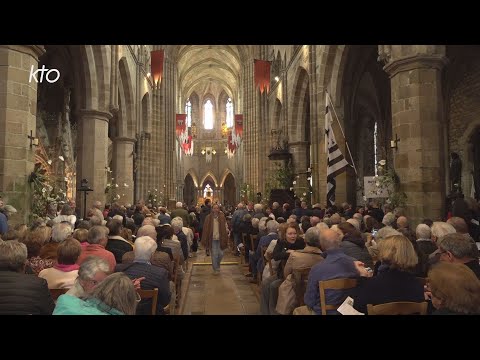 KTO’s report follows the 2024 Pardon of Saint-Yves, a specific religious gathering held in Tréguier during the Pentecost weekend. It shows the procession and the participation of lawyers, whose professional patron is Saint Yves, alongside the wider pilgrimage. This is a record of one edition rather than a promise of the same programme every year. Viewers interested in local religious practice can see how the cathedral, town streets and the route toward Minihy-Tréguier come together for the event.