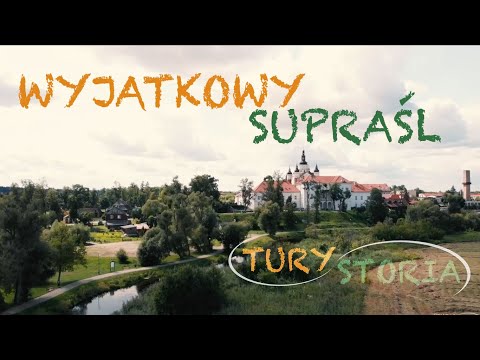
monastery towers, rescued frescoes, weavers’ houses and a forest spa town
Supraśl stands on the river of the same name in Białystok county, Podlaskie. The monastery dominates its familiar skyline, but the town also has textile-industry heritage, timber workers’ houses, a manufacturer’s palace and an active theatre. The surrounding Knyszyn Forest and spa role add reasons to stay. Nearby Białystok makes Supraśl relevant both to visitors and to people considering everyday life outside a larger city.
| Municipality | Supraśl |
|---|---|
| Whole municipality population, GUS BDL 2025 | 8,188 |
| Town population within urban boundaries, GUS BDL 2025 | 4255 |
The whole-municipality figure includes other settlements; it is not the population of this individual town or village.
Ancient finds and monastic beginnings
Archaeological finds around Supraśl include material from the Stone, Bronze and Iron Ages, alongside evidence of medieval activity. They demonstrate people using the area, rather than establishing a single prehistoric foundation date for today’s town.
The documented settlement developed around Orthodox monks who arrived around 1500 under the patronage of Aleksander Chodkiewicz, after an earlier residence at Gródek. The story of a cross floated down the river belongs to monastic tradition explaining the choice of site, rather than to independently observed events.
The monastery developed a library, economic enterprises and cultural contacts. During its later Basilian period, printing became important from the late seventeenth into the early nineteenth century. Eastern and western traditions both contributed to this history, which cannot be reduced to one architectural label.
A rebuilt church and original frescoes
The early sixteenth-century Annunciation Church combined Gothic defensive forms with Byzantine traditions. German soldiers blew it up on 23 July 1944. The building whose towers rise above Supraśl today is the result of later reconstruction.
Fragments of its original frescoes were rescued from the ruins in 1946 and conserved during the 1960s. These surviving works, displayed by the Museum of Icons, offer access to sixteenth-century painting independently of the rebuilt walls.
Scholars continue to discuss the detailed dating and authorship of the paintings. Attributing the entire scheme with absolute certainty to a single artist oversimplifies the evidence. Distinguishing original material from reconstruction is an essential part of understanding the visit.
The Museum of Icons and a working monastery
The Museum of Icons at Klasztorna 1 is a branch of the Podlaskie Museum. It introduces icon painting and objects connected with the region’s religious culture. Their symbolism and use matter alongside their appearance.
The current museum timetable gives Tuesday–Sunday opening from 10am to 5pm, with final entry an hour before closing. It observes its own holiday closures. The museum is institutionally separate from the monastic community.
The monastery remains a place of worship and religious life. Access to churches and other spaces must accommodate services. Museum admission does not provide unrestricted entry to every part of the complex.
Textile manufacturers and their workers
Nineteenth-century Supraśl developed into a textile centre. Manufacturers used earlier monastic economic premises, while customs barriers between the Kingdom of Poland and the Russian Empire encouraged production to move into this region. Wilhelm Friedrich Zachert arrived in 1834, followed by other industrialists and skilled workers.
Former factory sites and modest workers’ dwellings reveal a different scale of life from the monastery. Timber weavers’ houses on 3 Maja Street recall the people whose labour supported that expansion. Looking along the whole street adds context beyond the grander residences.
The Buchholtz Palace combines historicist architecture with Art Nouveau decoration. It now houses a state secondary school of fine arts, rather than a palace museum with permanently open rooms. That educational function is a further chapter in the residence’s history.
Theatre and cultural life
Wierszalin Theatre at Kościelna 4 provides a reason to remain into the evening. Performances follow a dated programme, and some are presented at venues outside Supraśl. Check the actual stage as well as the title and date.
The museum, art school and cultural organisations form part of the town’s institutional life. They are not simply temporary attractions assembled for the holiday season.
Combining a performance with accommodation in town can be more practical than relying on a late connection back to Białystok. It also introduces a different aspect of Supraśl from a brief visit focused on the monastery skyline.
Forest, river and spa identity
Supraśl received spa status through a regulation issued at the end of 2001. This role develops alongside tourism, culture and other services. A hotel wellness stay should nevertheless be distinguished from formally organised spa treatment.
The river and forest setting support walking, cycling and seasonal activities on the water. Choose routes by their actual length and conditions rather than by the simple presence of woodland on a map. Winter activities also depend on weather and snow cover.
Kopna Góra Arboretum is outside Supraśl, towards Sokołda, and requires a separate excursion. The forest authority publishes visitor information and material about local history. It is not a municipal garden immediately beside the town centre.
Where to stay and try regional food
Borowinowy Zdrój at Zielona 3 is a hotel within Supraśl, offering rooms and wellness facilities. Its Dzika Róża restaurant presents Polish and regional food, including game dishes. Access to treatments and particular facilities depends on the chosen arrangement.
Bar Jarzębinka at 3 Maja 22 provides a simpler alternative for regional cooking and appears in the municipal dining directory. Potato dishes are part of the local culinary tradition; check what is currently being served.
The directory also lists Łukaszówka at Nowy Świat 2 and numerous guest rooms. Accommodation outside the town is therefore not essential. Properties using a Supraśl postal address but situated in Sokołda, Łaźnie or Surażkowo are separate locations requiring an onward journey.
Understanding the 2025 population figures
On 1 January 2025, Grabówka, Henrykowo, Sobolewo, Sowlany and Zaścianki became a separate Grabówka municipality. Supraśl municipality consequently became smaller in both area and population. That statistical change is not simply a sudden loss of residents through migration.
The 2025 table uses the new boundaries. The separate Supraśl town figure concerns the urban settlement itself. Older totals for the whole municipality cannot be compared directly without adjusting for the boundary change.
For someone considering a property, the exact locality and responsible municipality matter. A name used in an advertisement or postal address may not fully explain the administration or the journey to daily services.
Connections with Białystok and Warsaw
Białystok is approximately sixteen kilometres away and is the main large-city gateway. Road access uses regional road 676. Travel time varies with the actual starting point and commuter traffic.
Supraśl has no railway station of its own. From Warsaw or other major cities, consider rail to Białystok and an onward regional bus. Municipal information identifies the PKS Nova Białystok–Supraśl service and points to the current timetable.
A potential resident should check afternoon returns, weekend services and the walk between the stop and a particular street, as well as the morning journey. Proximity to a larger city is useful, but the complete daily connection still determines how practical an address will be.
Sources and practical information
- Urząd Miejski: klasztor, drukarnia i przemysł włókienniczy
- Muzeum Ikon: zwiedzanie i aktualne godziny
- Muzeum Ikon: oryginalne freski i zniszczenie cerkwi w 1944 roku
- Ministerstwo Kultury: pałac Buchholtzów i liceum plastyczne
- Gmina: oferta uzdrowiskowa
- Teatr Wierszalin: repertuar i miejsca spektakli
- Nadleśnictwo Supraśl: Arboretum w Kopnej Górze
- Gmina: hotele, restauracje i usługi
- Borowinowy Zdrój: pokoje, wellness i restauracja
- Gmina: autobusy Białystok–Supraśl
- PKS Nova: rozkłady i komunikaty
- Miasto Białystok: położenie Supraśla, około 16 km
- Wojewoda: powstanie gminy Grabówka w 2025 roku
- Dziennik Ustaw: zmiana granic gmin od 1 stycznia 2025 roku
- GUS Bank Danych Lokalnych: ludność gminy, dane roczne 2025
- GUS BDL: ludność miasta, dane roczne 2025