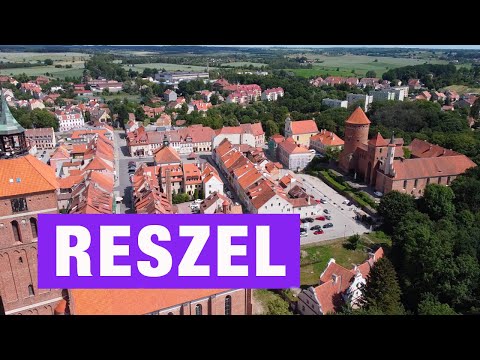
a bishop’s castle, Gothic bridges and a Warmian town above the Sajna
Reszel is a Warmian town in Kętrzyn county, Warmińsko-Mazurskie. A bishop’s castle, St Peter and St Paul’s Church and the historic centre overlook a bend in the Sajna. Its distinct Warmian identity is easily lost when the whole region is loosely described as Masuria. Medieval streets, later townhouses, the river valley and changing borderland history combine in a settlement that rewards exploration beyond the castle entrance.
| Municipality | Reszel |
|---|---|
| Whole municipality population, GUS BDL 2025 | 6,395 |
| Town population within urban boundaries, GUS BDL 2025 | 3853 |
The whole-municipality figure includes other settlements; it is not the population of this individual town or village.
Old Prussian land and a medieval charter
Before the Teutonic conquest, this area belonged to the Old Prussian Bartian lands. A timber-and-earth stronghold was established in the thirteenth century and repeatedly damaged during uprisings. That phase should not be confused with construction of the brick castle standing today.
Reszel received Chełmno town law on 12 July 1337. It developed beside the bishop’s stronghold as a trading and craft centre, with activities including metalworking, joinery and services connected to the agricultural hinterland.
Following the Second Peace of Toruń in 1466, Warmia came under the Polish Crown while retaining the particular position of its episcopal territory. The first partition in 1772 brought incorporation into Prussia. Administration and building functions changed, although the compact town plan remained legible.
Half a century of castle building
The masonry castle was erected from 1350 to around 1401. Its rectangular plan, approximately forty-five by forty-eight metres, used a high bank above the Sajna. Brick walls rose from stone foundations and cellar structures.
Construction proceeded through successive residential wings, a chapel, tower, defensive perimeter and service accommodation. Later fortifications responded to firearms. By the end of the sixteenth century, alterations also emphasised a more representative residential role.
Prussian authorities subsequently used the castle as a prison. Major fires in 1806 and 1807 caused serious damage. Rebuilding in 1822–1823 saved the complex but changed its appearance, and part became a Protestant church. The surviving building is therefore not an unaltered medieval structure.
The church, streets and river valley
St Peter and St Paul’s Church forms the other major element in the skyline. Its Gothic body, tower and later furnishings reveal a long sequence of use and renewal. Seeing church and castle from different streets explains their relationship with the town.
The market, town hall and surrounding houses lead into narrower streets. Early nineteenth-century fires help account for newer buildings within an older layout. Defensive remains and bridges over the Sajna recall the town’s former edges.
Descending into the river valley gives a different view of the high walls from the approach through the square. Green paths extend the visit naturally. Slopes and steps mean that a short distance on the plan is not necessarily a flat walk.
Barbara Zdunk and a misleading witch story
Barbara Zdunk was executed in 1811 after being accused of arson. Modern tourism often calls her Europe’s last witch. Researchers studying the proceedings point out that she was not tried for witchcraft, an important distinction when recounting her tragedy.
The case concerned a fire and a lengthy prosecution, rather than proof of supernatural powers. Nor should guilt be treated as obvious simply because a historical court imposed a sentence.
Castle displays and commercial attractions now use witch-related imagery. These are modern interpretations and entertainments. They should be distinguished from court records and historical research rather than presented as direct evidence of what happened.
Visiting the castle today
The castle combines hotel, restaurant and exhibition uses. Its visitor route includes the courtyard, walls and tower. Views from above reveal the small scale of the centre and its surrounding landscape.
The current programme lists a torture-instrument exhibition marked for visitors aged sixteen and over, gallery space and a work by Franciszek Starowieyski. Families should select suitable parts of the programme; that age marking does not automatically apply to the entire castle.
For 1 November 2026–28 February 2027, the operator gives visiting hours of 9am–6pm. It also publishes temporary exclusions affecting visitors and restaurant guests. Confirm the day if the castle is the main purpose of the journey.
A separate outing to Święta Lipka
Święta Lipka is outside Reszel and has its own sanctuary, religious calendar and musical programme. Baroque architecture and the organ create a different experience from the bishop’s Gothic fortress. It is not a castle district or a church beside Reszel’s market.
Choose organ presentations and concerts from the current programme. A summer concert series does not mean the same events continue throughout winter. The sanctuary publishes separate seasonal arrangements.
The road towards Kętrzyn allows both places to be combined. Public-transport visitors need to fit the itinerary around actual departures rather than assume that a short distance guarantees frequent buses at all times.
Staying in Reszel and finding a meal
Hotel Zamek Reszel occupies the historic complex at Podzamcze 3. Its Siedem Kotów restaurant operates within the same building. Current information gives service from midday, with later hours on Fridays and Saturdays.
U Renaty at Wyspiańskiego 3 is another town address included in the local accommodation and dining directory. Bar Pod Kasztanem at Płowce 2 appears in the same listing, providing an alternative to eating at the castle.
Accommodation in Święta Lipka, Pilec, Leginy or Pasterzewo belongs to separate surrounding settlements. A Reszel postal address does not place a property beside the market. That distinction is especially important for a stay without a car.
Connections with Olsztyn and regional stations
Olsztyn is the main large-city gateway for this part of Warmia. A road approach uses the regional network towards Biskupiec and Bęsia or other connections depending on the starting point. Regional road 594 links Reszel with Bisztynek and with Kętrzyn through Święta Lipka.
Reszel has no active passenger railway station. Korsze and Kętrzyn are relevant rail arrival points, followed by a bus or taxi. Plan the complete current connection; the historical arrival of the railway in 1908 does not describe present access.
A location away from major through routes contributes to the setting but also affects commuting to Olsztyn and access to specialist services. Compare a particular property with the actual stop network and return journeys rather than with the distance between town names alone.
Sources and practical information
- Informacja turystyczna: historia Reszla
- Narodowy Instytut Dziedzictwa: budowa i przekształcenia zamku
- Zamek: historia siedziby biskupiej
- Uniwersytet Mikołaja Kopernika: proces Barbary Zdunk i mit czarownicy
- Muzeum Pałacu Króla Jana III: sprawa z 1811 roku
- Informacja turystyczna: zabytki i plan wizyty
- Zamek: sezon zimowy 2026–2027, restauracja i wystawy
- Informacja turystyczna: noclegi i gastronomia w mieście i okolicy
- Sanktuarium Święta Lipka: aktualny program i odwiedziny
- Lokalny portal: drogi i połączenia przez Korsze i Kętrzyn
- PKP PLK: aktualne połączenia kolejowe do okolicznych stacji
- GUS Bank Danych Lokalnych: ludność gminy, dane roczne 2025
- GUS BDL: ludność miasta, dane roczne 2025