Sovana rewards a slower visit than its size suggests. The hamlet is a single historic thread through a broad landscape: a small street and square, churches and civic buildings, then a separate archaeological area in woodland and tufa ravines. Sovana is a frazione of Sorano, not a municipality in its own right. ISTAT’s provisional resident population on 1 January 2026 is 2,983 for the entire Comune of Sorano; that figure includes Sorano and its other settlements and must not be presented as the population of Sovana alone. The current dataset does not give a separate figure for the hamlet.
A long past without invented beginnings
Tuscany’s regional visitor service places Sovana’s roots in the seventh century BC, while the archaeological landscape provides the clearest evidence visitors can examine: Etruscan tombs cut into the surrounding tufa. That evidence makes Sovana an important Etruscan centre, but it does not prove that the present street plan has remained continuously occupied in the same form since antiquity. The name Tomba Ildebranda can also mislead. The monumental tomb dates to the third–second centuries BC and was named for Ildebrando of Sovana, the medieval figure who became Pope Gregory VII; the tomb itself has no connection to him or to Christianity.
The medieval town is easier to trace in its buildings. At the entrance stand the remains of the Rocca Aldobrandesca, an eleventh-century fortress associated with the ruling family. The main street leads to Piazza del Pretorio, where Palazzo Pretorio, the Loggia del Capitano, the civic archive building, Santa Maria Maggiore and the former church of San Mamiliano form an unusually close group. The municipal account dates Palazzo Pretorio and Santa Maria to the twelfth–thirteenth centuries and points to the rare pre-Romanesque ciborium above Santa Maria’s altar. The cathedral of Saints Peter and Paul stands apart at the far end of the village; a papal document from the eleventh century attests to it, while its fabric shows Romanesque, Gothic and Lombard elements. Sovana was also the birthplace of Ildebrando, later Gregory VII. A museum dedicated to his history opened in Palazzo Pretorio in 2024, adding interpretation of the town’s medieval religious importance.
Read the square, then leave the village for the tombs
Start at the Rocca and walk the main street to Piazza del Pretorio. The short distance is part of the experience: civic authority, church life and public space meet in one small square rather than in a monumental avenue. Look for the coats of arms on Palazzo Pretorio, the open loggia and the sheltered entrance of Santa Maria. Continue along the lane to the cathedral, whose position at the edge of the settlement makes the walk feel like a conclusion rather than another stop in a checklist. San Mamiliano links the medieval centre with earlier layers: the municipal history describes the church as built over Etruscan and Roman remains, and the museum system presents finds from the area. A hoard of 498 late-antique gold coins was discovered during restoration work in 2004; the romantic name “Treasure of Monte Cristo” belongs to local storytelling, not proof that Alexandre Dumas based his novel on Sovana. Ask the museum system what is currently on display, since collections and openings can change.
The necropolis is outside the historic centre, within the Città del Tufo archaeological park. It is not one tomb beside the road but a dispersed landscape of burial sites, wooded paths and carved passages. The Tomba Ildebranda is the most imposing temple-fronted monument; other named sites include the Tomba Pola, the Tomba dei Demoni Alati and the Tomba della Sirena. Their forms and dates differ, and names given by modern visitors or archaeologists should not be mistaken for the identities of the ancient people buried there. The vie cave are deep routes cut through tufa. Their exact ancient functions are debated; they may have connected settlements and burial grounds, but assigning every cut to a single purpose would overstate what is known. Wear shoes suited to uneven ground and check access, weather notices and any guided-visit requirements before leaving the village.
Landscape, local work and nearby journeys
Sovana sits in the Maremma’s tufa country, where valleys, ravines and agricultural land shape the route between villages. The regional account describes the area’s early inhabitants as farmers and pastoralists; today the visitor offer is closely tied to the archaeological park, museums, churches and countryside walks. The Sovana DOC wine designation covers the whole municipalities of Sorano and Pitigliano and part of Manciano, so it reflects a wider agricultural zone rather than vineyards confined to the hamlet. Visitors can use Sovana as one stop in a slower circuit that also includes Sorano, Pitigliano and the park’s rock settlement at Vitozza, but each site needs its own travel and opening plan.
Public transport is possible but needs attention to the exact run. Autolinee Toscane lists a Sovana stop on route 17P, between the Manciano/Saturnia area and the western Maremma, and the 18P network connects other towns in the tufa area. Some departures serve only selected stops, and the timetable can vary by school day, weekday and season. Check the operator’s current route planner before setting out; do not assume a convenient return simply because a bus reaches the hamlet. There is no railway station in Sovana. Travellers who need flexibility often combine bus and walking or arrive by car from the nearby Sorano–Pitigliano road network; parking and the final approach should be checked locally. In the village, the historic lane is short, but the necropolis paths are a separate outdoor visit and not equivalent to a level town walk.
 Sovana on film: Etruscan tombs, a medieval village and a walking tour
 Claudio Mortini’s film pairs Sovana’s medieval village with the surrounding Etruscan necropolis. That wider frame is useful because the two experiences are related but physically separate: the compact street and civic square are not the same visit as the forest paths and rock-cut tombs. The video offers a broad visual introduction to both, though it should not be treated as a source for dates or tomb identifications. Its upload date is 15 June 2015. For a visit, confirm which archaeological sectors are open and allow time for the walk between the village and the park area.
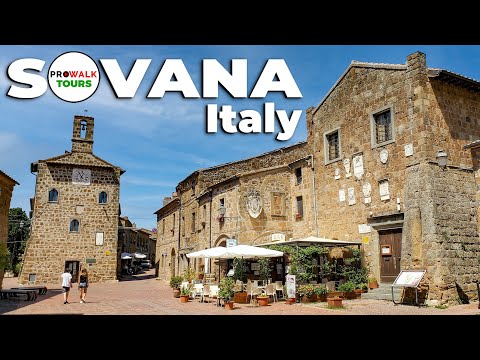 Prowalk Tours’ 4K walking tour is the most practical visual companion for the village itself. It lets viewers follow the compact historic street at walking pace and includes the Cathedral of Saints Peter and Paul in its route, with captions and a clear visual sense of scale. Unlike a short promotional montage, it shows how quickly the main village walk unfolds and where the cathedral sits in relation to the centre. It was published on 17 April 2021. The footage is not a live access guide, so current opening times, bus runs and archaeological access still need checking.