Capalbio is often introduced through a medieval hilltop and its celebrated beaches, but the municipality is a whole landscape between them: farms, scattered settlements, coastal dunes and a brackish lagoon in the southern Maremma. Italy’s 2026 resident-population estimate counts 3,660 people in the entire municipality on 1 January, not just in the walled old centre. That distinction matters when planning a stay. Capalbio’s historic core, Capalbio Scalo, the coastal hamlets and the countryside are separate places, and many of the best-known sights require a short onward journey.
+A castle in the records, not a Roman foundation story
+The town’s own historical account traces an early written reference to 805, when the castle of Capalbio was included in a donation to the Abbey of Tre Fontane near Rome. Pope Alexander III confirmed the abbey’s possession in 1161. These are documentary milestones; older Etruscan and Roman traces in the wider Maremma do not prove that the present settlement was founded by either civilization. In the later Middle Ages the territory passed through the hands of regional powers, including the Aldobrandeschi and the Republic of Siena. The double line of walls tells part of that story in stone: the earlier defensive circuit is medieval, while Siena’s fifteenth-century works added a higher outer walk and Porta Senese. A plaque there records the rebuilding of 1418. After Spanish forces took Siena in 1555, Capalbio entered a period of economic and demographic decline, according to the municipal account.
+Walk the walls, then look closely inside the churches
+Enter through Porta Senese and follow the ramparts at two different heights. The route gives changing views over the tiled roofs, the surrounding hills and, on clear days, the coastal plain. Narrow lanes lead uphill to the Rocca Aldobrandesca, the castle complex that anchors the skyline. At its foot, the Pieve di San Nicola combines medieval origins with later Gothic and Renaissance details. The municipality describes frescoes from the Sienese and Umbro-Latial schools, including images of the Madonna and Child with saints. Outside the walls, the Oratorio della Provvidenza preserves early-sixteenth-century frescoes attributed to Pinturicchio or a close follower; the attribution is not certain, and visitor opening is limited, so check with the town before setting out specifically to see it.
+Capalbio is not a museum set apart from daily life. The municipal structural plan, adopted in 2025 and still part of a planning process, describes a productive territory that includes agriculture, crafts, services, tourism and commerce. Its stated aims include maintaining agricultural activity and its landscape role. Fields and rural businesses remain part of the experience between the hill town and the sea; the visitor encounters a working countryside as well as heritage and holiday services.
+From contemporary sculpture to protected wetlands
+At Garavicchio, several kilometres from the historic centre, the Giardino dei Tarocchi turns the landscape into a monumental work of art. Niki de Saint Phalle developed the project over roughly two decades; its figures draw on the twenty-two major arcana of the tarot, using vivid mosaics, mirrors and ceramics. The garden opened to the public in 1998. It is a separate, ticketed attraction rather than an extension of the old town. The foundation’s current visitor information says advance online booking is needed to guarantee entry, gives a seasonal opening period, and notes that the complex has stairs and no complete wheelchair-accessible route. Its fountain area offers a partial accessible overview, while a stair lift can be arranged by reservation.
+At the coast, the WWF-managed Lago di Burano is a brackish coastal lagoon behind a sandy dune system. WWF describes a 410-hectare reserve, a nature trail with observation hides and a record of more than 300 bird species. Those figures describe the protected area and its recorded wildlife, not a promise of a particular sighting. The organisation requires reservations for guided visits and tells visitors to contact the reserve before travelling; reaching its visitor centre from Capalbio Scalo station is different from reaching the reserve entrance, for which WWF advises continuing by car, motorcycle or bicycle. Chiarone, Macchiatonda and La Torba are other coastal names to know, but each beach access point and service has its own seasonal arrangements.
+Getting around and making a useful day of it
+Capalbio Scalo is the railway stop on the Rome–Pisa coastal line. From the station, Autolinee Toscane’s route 12O lists connections with Capalbio village, the Tarot Garden, the station and Orbetello; a separate shuttle to the garden operates in high season according to the garden’s visitor information. Services vary by day and season, so check both operator timetables and the garden’s booking calendar before relying on a connection. By car, the SS1 Aurelia is the main approach, with local roads leading inland to the hilltop and out toward the coast. The old centre is best explored on foot, on uneven slopes and stone paving. Leave time for the churches, the ramparts and a meal; Maremma staples such as acquacotta, lamb stew and ciaffagnone appear in the regional food tradition. The Capalbio Cinema short-film festival is another seasonal reason to return, but consult the current programme rather than assuming dates from a previous year.
+ Capalbio on video: medieval streets, ramparts and Niki de Saint Phalle’s Tarot Garden
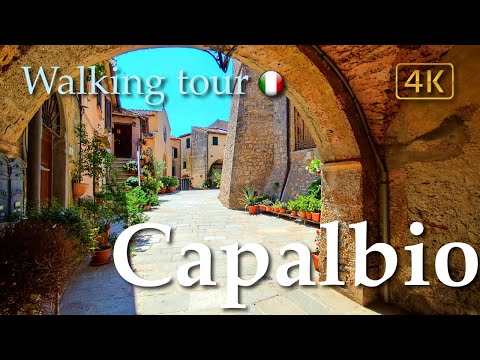 Still Wanderer’s 4K walking tour adds a second, separately filmed view of Capalbio, with subtitles intended to supply context as the camera moves through the old centre. It is useful for previewing the narrow lanes and the relationship between the castle area and the walls, especially if you want to judge the terrain before walking it. The subtitles are a creator’s summary rather than a scholarly source, and the recording is several years old; it cannot confirm current church access, business hours or transport. Treat it as a visual orientation, then use municipal visitor information and current bus timetables for practical planning.
 Intesa Sanpaolo’s 2025 episode follows art historian Jacopo Veneziani into the Giardino dei Tarocchi and frames Niki de Saint Phalle’s work through its emotional and creative background. It is the most interpretive of the three films and helps viewers look beyond the colourful surfaces to the artist’s long project and the garden’s symbolic figures. Its lyrical presentation is not a visitor-service notice: opening dates, advance booking, accessibility and the seasonal shuttle can change. The Foundation’s own information is the right place to check those details before travelling to Garavicchio.