A seaside town with more than one face
Royan sits on France’s Atlantic coast, on the right bank of the Gironde estuary. Its five sandy beaches are close enough to the centre to make the sea part of ordinary urban life: the long Grande Conche, the smaller coves of Foncillon, Chay and Pigeonnier, and Pontaillac, whose crescent bay has its own neighbourhood rhythm. The water and the architecture compete for attention. Royan is both a working service town and a resort, with a port, shops, markets, cultural institutions and residential streets behind its waterfront.
INSEE counted 19,425 municipal residents across the whole commune in 2023. This is the commune-wide population, not the number of people in the beach districts or the old centre. The town’s changing visitor presence is visible in its housing: 42.6% of dwellings were second homes or occasional-use homes in the 2023 census. The local economy also serves more than holidaymakers. At the end of 2024, 1,243 employer establishments were active in Royan; 77.5% were in commerce, transport and other services, while public administration, education, health and social care represented 10.1%. These are INSEE categories, not a count of tourism businesses alone, but they help explain why the town remains a regional centre throughout the year.
A long history, without a convenient founding myth
The municipal museum traces human presence here from the earliest known occupations and presents Royan as an ancient settlement, but the evidence does not support a single, simple foundation story. Its story is better understood through the estuary: a strategic maritime threshold, exposed to shipping hazards, coastal defence and changing trade. The museum’s account records the siege of Royan in 1622 and the town’s first destruction during the Wars of Religion. The later resort did not erase that earlier history; it added another layer to a town repeatedly reshaped by its position at the mouth of a major estuary.
Seaside bathing transformed the coast in the nineteenth century. In 1850 the Bordeaux entrepreneur Jean Lacaze identified Pontaillac’s sheltered cove as a place for a new bathing district; he bought land there two years later. The street plan turned toward the ocean, and villas, cafés and bathing facilities followed. The railway’s arrival in 1875 widened Royan’s appeal, while a tramway later linked the Parc and Pontaillac districts along the shore. The Belle Époque villas that survive in Pontaillac and parts of the Parc are valuable precisely because they show a pre-war town that can no longer be seen in most of the centre.
Five beaches, five ways to meet the coast
The Grande Conche gives the town its broad urban beach, close to the station, port and central streets. Foncillon lies nearer the ferry terminal and Palais des Congrès; Chay and Pigeonnier are smaller coves along the coastal walk. At Pontaillac, the beach, casino, cafés and surf culture make the evening feel different from the open sweep of the Grande Conche. This is not a single continuous “resort strip”: each cove has a separate setting, and the short walks between them reveal cliffs, villas, headlands and changing views across the estuary. Swimming supervision, beach access and water conditions vary by season, so check the town’s current notices before choosing a beach.
Reconstruction became the town’s signature
Royan’s most decisive break came in 1945. Allied bombing in January and April targeted the German-held pocket at the mouth of the Gironde; the town’s official visitor history estimates that nearly 85% of Royan was destroyed. The memorial work Le Souffle at Pointe du Chay honours those killed in the raids. It belongs to a landscape where remnants of the Atlantic Wall also remain, making the headland a place to understand the war rather than simply a viewpoint.
Rebuilding took nearly two decades and gave Royan a distinctive modern profile. Claude Ferret led the urban reconstruction, with architects including Louis Simon and André Morisseau. The central market, completed in 1956, is an expressive concrete shell whose roof spans the hall without internal pillars; its 2024 renovation sought to protect the structure while renewing its facilities. Notre-Dame church, designed by Guillaume Gillet and built from 1955 to 1958, gives the skyline a slender concrete landmark. The low-rise villas and public buildings mix modern engineering with regional details and, in some designs, tropical references. A walk through Royan is therefore also a walk through post-war architectural choices.
Museums, markets and everyday services
Two cultural stops make that history easier to read. The CIAP, the Centre for Interpretation of Architecture and Heritage, uses models, projections, digital material and a reconstructed 1950s interior to explain the town’s change from nineteenth-century bathing resort to post-war city. The Musée de Royan occupies the former covered market at Pontaillac and follows local history from early occupation and the 1622 siege through the resort era, Picasso’s wartime stay, the Occupation, the bombings and reconstruction. Temporary exhibitions add changing subjects; check the museum’s current access information before going.
For a more everyday encounter, go to the central market. Built in 1956 and restored in 2024, it is both a food market and a landmark of the reconstruction. The current visitor listing gives morning hours from Tuesday to Sunday for much of the year, with daily opening in July and August; Wednesdays and Sundays are the larger market days. Hours can change, so confirm them before setting out. Royan’s port remains a centre for pleasure boating and fishing, while the town centre concentrates cafés, shops and visitor services.
Arriving and exploring beyond the centre
Royan’s railway station is a terminal close to the centre and beach. TER services connect the town with Saintes; longer journeys from Paris usually require a change at Angoulême or Saintes, and travel time depends on the connection. From Bordeaux, the official visitor guide gives a road approach via the A10 and Mirambeau; from La Rochelle, it points to the D733 via Rochefort. The Cara’Bus network and regional coaches serve the wider coastal area, and the central districts are practical on foot or by bicycle. The Royan–Le Verdon ferry crosses the Gironde estuary, but sailings are seasonal and depend on the current timetable.
With another day, follow the coast toward Saint-Palais-sur-Mer or Saint-Georges-de-Didonne, or visit the cliff dwellings at Meschers and the historic village of Talmont-sur-Gironde. The Cordouan lighthouse can be reached by boat from Royan or Le Verdon; landing depends on tides and the visitor season, so reserve and check the operator’s schedule. Royan rewards a slower visit: a market morning, a walk between coves, a close look at the concrete rooflines and a pause at the memorial give a fuller picture than a beach stop alone.
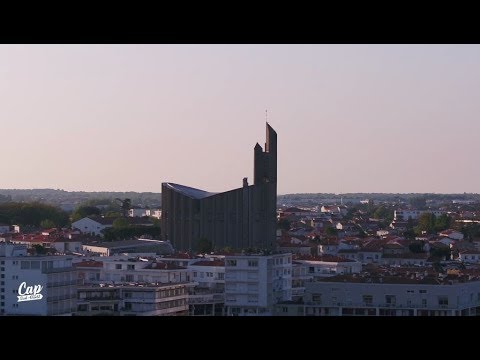 Royan en trois vidéos : reconstruction, marché et littoral
 This France 3 report follows the temporary move of Royan’s covered market during works and identifies local butchers, a municipal market representative and the merchants’ association among its interviewees. Its value is the everyday perspective: the central market is not only a striking 1950s structure but also a place of work and exchange. Because the report was made in 2023, its construction details describe that period; check the current market page for today’s opening arrangements.
 TF1 INFO presents a weekend in Royan through its urban beaches, villas, covered market and the Cordouan lighthouse. The report is a broad visitor-oriented view rather than a local history lesson, and its mix of shoreline and built heritage captures why Royan works as more than a summer beach stop. The video was published in 2025; ferry and lighthouse visits still depend on the season, tides and operator timetable, so confirm those details independently before travelling.