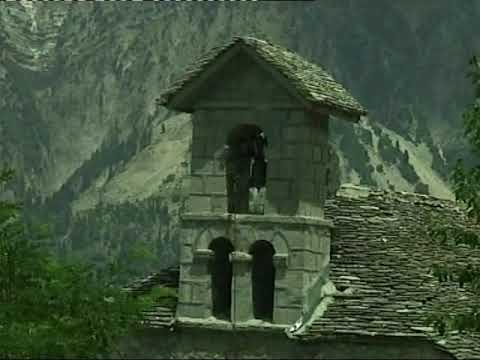
Pramanta is a mountain village of northern Tzoumerka below the striking profile of Stroggoula. Its houses climb around a central square that continues to serve as a social and commercial meeting place. A regional heritage archive describes the plane tree, the Arapis fountain and the church of Agia Paraskevi. These features belong to the everyday village, not to an isolated scenic viewpoint.
Square, water and high ground
Begin at the square and look outward to the slopes. The fountain and church anchor routes through the built settlement; the mountain above gives their setting scale. Regional records describe local feast days and gatherings, showing that the square is a place used by residents as well as travellers. Stone houses and lanes illustrate a mountain building tradition, but no reliable source here establishes an exact founding year or an ancient city beneath the present village. An unsupported classical origin would add little to its real character.
Anemotrypa cave is a separate attraction a short distance from Pramanta. The Greek Ministry of Environment lists it among important caves of the area. Cave researchers describe its discovery by local residents in 1960 and chambers with mineral formations and small pools. It is a managed underground site, so tours, opening and access need checking. Its geology is a complement to a village visit, not the origin of the settlement.
Roads through Tzoumerka
Ioannina and Arta are the larger city connections. The mountain roads are winding, and travel time depends more on terrain and weather than on the map's straight line. Accommodation and meals can be found in Pramanta and other Tzoumerka villages, but seasonal operation varies. A prospective resident should assess winter access, schools, medical services and employment. The appeal of Pramanta is the close relationship between a lived-in square, craft-built streets, cave geology and the slopes above them.