Pietramontecorvino is best understood as two places joined by memory. The inhabited village, known locally as Pietra, climbs a rocky spur above the Daunian foothills; several kilometres away, the ruins of Montecorvino preserve the story from which the municipality says its own beginnings are traditionally traced. On 1 January 2025, the whole municipality counted 2,415 residents in ISTAT’s population balance. That figure covers the municipal territory, not only the stone-built historic centre. The distinction matters here: this is a small rural community with a medieval heart, surrounding cultivated slopes and woodland, rather than a preserved set built only for visitors.
Terravecchia, shaped by the ridge
The oldest quarter, Terravecchia, follows the rocky ground in a compact, irregular pattern. The Comune describes its lanes as a fishbone plan: narrow passages turn between stone houses, stairs and arches, while Port’Alta remains as a pointed Gothic entrance from the former defences. The climb and uneven paving are part of the experience, so comfortable shoes help. From the outside, the village’s defining group is easy to read: the Palazzo Ducale, the adjoining Torre Normanna and the church of Santa Maria Assunta form a connected landmark rather than three isolated monuments.
The Comune dates the start of the ducal palace probably to the thirteenth century and says the Norman-Angevin tower dominates it. The tower rises about 30 metres, according to Puglia’s regional visitor portal. It has hosted a permanent exhibition on brigandage and a crenellated terrace with a broad view over the valley; neither the exhibition nor the climb should be assumed open on arrival. Check the current arrangements with the local cultural circuit or municipality. The mother church is dedicated to the Assumption. Its campanile, described by the regional tourism portal with a green-and-yellow majolica dome, gives the skyline a vivid counterpoint to the pale stone. Nearby churches, including the Rosario and Annunziata, reward a slower walk, but access depends on worship and opening schedules.
Montecorvino: what is documented and what belongs to tradition
The municipality begins its account with an important qualification: according to local tradition, Pietramontecorvino grew from Montecorvino, an older settlement of probable Byzantine origin. The Comune records Montecorvino as an episcopal seat in 1018. It says Roger the Norman destroyed it in 1137 and that some inhabitants settled at Pietra, taking refuge in caves on the rocky spur. Pietra appears in a feudal record in 1195 under the names Castel di Pietra and Pietra di Monte Corvino. Montecorvino’s small diocese was suppressed in 1433; the settlement was sacked in 1441, and an earthquake on 5 December 1456 completed its destruction. The old site was later reported uninhabited. These dates come from the municipality’s historical account; the precise origin story is explicitly presented as tradition, not as proof of a Roman or Greek foundation. The present town’s official name was established in 1862.
The ruins of Montecorvino are not another lane of the modern village but a separate archaeological destination. Their surviving tower is popularly called the Sedia del Diavolo because erosion has made it resemble a seat. The name is a visual nickname, not evidence of a supernatural story. A more living connection is the 16 May pilgrimage for Sant’Alberto, the bishop associated with old Montecorvino. A local devotional legend says the saint appeared during the drought of 1889 and called people to walk to the ruins; rain followed, and the journey became a recurring act of faith. The account is a legend, not a verifiable explanation of the weather. The procession, with decorated tall poles and coloured cloths, is a powerful way to see how the abandoned settlement remains part of present-day identity. Confirm the date and route locally before planning around it.
Woods, springs and the flavours of the Daunia
The visit need not end at the walls. Bosco Celle is a nearby wooded area named for the medieval Franciscan cells of Sant’Onofrio, of which only hard-to-spot ruins remain. The woodland is mainly oak, downy oak and Turkey oak; local nature guides describe seasonal flowers and wildlife rather than a manicured park. Paths connect the Pila del Ladro and Pila di Sant’Onofrio springs and can be used for walking or cycling. The latter area also has an adventure park, but trail conditions, facilities and opening dates should be checked before setting out. Bring water and allow more time than the short distances on a map may suggest.
Agriculture remains visible in the surrounding fields and hills, which the Comune describes as partly level and partly hilly, cultivated with traditional methods. Forestry and small-scale food production also shape the visitor experience. The regional Monti Dauni portal identifies n’nogghj, a local pork sausage, as a speciality associated specifically with Pietramontecorvino; availability varies by producer and season. In September, Suoni, Sapori e Colori di Terravecchia typically brings performances, crafts, food stands and guided visits into the old lanes. It is a recurring event, not a fixed-date attraction: use the latest municipal calendar rather than an old programme. Nearby Motta Montecorvino and the Montecorvino archaeological site make natural extensions for travellers with a car or a prearranged local transfer.
Getting there and making a practical visit
Foggia is the regional transport hub. Ferrovie del Gargano lists Pietramontecorvino among the Monti Dauni communities that can reach Foggia with a combined bus-and-train journey, changing at Lucera on the Foggia–Lucera railway; its notices also show buses serving Foggia directly. Check the operator’s current bus timetable, the Lucera connection and the return journey for your exact day, since schedules and temporary road diversions change. By road, plan the final approach through the Daunian hills and check local traffic notices. The regional tourism portal helps orient visitors to sites and experiences; the municipal site is the best place to check event announcements. Allow time for steep lanes, pauses at the viewpoints and, if you want to reach Bosco Celle or Montecorvino, a separate transport plan.
 Pietramontecorvino in three videos: village, tower and local memory
 MiraTube’s 9-minute-2-second film, published on 12 May 2021, concentrates on Torre Normanna. Its description names Mira APS and collaborations with Italia Nostra, the Ministry of Culture, the archaeological heritage authority and the University of Foggia; it lists contributors in heritage education, ancient topography and local government. This makes the clip a more focused interpretive companion to the tower than a simple panorama. It helps explain why the monument matters, but it cannot confirm whether visitors can enter today.
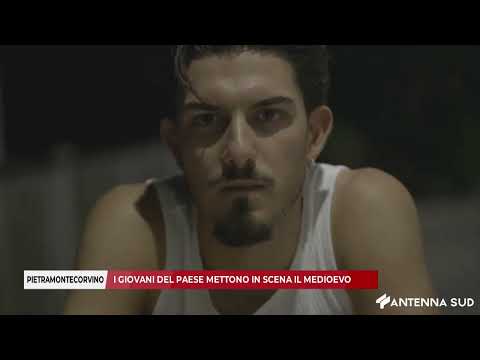 Antenna Sud published this 91-second item on 3 September 2026 under a title about young residents staging the Middle Ages. Its accompanying report describes a short film in which local young people act out the memory and atmosphere of their land. The distinctive value is the community’s contemporary voice and participation. Because it is a staged short film, its scenes are a creative interpretation of medieval history, not documentary proof of specific events or costumes.