Approaching Bovino from the lowlands, the town appears fitted to the shape of its ridge. The old center occupies two neighboring heights: San Procopio, where the Ducal Castle rises above the valley, and San Martino, marked by a medieval tower. Between them, the quarters of San Martino, San Procopio, Sant’Angelo and Sotto le Mura unfold through stone lanes, arches, small squares and tiled roofs. Bovino is best read on foot. Its bends and changes in level reveal a settlement shaped by a defensive crest overlooking the Cervaro valley and the cultivated and wooded slopes of the Daunian Apennines.
ISTAT’s 2025 demographic balance records 2,881 residents for the whole municipality on 1 January 2025. That figure describes the Comune, not just the historic center. The distinction matters in a landscape where the compact hilltop settlement and its wider rural territory belong to the same administration. Bovino’s position also helps explain its historic role between the Foggia plain and routes toward Campania and Benevento.
What archaeology can tell us
The Civic Museum C. G. Nicastro offers a sounder starting point for the distant past than a foundation legend. Its displays include Neolithic and Eneolithic ceramics, anthropomorphic stelae dated by the museum to the third and fourth millennia BC, and Iron Age pottery and figurines. Carlo Gaetano Nicastro donated the collection to the municipality in 1925. These finds document human activity across the surrounding territory over a long span; they do not prove continuous occupation of today’s town since prehistory.
Bovino is often associated with the Roman name Vibinum, and Roman traces form part of its heritage narrative. The exact origins and etymology of the ancient name are unsettled, so it is safer to describe an association than to give the settlement a precise Roman founding date. The distinction between material evidence, later historical reconstruction and local tradition makes a visit more rewarding: the town does not need an invented origin story to make its layered past visible.
Castle, cathedral and a walk through the old quarters
The Ducal Castle occupies the rocky point of San Procopio. Its cylindrical tower is identified with a Norman phase; later rebuilding, including work under the Guevara family in the seventeenth century, gave the complex the character of a residence. A familiar local account places a Roman stronghold beneath it, but this should not be mistaken for a secure date for every surviving wall. Today visitor information presents the castle with rooms, a hanging garden, a tower and the Diocesan Museum. Confirm access and opening times before setting out.
From the castle, follow the old lanes toward the Co-Cathedral of Santa Maria Assunta. The National Catalog of Cultural Heritage treats the chronology cautiously: a late tenth-century predecessor has been proposed, while major medieval construction is associated with Bishop Pietro I in 1231. The building gathers several phases rather than belonging to one moment. The Romanesque church of San Pietro, in the upper town, adds another stop for visitors interested in religious architecture and reused building materials.
Via Roma makes a natural walking line through the center, connecting the cathedral area with the Cantine Cerrato and Civic Museum. Some lanes are steep and paved in stone; comfortable shoes help, and visitors with mobility needs should ask sites about access. Local visitor services advertise guided walks through the center, castle, cathedral and museums by reservation. Confirm the meeting point and current arrangements.
Museums and rural life
Bovino’s museums broaden a visit beyond façades and noble family names. The Civic Museum follows the archaeology of the area; the Diocesan Museum in the castle preserves liturgical objects and works from local churches. The Museum of Rural Civilization, in the former Capuchin convent by the municipal villa, brings together more than 500 objects linked to farming, livestock, crafts, household life and religion. The collection shows how closely work, domestic routines and belief were connected in a rural community. A separate arms collection at Palazzo di Città traces weapons from the seventeenth century to the present. The diocesan library and archives preserve manuscripts and printed works, including an incunable dated 1481.
Agriculture and pastoral work belong to Bovino’s documented social history, but they do not by themselves describe today’s employment mix. The rural museum preserves tools and objects through which that past can be understood. Visitor offerings focus on guided heritage visits, museums and local products; the sources consulted do not provide a reliable current breakdown of jobs by sector, so it would be misleading to label tourism or one crop the dominant economy. The surrounding countryside remains essential to the experience: views open over cultivated slopes and woodland at the edge of the old quarters.
Getting there and exploring the area
For public transport, travel first to Foggia railway station and continue from the city’s bus station on an ACAPT service for Bovino. Schedules vary by weekday and season, so check the return trip before booking rail connections. Bovino’s railway station is not in the historic center; a train does not deliver visitors directly to the hilltop town. By car from the Adriatic side, visitor information directs drivers from the Foggia exit of the A14 along the SS90. From the Tyrrhenian side, it points to the Candela exit from the A1 and the SR1. Verify road and bus conditions for the day of travel.
Bovino works well as a slow visit rather than a checklist. Allow time for the museum route and cathedral, pause at a viewpoint, then follow the old lanes back toward the valley. Nearby Daunian communities such as Deliceto, Orsara di Puglia and Panni can extend a stay into a wider hill-country itinerary, but mountain roads and limited public transport make it sensible to plan each leg ahead. Bovino’s appeal lies in the relationship between its ridgeline plan, religious and civic collections, and the agricultural landscape below—not in one monument or a story that claims more certainty than the evidence allows.
 Bovino on video: town, heritage and Valleverde feast
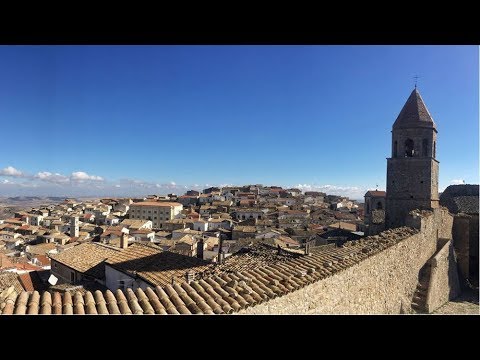 The TV2000 Borghi d’Italia episode is the broadest of the three. Its published description says the presenter visits the old center, castle, co-cathedral, Diocesan Museum and Civic Museum C. G. Nicastro, while also introducing local food, events and dialect. That range makes it useful for choosing what to explore, especially for viewers who want a narrated overview rather than aerial images. The episode’s promotional phrase about hundreds of portals is a local nickname, not a verified count.
 Antenna Sud’s report is tied to one date: 29 August 2022, during the Valleverde celebration. It offers a record of the feast as a living public event and reports on the traditional cavalcata. The narration also repeats historical-duration claims made around the celebration; these should be understood as local tradition unless supported by separate documentary evidence. It is most useful to visitors considering the late-August calendar, which should be checked anew each year.