Alberona counted 832 residents on 1 January 2025, according to ISTAT. At 732 metres above sea level in the Daunian Apennines, it feels shaped by water and elevation: the municipality describes numerous springs, steep lanes and a historic centre that looks out across the Tavoliere toward the Tremiti Islands on clear days. Rather than a single grand monument, the visit unfolds as a sequence of small discoveries—church portals, stone troughs, towers and sudden views—within a community whose history is closely tied to the mountain landscape.
What the town’s history can and cannot tell us
Alberona’s municipal chronology says some sources place its beginnings in the Byzantine period, but it presents that as an account rather than settled archaeological proof. A firmer documentary sequence begins with a 1258 royal donation to Amelio de Molisio; the municipality says the settlement later passed to the Templars and, after their suppression, to the Hospitallers, or Knights of Malta. In 1414 it was recorded as a castrum, reflecting its fortified role. That medieval history remains visible in the town’s religious and defensive landmarks, although buildings were altered over centuries and their present forms should not be mistaken for untouched medieval fabric.
A walk through stone, water and viewpoints
Start at Piazza Civetta and the neo-Gothic church of San Rocco, then continue to the Church of the Nativity of Mary. The municipal guide associates its bell tower with an earlier military tower and notes Maltese crosses on stone slabs. Via Torre leads to the Torre del Gran Priore, dated by the Comune to the twelfth century. From there, narrow lanes pass the Fontanella, the fourteenth-century wooden Arco Calabrese and the sixteenth-century church of San Giuseppe. The fifteenth-century Arco dei Mille opens a broad outlook beside the nineteenth-century Fontana Muta and its long stone troughs. Finish at the Muraglione viewpoint, where the municipality says the Tremiti Islands can appear beyond the plain in clear weather. Alberona’s Antiquarium adds local pre-Roman and Roman finds; its published access arrangements can change, so contact the Comune before planning around a visit.
Getting there and making a day of it
Lucera is the nearest transport hub in the documented bus corridor: Ferrovie del Gargano lists services between Lucera and Alberona, and the route can be combined with a visit to Lucera’s own historic centre. There is a current complication: the operator’s notice dated 24 September 2026 says the SP 130 is closed from 28 September until further notice and that buses terminate near Alberona’s town hall rather than continuing beyond the village. Check the latest service notice and road conditions before travel; do not rely on an older printed timetable. Within Alberona, expect a walk with slopes and steps. Allow time for the Antiquarium and churches, and verify current opening arrangements rather than assuming a fixed daily schedule.
 Alberona in three portraits: heritage, the village and the Daunian hills
 The I Borghi Magazine & Città video uses the town’s name as its whole subject, giving this selection a different role from a travel feature with a descriptive subtitle. It is useful as a concise visual introduction to Alberona before moving on to the detailed route through churches, towers, arches and fountains. Its value is the town-wide frame rather than a claim to cover every historic episode.
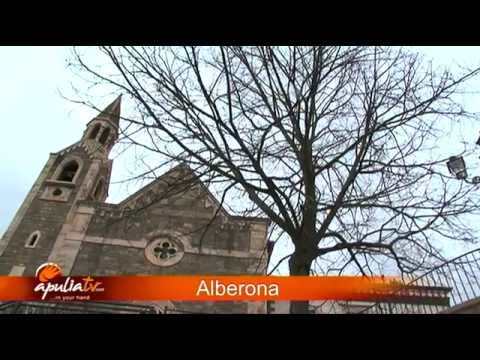 ApuliaTV places Alberona within the Monti Dauni, connecting the village to the inland landscape of northern Puglia. That regional frame helps explain why a visit is more than a monument checklist: the hills and the town’s position are part of its identity. The video complements the closer town portraits with a wider sense of where Alberona sits in the region.