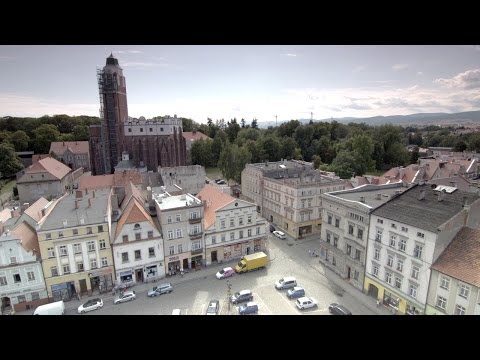
medieval walls, a fortified church and industrial museums near Czechia
Paczków lies in Nysa county in the Opole region, close to Czechia. A distinctive ring of walls encloses its compact street plan, while the town-hall tower and St John the Evangelist’s church rise above the roofs. GUS counted 6,364 people in the town and 11,048 across the urban-rural municipality on 30 June 2026.
| Municipality | Paczków |
|---|---|
| Whole municipality population, GUS 30 June 2026 | 11,048 |
| Town population within urban boundaries, GUS 30 June 2026 | 6364 |
| Whole municipality area, GUS 1 January 2026 | 79.98 km² |
| Town area, GUS 1 January 2026 | 6.6 km² |
The whole-municipality figure includes other settlements; it is not the population of this individual town or village.
A planned bishops’ town
Bishop Thomas I of Wrocław founded Paczków in 1254 as a defensive town within the Nysa principality. Its rectangular market and right-angled streets still reveal the planned medieval layout.
For centuries it remained connected with the bishops of Wrocław. Its later history passed through Bohemian, Habsburg and Prussian rule before it became part of Poland after the Second World War. Wars and disasters weakened the economy; renewed development followed in the nineteenth century.
The old town and fortifications became a national Historic Monument in 2012. Their importance lies in the survival of an urban ensemble as well as individual buildings.
Following the defensive circuit
The walls extend around a circuit of approximately 1,200 metres. Nineteen towers survive, while gate towers and the Nysa Gate mark former approaches. Repairs and later pedestrian openings reveal changes over time.
The defences developed during the Middle Ages and were altered in subsequent centuries. Nineteenth-century work filled the moat to create planted walks and removed remains of the outer wall. Today’s green circuit occupies ground formerly used for defence.
Combine the outside walk with streets inside the enclosure to appreciate the relationship between market, gates and parish church.
The fortified church
Construction of the masonry church began after 1360, followed by consecration in 1389. Its Gothic hall contains vaults completed during later building phases.
In 1529 the threat of an Ottoman attack prompted defensive alterations: changed roofs, firing positions and a protective parapet. A well was installed inside, later associated with local stories under the name Tatar Well. That legendary name does not establish that Tatars captured the church.
Renaissance memorials, chapels and nineteenth-century furnishings show the building’s continuing use. Arrange a visit around its role as an active church.
Market square, town hall and Executioner’s House
The town-hall tower retains its Renaissance form, while the main building was remodelled in the nineteenth century. When the tower is open, its viewpoint reveals the circuit of walls. An 1858 clock mechanism survives inside.
Market-square houses combine several periods and later façades. Their changing appearance adds another layer to the original medieval plots.
The timber-framed Executioner’s House stands outside the former enclosure near the Nysa Gate. Its architecture and stories of former occupants make it a distinctive local landmark; tourist information also operates here.
Two museums of technology
The Gas Industry Museum occupies the former 1902 gasworks at Pocztowa 6. Production continued until 1977. Surviving equipment, meters and domestic appliances explain the changing role of gas in street lighting and household life. Confirm admission arrangements before travelling.
The collection gives industrial Paczków a place beside its better-known medieval heritage.
Metamuzeum Motoryzacji at Kościuszki 4C combines historic cars and motorcycles with interactive physics experiments. Housed in a restored barn, it provides a family activity extending beyond a conventional vehicle display.
Accommodation and places to eat
Within Paczków, the municipal directory lists Śpij w Paczkowie apartments at Armii Krajowej 33, no3 apartments at Pocztowa 3 and rooms at the Gas Industry Museum. Check availability directly for the chosen dates.
Properties in Ścibórz, Kozielno, Trzeboszowice and Gościce are in separate settlements. They may suit a lakeside or border-area holiday but are outside the town centre.
Czarna Kawka at Sikorskiego 14 occupies a former fire station, serving coffee, desserts and lighter meals. Kamienica pizzeria is at Wojska Polskiego 15–17 near the Nysa Gate, and U Niemca at Sienkiewicza 1. Przystań u Grubego at Staszica 28A provides another local meal option. Check addresses because the wider dining directory includes rural locations.
Across the border and practical considerations
Javorník in Czechia makes a natural extension to a visit. Jánský Vrch castle above it also has historical ties to the bishops of Wrocław. Its Czech heritage operator publishes the current visiting calendar.
A joint Paczków–Javorník project established a cycling loop through places on both sides of the border, including Bílý Potok and Gościce. Check present signs and surfaces before riding. Jeseník provides a Czech approach through Javorník; Nysa, Kłodzko, Opole and Wrocław are relevant Polish travel points. Plan the actual public-transport leg from current timetables.
Flooding in September 2024 damaged municipal infrastructure, including the wastewater treatment plant. A study published in 2026 examines the damage and restoration of operations. For a move, the position of an individual property, post-flood documentation and utility condition therefore matter. The compact centre is walkable, while daily travel from surrounding villages needs separate planning.
Sources and practical information
- NID: lokacja, dzieje i ochrona zespołu staromiejskiego
- Miasto: mury, baszty i przekształcenia obwarowań
- NID: budowa i inkastelacja kościoła św. Jana
- Miasto: ratusz i renesansowa wieża
- Miasto: dawna gazownia i muzeum
- Miasto: Metamuzeum Motoryzacji
- Miasto: Dom Kata
- Miasto: noclegi z rozróżnieniem miejscowości
- Miasto: gastronomia i konkretne adresy
- Miasto: transgraniczna pętla rowerowa
- Czeski Narodowy Instytut Zabytków: Jánský Vrch w Javorníku
- Gaz, Woda i Technika Sanitarna: badanie skutków powodzi dla oczyszczalni, 2026
- GUS: ludność według gmin, tablica 11, stan na 30 czerwca 2026
- GUS: powierzchnia gmin i miast, tablice 19–20, stan na 1 stycznia 2026