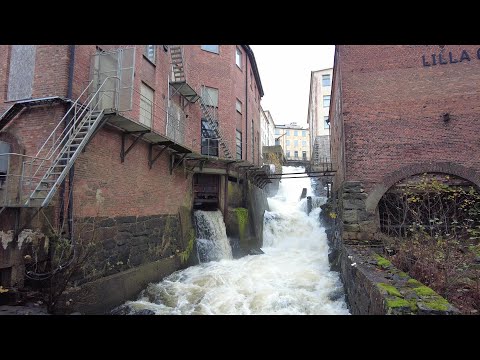
Mölndal sits just south of Gothenburg, but its story does not begin as a suburb. The town grew where Mölndalsån drops through a narrow valley and the force of the water could turn mill wheels. Today the contrast is still legible: Kvarnbyn climbs steeply beside brick factories and the rapids, while the newer inner city gathers shops, public services and transport around Mölndal station. Walk farther east and the built-up streets give way to woodland, lakes and the gardens of Gunnebo.
Population and the town’s exact statistical boundary
Population figures need a careful label here. On 31 December 2023, Statistics Sweden counted 63,901 residents in the part of the Göteborg statistical urban locality (tätort) that lies inside Mölndal Municipality. The SCB table codes that municipal share as 1480TC108. It is not a standalone SCB tätort called Mölndal, and it is not the population of the whole municipality: the continuous built-up area has grown across municipal boundaries into Göteborg and neighbouring municipalities. For a visitor, this explains why daily life feels connected to Gothenburg while Mölndal retains its own centre and local identity.
Kvarnbyn: the documented beginnings
The municipal planning account traces water mills at the falls to at least the fourteenth century. The name Mölndal is linked to the older Swedish word mölna, a water mill, and the falls have a stated drop of about 48 metres. These are the documented foundations of the place’s name and early economy. Paper-making began at the stream in 1653; later centuries added oil pressing, textile work and larger factories. The rapids supplied power, while the valley and transport routes connected the works to markets.
During the industrial era, Korndal’s paper works and later Papyrus helped shape Mölndal as a working town. Papyrus was founded in 1895; paper production at the former works ended in 2006. Buildings from different periods remain around the water, alongside workers’ housing, lanes and civic structures. The municipality treats Kvarnbyn as a nationally significant cultural environment. This account sticks to dated records and official heritage descriptions rather than turning folklore into fact.
From the mill valley to the present centre
Mölndal’s urban form changed again in the twentieth century. The inner city visitors see now was inaugurated in 1976 after the centre shifted toward the western side of Mölndalsån. In the 1970s the river channel through the centre was covered and routed into a culvert, so the lively falls at Kvarnbyn and the hidden water beneath the shopping streets belong to different experiences of the same river. The centre is practical rather than monumental: a place for shopping, cafés, civic services and changing neighbourhoods, with Mölndal resecentrum providing the main connection toward Gothenburg and the wider region.
What to see and how to move around
Begin in Kvarnbyn, where the sound of the falls, steep lanes and industrial buildings make the town’s origins tangible. Mölndal City Museum is beside the rapids and presents local social and industrial history; its current programme includes exhibitions and guided walks. A mobile guide from the museum adds archival images and stories along the streets. The route is hilly, with uneven paths and stairs, so choose footwear and check access arrangements in advance.
For a different landscape, follow marked nature-and-culture walks around Safjället or along Stensjön toward Gunnebo. Gunnebo House and Gardens was built between 1784 and 1796 as a summer residence for John and Christina Hall, designed as a complete estate by architect Carl Wilhelm Carlberg. Restored interiors, formal gardens, woodland paths and seasonal food or cultural programmes make it a substantial visit; guided access to the interiors follows a schedule, while grounds and routes have their own conditions. The city’s route pages also map longer walks such as the 12-kilometre circuit around Rådasjön.
Visitor services and arrival
Mölndal’s central area has shops, cafés, restaurants, libraries and everyday services; Kvarnbyn adds the museum and a café close to the water. The museum is about one kilometre from the inner city and can be reached on foot or by public transport. The city lists bus, tram and commuter-train connections to Mölndal’s central stops, with local bus services to the museum area. Schedules and stop arrangements change, so check Västtrafik before setting out. Confirm museum opening hours, guided-tour availability, Gunnebo access, trail conditions and any works around the former industrial district on the day of your visit.