A town with a trading pulse
Kungsbacka feels more like a lived-in market town than a museum set. Its compact centre gathers around the square and the Kungsbacka River, where cobbled lanes, low timber façades, cafés and independent shops make a relaxed walking circuit. The river’s route toward the fjord helps explain why this became a place of exchange, while the nearby coast and countryside remain part of the town’s wider setting.
Population figures need a clear boundary. On 31 December 2025, Kungsbacka Municipality counted 24,360 residents in its planning area called Kungsbacka stad; the whole municipality had 86,332. The first figure is a municipal planning-area total, not the population of the entire municipality or an interchangeable statistical locality figure.
Evidence, records and a changing border
The surrounding area has an older story than the written town record. Archaeologists found buildings and objects dated 900–1150 at Varlaplatån. Across the river, Tölö has its own early medieval evidence, including remains of an 11th-century stave church and traces of a royal estate from the 13th century. These are distinct archaeological places and should not be mistaken for proof that the present town centre was already a town then.
The first written reference to Kungsbacka is from 1366, under the name Koningsbakkae, for a defensive site at today’s Skansen. The municipality says the town probably first gained trading privileges in the 15th century; it certainly regained them in 1582. Halland passed from Denmark to Sweden in 1645 and became Swedish permanently in 1658, so Kungsbacka’s past is also a borderland story.
Rebuilt in timber
A major fire in 1846 destroyed much of the town. Its reconstruction introduced broad, straight streets, larger blocks and low, light-coloured timber houses around an ample market square. The plan still gives the centre its unusually open rhythm. Röda stugan on Norra Torggatan and Borgmästarvillan on Östergatan are identified by the municipality as the two surviving buildings from before the fire. The present timber church by the square was rebuilt in 1875. Trade remains visible today in the centre’s small retailers, food shops, restaurants and cafés; across the municipality, construction, wholesale, retail and business services are among the larger business sectors.
Walks and practical connections
Start at the square, then follow the old centre’s short streets and river edge; allow time to step into a café or browse local shops. Hunehals Castle, on Hanhals Holme outside the centre, makes a separate history outing: the official visitor guide describes a medieval site with a self-guided cultural trail. It is not part of the central walking loop. Kungsbacka station connects by Västtågen and Öresundstågen to Göteborg Central; Västtrafik currently describes the trip as 21–26 minutes. Check live departures, tickets and service notices before travel. Market days, summer events, the Hunehals trail conditions and opening hours can change, so confirm details locally.
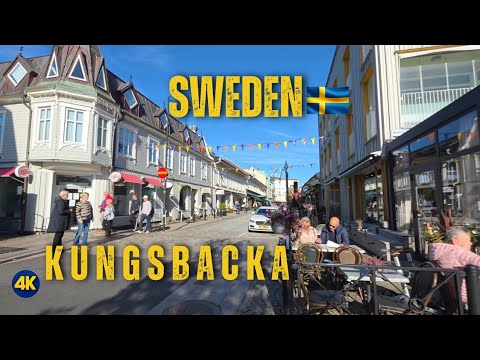 Kungsbacka on foot: the town, its roots and a medieval outpost
 The strongest pairing is the city walk with the Tölö film. The first is presented as a 4K walk through Kungsbacka; the publisher's description specifically names the river, streets, a park and the central station. That makes it a practical visual prelude, though not a guarantee of present-day conditions. The second, made for a local-history project, is brief and more interpretive. Its Swedish description says medieval and local historians have discussed whether an earlier trading and political centre existed at Tölö and Varlaplatån, citing archaeological material. It is best watched with the municipality's history page: that account separates the two find areas and dates the evidence it lists. The Hunehals clip adds an outing beyond the old streets. Its published description locates the ruin on Hanhals Holme by the fjord and labels the visit autumn 2021; the local visitor guide confirms Hunehals as a medieval site with a marked cultural trail. The three films therefore offer different scales of context—today's town, a carefully qualified early-history question and a regional ruin—without suggesting that every stop belongs to one walk.
 For viewers deciding whether Kungsbacka merits a slower visit, the first clip is the broadest introduction: its title advertises a 4K walk and the publisher's text names the central streets, river, park and station. Treat it as a traveler's town-walk film rather than an official guide, since its publication date and route do not establish today's opening hours or street conditions. The second video is the most historically focused. “Tölö – Norra Hallands första handelscentrum” presents a local-history account, and its description is explicit that a predecessor trading centre is a scholarly and local-history hypothesis supported by finds, not a settled claim about the present town's foundation. The municipal history provides a useful check on that distinction. Finally, the Hunehals recording is described as an autumn 2021 visit to a castle ruin near Kungsbacka; the official visitor page independently identifies the site as medieval and describes a self-guided cultural trail. It belongs in a regional itinerary, not as evidence that the town centre itself is a castle landscape. This set is most helpful when each clip has its own task: orientation, interpretation and a separate heritage excursion.