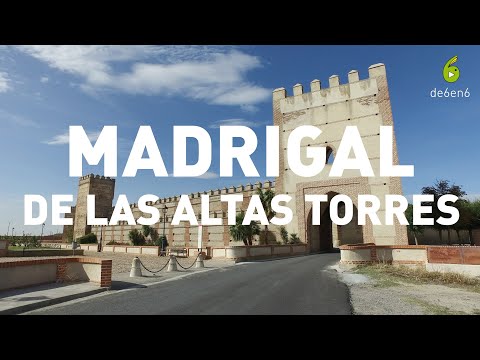
Mudéjar walls, Isabella I and the open country of La Moraña
Towers rising above cereal fields announce Madrigal long before its streets come into view. This town in La Moraña combines brick and earth-built defences with royal history, churches, wine cellars and the everyday life of an agricultural community. Isabella I of Castile was born here, yet a rewarding stay also leaves time for the hospital, the outer walls and the broad countryside beyond them.
| Municipal population at 1 January 2026 | 1,293 |
|---|---|
| Area of the municipality | ≈ 106.80 km² |
INE Annual Population Census, reference 1 January 2026, released on 24 November 2026. The IGN area covers the whole municipality, not only the built-up centre.
A medieval town on the plain
The urban centre developed during settlement of the area in the tenth and eleventh centuries, around Santa María del Castillo. Further growth between the fourteenth and sixteenth centuries helped shape the town now explored on foot. The official heritage declaration traces that medieval development rather than assigning a single foundation ceremony.
Madrigal was connected with Arévalo and subsequently with the Castilian crown. John II and the Trastámara dynasty left particularly strong associations. In 2020 the historic-area designation completed proceedings opened in 1963. Its scope includes houses, public spaces and views of the town as well as the major monuments.
An earth-and-brick defensive circuit
The enclosure uses rammed earth reinforced with brick and follows an irregular oval. It was already standing in 1302, when Ferdinand IV ordered its demolition because it had been built without permission from the council of Arévalo. Surviving sections still define the boundary between streets and farmland.
Gate names recall routes towards Medina, Arévalo, Peñaranda and Cantalapiedra, although entrances and stretches of wall have changed or disappeared. Walking outside the enclosure helps explain its purpose: a settlement on open ground created a defensive perimeter without a steep hill or a river providing a natural barrier.
The birthplace of Isabella I
Isabella was born on 22 April 1451 in the royal palace of John II. The building later became the monastery of Nuestra Señora de Gracia and retains a religious community. Visits to its royal heritage therefore take place within a building with a continuing purpose.
The palace and former hospital frame one of Madrigal’s most memorable public spaces. Arrange access through current monastery information and the municipal tourist office. Combining an interior visit with a walk around the town makes it possible to explore Isabella’s early setting more fully than a brief stop at the exterior alone.
Two approaches to Mudéjar architecture
San Nicolás de Bari contains the baptismal font associated with Isabella and a remarkable timber ceiling. Medieval construction and later alterations can be followed through its nave spaces, apses and tower. The bell tower provides a useful point of orientation from surrounding streets.
Santa María del Castillo stands on higher ground within the centre. Its name is connected with interpretations of an earlier defensive site. Brick arcading around its apses and paintings discovered behind the high altarpiece offer different details to examine. Allow time for both churches, subject to their current opening arrangements, rather than treating one as a substitute for the other.
Care, religious life and wine storage
María of Aragon promoted the Hospital de la Purísima Concepción in 1443 to care for poor and sick people. Its arcaded front and subsequent cultural uses give the former institution an enduring public role. The tourist office is based here, making it a practical starting point for organised visits.
Outside the enclosure stand the extensive remains of the Augustinian convent, with architecture influenced by the Herrerian tradition. The friars also held vineyards. Between 1732 and 1766 they enlarged a cellar within the town: the Bodega de los Frailes. Its vaulted passages and arches introduce the practical business of storing wine during arranged visits.
Birdwatching in cereal country
Great bustards, little bustards and other birds associated with open farmland occur in the surrounding cereal plain. Small wooded patches, river margins and wet areas add further habitats. Crop cycles and seasonal bird movements make countryside visits quite different at different times of year.
Stay on authorised tracks and keep away from nesting areas. Binoculars allow observation without approaching the birds. Wetlands and viewing places elsewhere in the district can extend a nature-focused stay, but establish access arrangements before setting off. The wide horizons are an attraction in their own right, particularly when a walk is planned around the changing light.
Meals and accommodation in Madrigal
The municipal directory includes Restaurante Los Ángeles and tapas venues such as Café Bar Sito and Bar Alfonso. Bakeries, butchers and food shops provide useful options for a self-catering stay. These businesses also show the everyday service role of a town surrounded by agricultural land.
Visitors can sleep in Madrigal itself. The municipal accommodation information lists Posada Isabel de Castilla, La Casona de Madrigal, La Capilla and La Real Herrería. The posada explicitly operates for adults only. Check the chosen property’s arrangements when booking, particularly for families or when meals in the same building are important to the trip.
Approaches and longer stays
Provincial tourism information places Madrigal roughly 25 kilometres from Arévalo, 65 from Salamanca and 74 from Ávila. These towns and the district’s railway connections offer ways to plan an arrival from larger centres, but the final section needs attention. Establish current bus services and the return journey before committing to a connection.
For a possible move, local shops, agricultural activity and municipal services provide concrete starting points for investigation. Check commuting, healthcare access and available housing in person. A rural holiday property can be useful for an exploratory stay, while its visitor rate should not be treated as a monthly residential rent.
Sources
- Ayuntamiento: recinto murado
- Ayuntamiento: San Nicolás
- Ayuntamiento: Santa María del Castillo
- Ayuntamiento: convento de San Agustín
- Ayuntamiento: Real Hospital
- Ayuntamiento: historia de la bodega
- Ayuntamiento: visitas y oficina de turismo
- Ayuntamiento: aves y paisaje cerealista
- Ayuntamiento: alojamientos
- Ayuntamiento: restauración, comercios y servicios
- Posada Isabel de Castilla: alojamiento solo para adultos
- BOE: declaración del conjunto histórico y evolución urbana
- Diputación de Ávila: ubicación y accesos
- Ayuntamiento: casa natal de Isabel I y monasterio
- INE: Annual Population Census, 2026
- IGN: municipal area