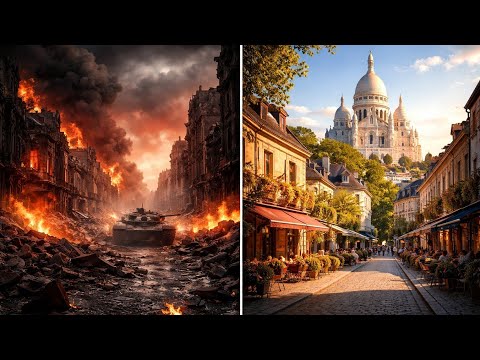
Lisieux is a town of the Pays d’Auge with two very different historic layers: a medieval cathedral that survived the Second World War and a centre largely rebuilt after the 1944 bombings. Pilgrimage linked to Saint Thérèse adds another layer, but the town’s story started long before it became a destination for pilgrims.
From the Lexovii to reconstruction
Local tourism identifies Lisieux as a Gallo-Roman centre associated with the Lexovii. The cathedral of Saint-Pierre belongs to the medieval city; the present Gothic building dates principally from the twelfth and thirteenth centuries. Much of the older urban fabric was destroyed during the liberation bombings of 1944. Reconstruction from the late 1940s kept elements of the earlier street plan while using new building methods. This is why the centre’s twentieth-century streets and surviving old structures should be viewed together.
The Basilica of Saint Thérèse, consecrated in 1954, is a major pilgrimage site with its own architectural language. It should not be confused with the medieval cathedral. The Museum of Art and History, the Carmel and scattered timber-framed houses help connect sacred history with the broader town. The Sainte-Anne tower is another visible remnant. For a longer stay, the countryside of the Pays d’Auge offers separate excursions.
Arriving, eating and sleeping
Lisieux has a railway station on the Normandy network, reachable from Paris and Caen with the appropriate service. The centre is walkable, though the basilica sits on higher ground. Local tourism lists hotels, guesthouses and restaurants in town. Staying overnight allows time for both cathedral and basilica without compressing them into a short stop. Check religious services and museum hours before planning interior visits.