Orbec is a Norman town where the rural character of the Pays d’Auge meets a compact centre of shops, services and historic houses. The commune counted 1,975 municipal residents in the 2023 census. Timber-framed façades, paved lanes and the valley of the Orbiquet give the town a distinct scale: it rewards looking closely at buildings and streets rather than rushing between distant attractions. The centre remains a place where people live, shop and gather, so the visit is best approached as a town walk, not a museum circuit alone.
From medieval stronghold to market town
The municipality places Orbec’s early written history around the year 1000, when Duke Robert I of Normandy gave it to his cousin Gilbert of Brionne. The family associated with Orbec later became linked to the Anglo-Norman lineage known as Clare and Pembroke. During the Hundred Years’ War, the town was pillaged and its castle dismantled by order of Charles V, according to the municipal account. Orbec’s administrative importance returned in the sixteenth century: it became a bailliage in 1583. Those shifts help explain why a modest centre contains traces of both defensive and judicial power.
The Vieux Manoir is the most compelling place to read the town’s prosperity through a single building. Built in 1568 for a wealthy tanner, its carved timber façade combines brown wood, pink brick tiles, pale stone and grey flint. The municipality says the historical society saved the building and donated it to the town on condition that it become a museum. Founded in 1873, the museum interprets local archaeology, architecture, everyday objects and popular traditions. The church of Notre-Dame, whose fabric spans the thirteenth to sixteenth centuries, and the Manoir Dossin add further layers to a walk through older streets.
Local life and the Pays d’Auge around it
Orbec’s municipal information describes a town of commerce and services, with schools, colleges, associations, crafts and activity areas near the A28. The broader Pays d’Auge landscape is associated with farms, horses, orchards and dairy production; local food traditions include cream, butter, cider and other apple products. This regional context is best experienced through markets and independent businesses rather than treated as a promise that every product is made in town. Cafés and everyday services make it possible to pause between heritage buildings and explore at a relaxed pace.
At the time of writing, the Lisieux tourism office says the Vieux Manoir museum is closed to the public until 2 May 2027; its timbered façade can still be seen from the street. Check the current reopening notice before planning an interior visit. The church and historic lanes can frame a short stop, while the countryside and valley paths invite a longer stay.
Getting there from Lisieux
Lisieux is Orbec’s main rail gateway. The town lists Astrobus route 5 between Orbec and Lisieux, and the visitor office gives the road distance as 21 kilometres via the D519. Confirm the bus timetable, operating days and return options, especially outside the main school and commuter periods. Once in Orbec, the central heritage area is compact enough to explore on foot. Allow time to notice the Vieux Manoir façade and the changing scale of the lanes, then use local services as a base for a wider Pays d’Auge outing.
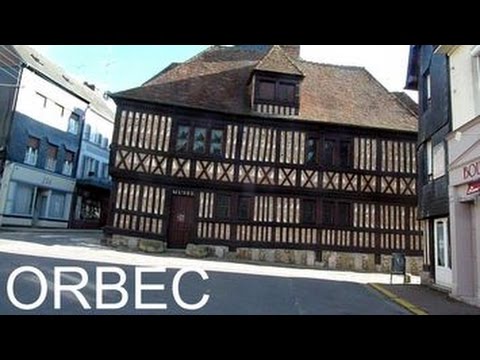 Orbec in three films: heritage, local life and the surrounding landscape
 Mikko’s Adventure records a personal detour to Orbec during a Normandy trip. Its value is the travel-scale approach: the town appears as a stop within a wider region, much like a visitor planning a half-day. Use municipal sources to confirm access to the museum and local transport.
 This 4K walk is titled directly for Orbec and offers a street-level way to orient oneself to the centre. It complements the narrated presentation and personal travel film by focusing on the town’s physical setting. It cannot replace historical interpretation, and the Vieux Manoir’s current closure should be checked separately.