A town with the sea ahead and another country across the river
Hendaye sits at the south-western edge of France, where the Bidassoa flows into the Bay of Txingudi and marks the border with Spain. The town is best understood as several places joined together: the central neighbourhood around the station, the long beach and marina, and the open coastal landscape around Abbadia. Basque culture gives this geography a language and a memory. Municipal information is available in Euskara as well as French, and the river has connected and divided communities across the border over many generations.
INSEE counted 18,102 municipal residents across the whole commune in 2023; that reference population took effect on 1 January 2026. Its 2023 employment dossier records 6,729 jobs located in Hendaye. Commerce, transport and other services accounted for 43.0% of those jobs, public administration, education, health and social action for 36.4%, and industry for 15.4%. This is a town with a strong service economy, but also with industrial and port activity beyond its visitor-facing waterfront.
Border history written into the landscape
Hendaye was a small settlement connected to Urrugne before it became an independent commune in 1654, initially recorded as Andaye in the municipal account. The same account recalls the importance of whaling to early local prosperity. Border life was never abstract: the Bidassoa shaped fishing, exchange, conflict and movement. Pheasant Island, in the river between Hendaye and Irun, was the setting for the 1659 Treaty of the Pyrenees. The municipality notes that the island alternates between French and Spanish administration every six months. It is a remarkable piece of European history, though not a normal public excursion site.
War repeatedly changed the town. Municipal historical records describe Hendaye's destruction in 1793 and a long rebuilding. The railway reached the border in 1864, creating a new commercial gateway as passengers and goods changed between French and Spanish rail systems. That connection also helped shape the later seaside resort. Hendaye Plage developed from the late nineteenth century, with hotels, villas and leisure facilities facing a wide sandy shore. Today the beach district still has a different feel from the station-side town, but both belong to the same working commune.
Abbadia, cliffs and an Atlantic beach
The beach extends for more than three kilometres, giving space for walking, swimming and surf schools in a sheltered bay. At its northern end, two offshore rocks known as Les Jumeaux mark the change from sand to the cliff coast. The Domaine d'Abbadia protects about 65 hectares of meadows, heath, paths and geological formations. The exposed flysch layers help explain why this coast looks so different from the broad beach below. Follow marked paths along the top; some cliff bases and steep sections are restricted for safety and erosion protection.
Above the shore stands Abbadia, the neo-Gothic observatory castle built between 1864 and 1884 for Antoine d'Abbadie by Eugène Viollet-le-Duc. The rooms bring together astronomy, travel, science and an elaborate personal imagination; the observatory and the library are part of the visit, not merely exterior decoration. The site has limited daily capacity, so reserve ahead, especially in summer. From Hendaye Beach, the castle can be reached on foot in about 15 minutes or by bus lines 14, 15 and 26, subject to current routes and timetables.
Crossing the border and planning a visit
Hendaye works well as a base for a short journey across the water. The Marie-Louise boat connects the marina with Hondarribia in about six to seven minutes; its frequency changes with the season. On the rail side, TER services link Hendaye with Bayonne, while Euskotren continues from Hendaia toward Irun and Donostia/San Sebastián. The station makes a cross-border day trip practical without a car, but allow time for the transfer and check both operators’ schedules. In town, leave time for the beach, the Abbadia trails and the station district rather than treating Hendaye as a simple border crossing. Check castle reservations, bus service, sea conditions and the boat timetable before travel.
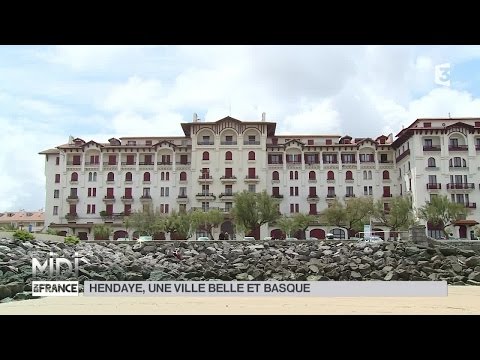 Hendaye in three scenes: Basque town, beach resort and Abbadia
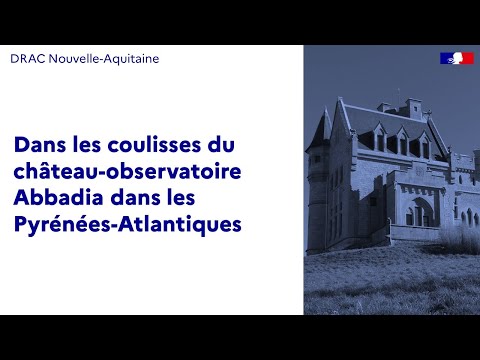 The Ministry of Culture film looks behind the scenes of Abbadia’s heritage protection. Instead of treating the castle only as a striking silhouette, it brings attention to the work required to preserve a fragile historic interior and observatory. It adds a conservation perspective to a visit focused on Antoine d’Abbadie and Viollet-le-Duc’s building.
 Images du Pays Basque’s retrospective turns to Hendaye Plage and the early development of the seaside resort. Its archival angle helps explain why villas, hotels and the beach district form a different urban landscape from the town around the station. It is a useful companion to a walk along the seafront, with dates and access details checked separately before a visit.