Espelette, or Ezpeleta in Basque, sits where the green foothills of the western Pyrenees begin to rise above the Basque Country. White farmhouses with red or green shutters line its compact centre, and in pepper season the bright red strings hanging from façades turn the streets into a working landscape. The village’s global reputation rests on a spice, but a visit also brings you to a baronial castle reused as the civic heart, a fortress-like church, mountain trails and the everyday markets of a small rural community.
INSEE counted 2,155 municipal residents across the whole commune in 2023; the reference figure took effect on 1 January 2026. Espelette is the municipal name used in French records, while the town itself also displays the Basque form Ezpeleta. Basque language and identity remain part of local life: the municipality describes bilingual Basque-French schooling, and the fronton is a visible reminder of the region’s pelota culture. French is the public language used in the site’s current local-language publication field; that choice should not be read as a claim that Basque is absent from the village.
The pepper is a crop before it is a souvenir
The Piment d’Espelette is not simply a red decoration. The protected designation covers three forms: powder, strings of peppers and fresh fruit intended for processing. The production area includes ten communes in the western Basque Country, not Espelette alone. The town’s agricultural account says growers obtained AOC and European AOP protection in 2000. It also describes a process that depends on selected seed, careful cultivation, drying and transformation, with significant work still done by hand. Local farms may specialize in peppers or use the crop to complement other agricultural activity; the municipality also notes horticulture and duck farming in the commune.
The town’s own history says peppers from Mexico reached France in the sixteenth century and that cultivation became established around Espelette by 1650. Those dates are the municipal account of a regional crop story, not a claim that one named person introduced the pepper here. The spice now flavours food from savoury dishes to sweets, but its seasonal work remains visible: growers tend the plants, gather and string the peppers, then dry and process them. A visit to a producer can make that chain clearer than a shop display. The Atelier du Piment offers a producer-led visit and tasting; Etxea, the AOP interpretation centre, explains the product’s origin, growing area, life cycle and rules. Confirm seasonal opening times and group arrangements before travelling.
A castle with a layered history
The Château des barons d’Ezpeleta now houses the town hall, library, tourist office and exhibition rooms, including a permanent display on the pepper. The municipality’s history traces the castle to the Ezpeleta family, a Navarrese noble lineage, and dates its construction to around the year 1000. That early date should be treated as the municipal tradition rather than a fully settled archaeological conclusion. A 1997 survey around the building uncovered remains of a large late-medieval fortress enclosure, an irregular polygon with five towers. The corner tower has been protected since 1937 and the larger ensemble since 1993. A later restoration consolidated the ramparts and made visitor circulation through the site clearer.
The official account says Baroness Juliana Henriquez, who died without an heir in 1694, bequeathed the castle to the people of Espelette. Today, its central position gives it an unusually civic role: it is not a detached ruin, but a working public building beside the lanes, shops and gathering places. The permanent pepper exhibition offers useful context before walking through the village, while the tourist office is well placed for maps and current local advice.
Church, fronton and Basque memory
Saint-Étienne church began in 1593 and is registered as a historic monument; the municipality describes its silhouette as fortress-like, with a broad bell tower above the porch. Inside, three levels of wooden galleries surround the nave. A gilded Baroque altarpiece with twisted columns, dating from the seventeenth century, anchors the interior. The church stands beside a cemetery where visitors can see Basque discoidal stelae and the Art Deco marble mausoleum of Agnès Souret, also protected as a historic monument. Respectful access matters: this remains a place of worship and burial, so check opening conditions and avoid disturbing services or graves.
Espelette’s Basque character is also lived outside monuments. The municipal fronton hosts the sport of pelota, while local place names, bilingual education and seasonal community events keep the language and culture in view. The nearby mountain landscape offers another way into local life. Mondarrain rises to about 750 metres and is known for rocky ground and wetland habitats; the municipality notes peat bogs, rare carnivorous plants and a protected Natura 2000 site. It also identifies prehistoric stone circles and a Roman-period redoubt on the summit. Those remains belong to distinct periods, not to a single invented origin story for the town.
Markets, walks and practical connections
Wednesday is the town’s weekly market day. The covered market runs from 08:00 to 12:30 and is focused on food, with priority for local producers; the outdoor market at Merkatu Plaza brings together non-food traders and artisans at the same hours. The centre also has shops and places to eat, while the castle’s library, town hall and tourist office provide everyday public services. During the autumn pepper season, strings drying on façades help visitors see that the crop is part of local work as well as a culinary emblem.
For an easy outing from the centre, the family circuit is seven kilometres, rated very easy, and takes about one hour and thirty-five minutes, with 158 metres of ascent. It passes built heritage, woodland and working farms where visitors may be able to buy peppers or sheep’s cheese directly. The mountain circuit to Mondarrain is a different undertaking: 17 kilometres, around six and a half hours, 908 metres of ascent and rated difficult by the municipality. Choose according to conditions and experience, and check route notices and weather before setting out.
Bus line 40 connects Espelette with Bayonne and Cambo-les-Bains on the Txik Txak network. This gives visitors an option beyond driving, although the exact timetable and seasonal service should be checked for the day of travel. From Bayonne, Biarritz or the coastal towns, Espelette makes a natural inland extension; nearby Cambo-les-Bains and Itxassou add gardens, spa heritage, river scenery and other Basque food traditions. Leave time to walk the village beyond the main street: the castle, church, market and farms make a fuller story than the pepper alone.
 Espelette in three videos: village, pepper and church
 The Atelier du Piment presents the production chain from seed to AOP powder in this short film. It is especially useful alongside the town’s visitor guide because it makes clear that the pepper is an agricultural product with successive stages of work, not simply a garnish or façade display. The 2012 upload is an older introduction; current growing rules and visitor arrangements should be checked separately.
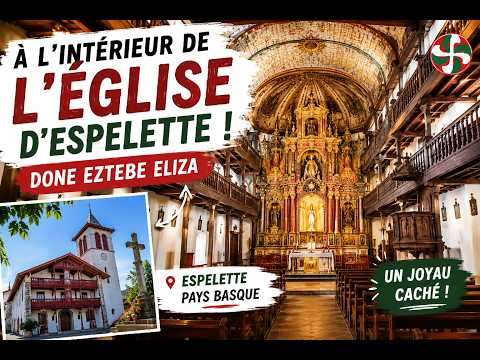 This 2026 independent video is devoted to the interior of Saint-Étienne church. Its description points viewers to the wooden galleries, gilded Baroque altarpiece and decorative details, a useful counterpart to a walk around the castle and pepper market. It is a visitor’s presentation rather than an official access notice; worship schedules and respectful behaviour still take priority.