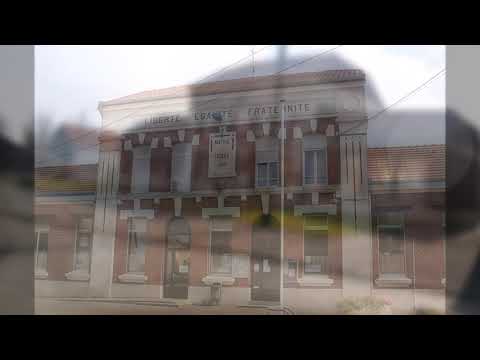
Gonnelieu is a small commune in the Cambrésis, where the built-up village sits within a broad agricultural landscape. Its appeal lies in reading a modest place through several firmly documented layers rather than expecting a large visitor complex: Roman-era material, medieval political history, a landscape scarred by the First World War, and a local community whose mairie still gives the Grand-Place its civic focus. INSEE’s 2023 reference figures count 279 municipal residents in the commune itself, plus eight people counted separately, for a total of 287. The municipal population is the appropriate figure for the resident community; it is not a count for the wider Cambrai area.
History that can be traced
The Cambrai intermunicipal authority reports that archaeological material found at Le Canton du Moulin indicates occupation during both the early and late Roman Empire. That evidence supports a long human presence in the area, but it does not by itself establish an uninterrupted settlement or explain how the name Gonnelieu arose. The same official account records a clear medieval milestone: in 1185, the place entered the holdings of King Philip II, known as Philip Augustus, following his marriage to Isabelle of Hainaut, whose dowry included Vermandois. In 1790 the former Picard village was incorporated into the newly formed Nord department, within the Cambrai district and Ribécourt canton. These administrative changes are documented history; local legends or etymologies should be treated separately unless supported by archival evidence.
The most consequential rupture came in 1914–18. The local authority describes the war as devastating and places Gonnelieu at the end of the advanced sector of the German Siegfried position, commonly called the Hindenburg Line by Allied forces. It records liberation on 29 September 1918 by patrols of the 16th Warwickshire. The date makes the village part of the final Allied advance, not merely a distant backdrop to it. A later layer of remembrance is visible in the French civilian and military cemetery listed by the Cambrésis tourism agency. Its record identifies the grave of Sergeant-pilot Arnoux Thiroux de Gervillers, whose aircraft was shot down near La Vacquerie on 21 May 1940. This memorial site links two conflicts without confusing their chronology.
Everyday life and a thoughtful visit
Gonnelieu is not described by the official sources as a large employment centre. INSEE counts 22 jobs located in the commune in 2023 and eight employer establishments at the end of 2024. In that small business base, construction and commerce, transport and varied services each account for 37.5 percent, while public administration, education, health and social action account for 25 percent. Because the denominator is only eight establishments, these percentages are a narrow statistical snapshot; they should not be mistaken for the occupations of all residents. The surrounding open countryside remains part of the experience, while the mairie at Grand-Place anchors the village’s civic life. Its published office hours are limited to selected evenings, so phone ahead and confirm them before travelling.
A useful regional outing is the Cambrésis agency’s 52-kilometre driving loop, “Chemins et Mémoires en Cambrésis: Après la Grande Guerre.” Its current stage list includes Gouzeaucourt, Villers-Plouich and other communities associated with the front, but does not list Gonnelieu as a formal stop. Treat a visit to Gonnelieu as a separate detour and verify the route, road conditions and cemetery access before setting out. The municipal profile, INSEE population table and official route page provide practical starting points; opening hours and access arrangements can change.