Ervillers is a small village in the open countryside of Artois, between the better-known destinations of Arras and Bapaume. Its scale is part of its character: a compact parish centre, fields at the edge of the built-up area and a present-day community whose municipal website speaks of living well together. INSEE counted 396 people in the commune’s 2023 municipal population, or 398 in the broader total population; the municipal figure refers to residents assigned to Ervillers itself, not a surrounding service area. The reported density was 55.5 inhabitants per square kilometre. INSEE places the commune in Bapaume’s living area and the wider Arras attraction area, a useful way to understand its links beyond the village.
A past recorded with care
The local archives make an important distinction between what can be documented and what has been lost. The departmental archive identifies Saint Martin as Ervillers’ parish dedication and lists parish, civil, population, tax and cadastral records for research. It also warns that parish registers earlier than 1737 were destroyed during the First World War. That gap is not evidence that the village began then; it limits how far a continuous local family or parish history can be reconstructed from those registers.
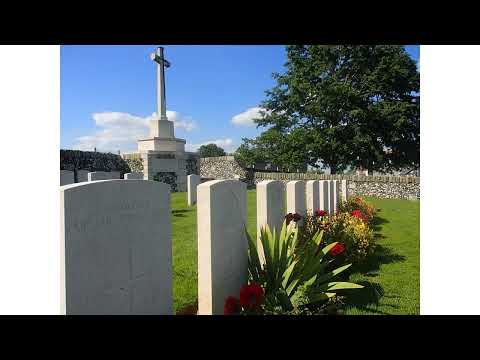
For the final year of the war, the same archive preserves a newspaper account dated 9 September 1918. It records the Pas-de-Calais prefect’s tour of communities recently recovered as the front moved back, and includes Ervillers in the itinerary. This is a contemporary trace of liberation and the work of rebuilding, though the published account does not provide a separate architectural inventory for every stop. The village’s military cemetery gives that history a visible memorial dimension. Its placement on rue de l’Église is identified in the cemetery record and in a locally named video; access and visiting conditions should be checked before setting out. No later legend is needed to make the documented record meaningful.
Village economy and everyday services
Ervillers remains a rural commune, but its economy is not captured by a single label. INSEE records 87 jobs located in the commune in 2023. Its end-2024 count lists 15 employer establishments: agriculture accounts for 20 percent, construction 33.3 percent, commerce, transport and varied services 20 percent, and public administration, education, health and social action 26.7 percent. With only 15 establishments in this particular table, those shares are a small-scale snapshot rather than a complete map of residents’ work; many people also depend on employment elsewhere. The municipal site’s current notice offering nine serviced residential plots, from 455 to 1,181 square metres, is another sign of a village planning for continued settlement.
The mairie is on rue de l’Église. The commune currently posts opening hours on Monday and Thursday from 16:00 to 17:00, while the national Service-Public directory gives the same weekly windows. Because office hours can change, call before travelling for an appointment. The municipal website also directs residents and visitors toward intercommunal services, including the pool at Bapaume, and to the Sud-Artois area’s visitor information.
Heritage and a short regional excursion
For a first walk, the parish centre and rue de l’Église offer the most grounded introduction: they bring together the mairie, the church area and the military cemetery without implying that the village is a large museum site. The available official sources consulted here do not establish a signed circular walking trail beginning in Ervillers, so visitors should use a current map and respect field access rather than follow an invented route. The countryside is best enjoyed from public roads and paths whose access is clearly indicated.
A practical history-focused extension is Bullecourt, where the Sud-Artois authority operates the Jean et Denise Letaille museum. Its collection grew from objects found by local farming couple Jean and Denise Letaille in fields around the two Battles of Bullecourt in April and May 1917. The museum is at 1 bis rue d’Arras, Bullecourt, and publishes seasonal hours, booking rules and accessibility details. Ervillers’ municipal site links to it, making the pairing a documented regional itinerary rather than a claim that the museum lies inside the commune. Bapaume is the nearer everyday service centre; Arras offers the broader regional context. Check road directions, public-transport timetables, cemetery access and museum hours just before departure.