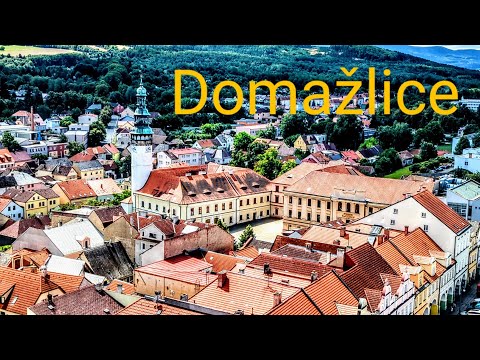
Domažlice lies in western Bohemia on the route between Plzeň and the Bavarian border. Its long arcaded square, slender church tower and Chod Castle are visible traces of a royal town. The surrounding Chodsko region has its own cultural traditions, which deserve more than a supporting role in the story of the historic centre. Domažlice developed in the Middle Ages. Archaeological evidence for earlier settlement does not establish a Roman, Greek or other ancient foundation for the present town.
An older settlement and a fortified royal town
The municipality places the core of an older market settlement near the eastern suburb and the Church of All Saints. Slavic pottery found within the later fortified town suggests that early medieval settlement extended beyond one location. In the 1260s, King Přemysl Otakar II ordered the settlement's transformation into a walled royal town. The approximate date of 1265 belongs to this new urban stage, not to the first human presence in the landscape.
Walls, ditches and towers guarded a trading route towards Bavaria. A castle for the royal burgrave occupied one corner, while an Augustinian monastery stood in another; the Church of the Nativity of the Virgin Mary rose near the centre. Free Chod villages also came under the burgrave's authority. Their inhabitants helped guard the border and the movement of people along the routes; written sources explicitly mention them from 1325. Visitors should distinguish the town from the wider Chodsko region: their histories overlap, but they are not the same place.
Battle, crafts and urban change
A decisive episode in the fifth crusade against the Hussites occurred near Domažlice in 1431. In the municipality's account, the crusading troops fled as the Hussites approached. The event remains part of local historical memory. In the late medieval and Renaissance periods, trade, brewing and crafts sustained the town. The arcades of its burgher houses are not a modern imitation; their form appears in an image of Domažlice from the end of the sixteenth century.
The Thirty Years' War brought confiscations and repeated plundering. The older privileges of the Chod villages also weakened. Jan Sladký Kozina, later remembered as a symbol of Chod resistance, was executed in Plzeň in 1695, not on the square in Domažlice. During the second half of the nineteenth century, some gates, walls and ditches disappeared as the town expanded. The Second World War and then the sealed border again interrupted its natural links with Bavaria. Present-day cross-border journeys make that geography easier to understand.
What to see and how to stay longer
A walk can start on Náměstí Míru and follow the arcades towards the town tower by the Church of the Nativity of the Virgin Mary. A climb gives a view of the centre's plan and the country beyond; check access before visiting. Chod Castle, founded in the thirteenth century, now houses the Museum of Chodsko. The cylindrical tower is the principal surviving part of the original building, while other sections have been rebuilt. The museum's exhibitions and collections bring regional everyday life into view alongside political events. The Lower Gate and nearby streets show more of the town beyond its main square.
The Chodské slavnosti festival presents music, dress and other living regional traditions, although dates and programmes should be checked for the relevant year. With more time, visitors can continue to Chod villages, the Vavřineček hill or the Český les countryside. These places lie outside the centre and need a separate outing. The municipal information centre lists routes and accommodation. Lodging, meals and cafés can be found in Domažlice itself; confirm the opening hours and location of a chosen business before booking.
A railway runs from Plzeň through Domažlice towards Furth im Wald and Bavaria. Travellers from Prague or Germany should check current timetables because operators and connections can change. The town also lists buses to nearby destinations and across the border. Drivers may prefer to park outside the narrowest historic streets. The Czech Statistical Office reported 10,973 residents for the municipality of Domažlice at the end of 2025. That is the population of its administrative area, not of the historic square alone.