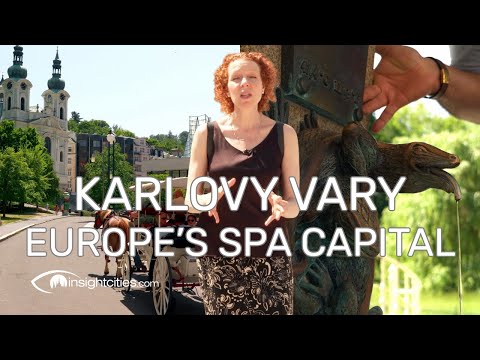
Karlovy Vary occupies a steep river valley in western Czechia, where hot springs shaped both the streets and the local economy. Visitors may know it by its German name, Karlsbad, or by images of colonnades and grand hotels. The place is also a regional city of 48,788 residents at the end of 2025, according to the Czech Statistical Office. Its spa quarter is one part of a wider inhabited city. To understand it, follow the Teplá River, look up at the wooded slopes and ask why public halls, paths and accommodation were built around mineral water. The answer runs from a medieval foundation to a modern tourism and service economy.
A medieval spa, not an ancient Roman town
The city's official history dates its foundation to the fourteenth century under Charles IV, king of Bohemia and Holy Roman emperor. A familiar story says that a hunting party discovered the springs; the municipality presents that as a legend, not a documented founding event. UNESCO's nomination material places the origin around the mid-fourteenth century. In 1370 the settlement gained the status of a town. The evidence does not justify calling Karlovy Vary a Roman, Greek or Celtic foundation. People may have known the landscape earlier, but the city whose spa institutions can be traced in written records took shape in medieval Bohemia.
Water gave the new settlement its purpose. Patients and visitors were drawn to the springs, and their needs produced bathhouses, lodgings and a culture of walking in the hills. The city history records growing attention from noble families and prosperous townspeople by the sixteenth century. Floods, warfare and fires repeatedly interrupted that development: major fires in 1604 and 1759 explain why relatively little of the earliest town survives above ground. Many of the buildings that now define a visitor's view belong instead to the eighteenth and nineteenth centuries. Their age matters, but so does the continuity of use around the springs.
How water organised the city
UNESCO includes Karlovy Vary among the eleven Great Spa Towns of Europe, inscribed in 2021. The designation recognises a transnational spa culture that flourished especially from the eighteenth century to the 1930s. It covers more than attractive façades: colonnades, treatment buildings, hotels, parks and paths form a landscape designed around drinking, bathing, exercise and sociability. Karlovy Vary is one of three Czech members of this group, alongside Františkovy Lázně and Mariánské Lázně. The World Heritage recognition should not be mistaken for a claim that every building or every medical practice dates from the medieval foundation.
The Mill Colonnade makes the nineteenth-century ambition visible. Designed by Josef Zítek and built between 1871 and 1881, it shelters several springs behind a long stone façade. The carved wooden Market Colonnade offers a different architectural language, while the present Hot Spring Colonnade is a twentieth-century building over Vřídlo. The city's guide gives the spring water a temperature of about 73°C and describes the fountain as the symbolic centre of the resort. These structures were practical responses to mineral water as well as places for ceremony and display. On a walk between them, the Teplá is never far away, and the compressed valley explains why promenades run lengthwise rather than forming a broad town square.
Above the hotels, wooded paths are part of the historic spa experience. The Diana lookout can be reached from near Grandhotel Pupp by funicular or by walking uphill; current operation should be checked before relying on the lift. The view helps separate the dense spa corridor from the larger city. A route through the forest also shows that exercise and scenery were intentionally folded into the resort's design. The nineteenth-century visitor did not only sit by a spring. Walks, viewpoints, music and meetings were part of the social world that made international spa towns distinctive.
Changes, industry and cultural life
Rail connection in 1870 opened Karlovy Vary more fully to European travel, and the resort expanded in the late nineteenth and early twentieth centuries. The twentieth century brought war, population rupture and a different political setting. After the Second World War, the German-speaking population of the region was expelled; the city's history notes that the first film festival in 1946 was partly intended to revive tourism in a depleted spa landscape. The Karlovy Vary International Film Festival later became one of the city's major cultural institutions. After 1989, spa businesses, tourism and cultural activity adapted again to an open economy. Those episodes complicate the easy impression of a resort unchanged since imperial times.
The spa is not the only work associated with the city. The official guide points visitors toward Moser glassmaking and the Jan Becher museum, evidence of crafts and branded products linked to Karlovy Vary. Hotels, restaurants, medical and wellness services, shops and public administration also support daily life. For economic context, the Czech Statistical Office estimates that tourism generated 5.1 percent of the Karlovy Vary region's gross value added in 2024, with roughly one in eleven regional workers in tourism. That is a regional measure, not a GDP figure for the municipality; assigning it to the city would be inaccurate. The same care applies to housing prices: no reliable, current city-wide sale or rental figure was established for this guide.
The demographic figures describe the municipality, not the spa quarter. The statistical office recorded 49,073 residents at the start of 2025 and 48,788 at its end, a fall of 285 during that year. One year's movement should not be turned into a simple story of terminal decline, but it reminds us that this is a community with its own pressures beyond visitor numbers. Schools, residential streets and everyday shopping sit outside many standard postcard frames. The town's future depends on those residents as well as on the guests who come for a short stay.
Arriving and spending time well
Karlovy Vary is about 120 kilometres from Prague according to the city's visitor guide; Cheb and the other western Bohemian spa towns are closer regional reference points. Rail and bus services serve the city, but the exact station, departure and onward connection should be checked for the travel date. Drivers should study the current parking and access rules because the central spa zone restricts vehicles. A useful first day follows the Teplá through the main colonnades, then takes a museum or a hillside walk rather than racing through every sight. With more time, compare the spa centre with ordinary neighbourhoods and visit a glassmaking or local-history exhibition. Opening times, treatment availability and funicular operation can change, so confirm them with the venue or operator.
Visitors planning a longer stay can consider Grandhotel Pupp at Mírové náměstí 2, identified by the municipal tourism office as a five-star property near the southern end of the spa promenade. For a meal nearby, Le Marché on Mariánskolázěnská street advertises a changing menu. Their locations and stated facilities are verified, while rooms, dishes, prices and opening arrangements should be checked with the businesses for the intended date.
Karlovy Vary puts a natural resource into an urban form: a spring became a treatment centre, then an international meeting place and a modern regional city. Its value lies in that long sequence, not in a promise that a brief visit will reproduce the life of earlier spa guests. The river, stone and wooden colonnades, woods and working streets together explain why the place remains distinctive.