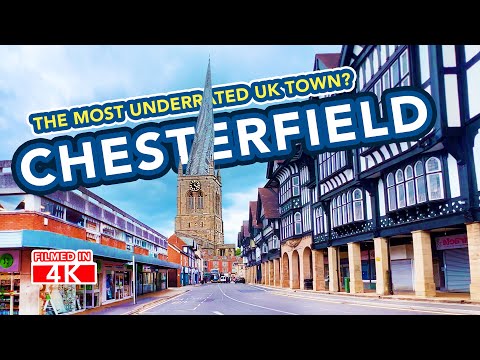
Chesterfield is a substantial Derbyshire market town south of Sheffield and near the eastern edge of the Peak District. The twisted spire of St Mary and All Saints is its familiar symbol, yet the market squares, Victorian hall, railway and surrounding industrial landscape explain just as much of the town. Chesterfield is a year-round service and employment centre, not merely a stop for a photograph of its church.
Population and the area being counted
The Office for National Statistics estimated 76,257 people in Chesterfield's unparished area in mid-2021. “Unparished area” is the statistical unit used in that dataset; the figure should not be presented as the population of the whole borough or the medieval centre alone. Chesterfield lies south of Sheffield, with Derby and Nottingham among other useful regional cities. Road and rail links make it a practical base, while the Peak District and nearby historic houses are excursions outside the town centre.
Roman evidence and the medieval market
Chesterfield Borough Council's historical report describes Roman occupation in the area and archaeological traces of a fort. This is stronger evidence than a vague claim that Romans passed nearby, but it does not prove an uninterrupted Roman street plan survives in the present market. The council's conservation appraisal explains that the visible core owes much to a planned medieval market settlement. Markets are documented by at least 1165. In 1204 King John granted a charter for markets and an annual fair. The arrangement of the market place, old plots and lanes still helps visitors read that phase of growth.
The church of St Mary and All Saints anchors the older centre. Its crooked spire is a real architectural feature, though folk stories about how it twisted should not be confused with a documented construction account. A walk around the church, market squares and connecting streets reveals the scale of a trading centre rather than an isolated village. Archaeology reported by the council in 2026 found medieval and later walls and floors from buildings beside the church. These remains show repeated change in the same central area.
Industry, railway and civic life
Coalfields and engineering transformed the wider town during the industrial period. The council's conservation appraisal says the railway reached Chesterfield in the 1840s and supported factories and workers' housing in the valleys. Much of the centre's eighteenth- and nineteenth-century building stock sits on older medieval routes. The Victorian Market Hall was built in 1857; after refurbishment it continues to host traders and a café. It is a working commercial building rather than a museum prop.
Later changes included electric street lighting in 1901, extensive rebuilding in the 1920s and 1930s, and a new Town Hall in 1938. The market squares also served as spaces for meetings, protest and celebration. An interpretation of Chesterfield that stops at the spire misses the relationship between market exchange, industry and civic gatherings. Today's town centre regeneration again changes the public spaces, so access and works around a particular square can vary.
What to see in town and nearby
Start at the Crooked Spire and move through the market squares to the Market Hall. Check church visiting and tower tour arrangements directly; worship and events may affect access. The council's museum and theatre redevelopment at the former Stephenson Memorial Hall was still described as forthcoming in 2026, so do not assume the museum galleries are open without confirming the latest status. The 2026 excavations near the church add a fresh archaeological perspective even when there is no permanent display to see.
Revolution House in Old Whittington relates to the 1688 plot against James II, but the council currently marks the cottage as temporarily closed to the public. It is a nearby historical story, not an open interior to promise visitors. Farther afield, the Chesterfield Canal, Barrow Hill Roundhouse, Hardwick Hall, Chatsworth and the Peak District offer different days out. They require separate travel and, for rural routes, weather planning. A two-night stay can combine the town centre with one substantial excursion without rushing.
Rail, road and daily connections
Chesterfield has its own railway station. CrossCountry lists trains towards Sheffield and Nottingham, and the station also has longer-distance services through the national network. Verify the chosen operator and timetable, especially around engineering work. The town's position near the M1 gives drivers access from Sheffield, Derby and other Midlands centres. Local roads then lead west towards Peak District destinations, where travel times may be slower than a map suggests.
For residents, rail, shopping, schools, employment and healthcare are more relevant than a single visitor itinerary. The old industrial economy has diversified, but the precise mix of work varies across the borough and nearby cities. A commute to Sheffield or Nottingham should be timed door to door. The sources reviewed here did not provide a current, like-for-like average rent for Chesterfield's unparished area, so housing cost claims should be based on current listings for the actual neighbourhood.
Hotels and food
Visitors can stay in Chesterfield. Destination Chesterfield lists Casa Hotel and its Cocina Restaurant, as well as central accommodation including a Premier Inn. The Market Hall café offers a lighter stop while exploring the centre, and the town has independent restaurants. These examples establish real options, not a ranking of the best places to eat. Menus, room rates and opening times change and should be checked directly. A town-centre hotel suits a rail trip; accommodation nearer the M1 or countryside may suit a car-based Peak District visit.
Sources
- ONS: mid-2021 population estimates and unparished area
- Chesterfield Borough Council: historical town-centre report
- Chesterfield Borough Council: conservation appraisal
- Chesterfield Borough Council: market history
- Chesterfield Borough Council: Market Hall
- Chesterfield Borough Council: 2026 archaeology
- Chesterfield Borough Council: museum status
- Chesterfield Borough Council: Revolution House
- CrossCountry: Chesterfield railway station
- Destination Chesterfield: accommodation and restaurants