Bougon is a very small commune in the Deux-Sèvres, but its story is easier to read as a connected landscape than as a single monument. INSEE counted 169 municipal residents across the whole commune in its 2023 reference population; six people were counted separately, making the total population 175. The same census-based comparison gives 14.4 residents per square kilometre and an average annual population change of -0.8% from 2017 to 2023. Those figures describe the administrative commune, not just the central village or the visitors to the museum. Around that modest population are a parish church, an old-fruit preservation orchard, the Mare des Antes, a cheese-making tradition and the archaeological complex that has made Bougon known beyond the district.
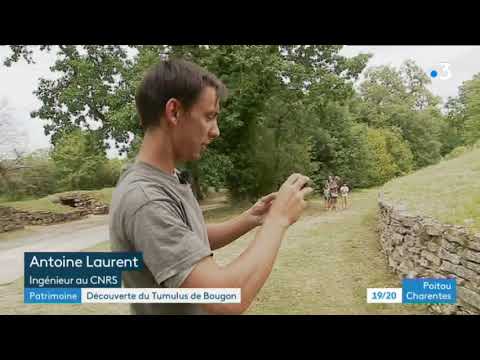
The tumuli are not one undifferentiated “prehistoric hill.” The museum dates their construction to the fifth millennium BCE and says some structures were reused in the fourth millennium. It identifies differing forms and sequences; for example, its account describes Tumulus A as a 40-metre-wide hemispherical mound with a capstone estimated at 90 tonnes. The Culture Ministry’s heritage register separately lists a protected group of six tumuli, classified in 1960. It is better to keep these specific records in view than flatten the site into a single date or count. The museum says researchers do not know with certainty how the dolmens were built: its reconstructions illustrate current hypotheses, not settled fact. This account does not replace that open archaeological question with a legend unsupported by the local sources consulted.
There is a documented village chronology too. The parish of Saint-Pierre appears in a tenth-century charter of the Abbey of Saint-Maixent. The regional heritage inventory says the church’s west front and bell-tower base may date to the twelfth century, marking that dating as probable rather than certain. It records changes to the choir in 1610 and substantial repairs in the mid-nineteenth century; parts of the church received heritage protection in 1929 and 1933. At La Chapelle, the modern museum wraps around evidence of a Cistercian priory: the chapel of Notre-Dame de Vaugénérault, a fourteenth-century farm tenant’s house and a seventeenth-century barn. After fifteen years of archaeological work directed by Claude Burnez and Jean-Pierre Mohen, the Department decided in 1991 to create a museum; Jean-François Milou’s metal-and-glass building opened in June 1993. The place therefore layers a written medieval parish record, later religious and farming buildings, and modern archaeological interpretation without pretending they belong to the same age.
Bougon’s local economy also has a named, verifiable strand. Goat breeders around the village formed the Bougon dairy in 1906; its signature cheese, Le Bougon, was sold in a little box lined with wood shavings. After a period of closure and renovation, Poitou Chèvre says it took over the dairy in 2016 and now makes regional goat cheeses including Chabichou and Mothais-sur-feuille. The local tourism office confirms that the dairy remains part of the village walk but says there is no on-site retail sale, so look for its products through listed local shops rather than arriving expecting a shop tour. Near the centre, the preservation orchard maintains old fruit varieties, while the Mare des Antes offers a waterside green space. The listed gîte Les Dolmens gives walkers and groups a village overnight option; check availability directly.
For a first visit, the museum’s six galleries set the Neolithic monuments in a wider prehistory, with local ceramics, flint tools, ornaments and other excavated material. Outside, the discovery route adds a botanical garden, a stone maze and learning stations; the full museum loop is a little over one kilometre. The local 13.1-kilometre “Autour des Tumulus” walk is a separate, easy loop published at about 3 hours 15 minutes and 112 metres of ascent. It starts in Bougon and links the museum with the village mill, Saint-Pierre church, the protected Dolmen des Sept Chemins and the dairy. For cycling, the Véloroute 94 passes about 150 metres from the museum and links into longer regional routes; confirm the current map and conditions. Museum access is seasonal: on 23 October 2026 its schedule listed the public season through 1 November, with a winter closure after that, so check the live opening page before travelling. The site offers multilingual audio guides, accessible facilities, cycle parking and a picnic area; its café is seasonal. Bring sun protection for the partly shaded outdoor route and duck under the low stone entrances. Current hours, trail details, accommodation and transport should all be checked before departure.