Above the Neckar valley, Bösingen is a small rural municipality whose two districts, Bösingen and Herrenzimmern, share a high plateau and a history that reaches back more than a millennium in written records. The municipality counted 3,396 residents on 30 June 2025, according to the State Statistical Office of Baden-Württemberg. That figure covers both districts and the full municipal area, not just the central village. At 22.45 square kilometres, the territory extends across the Oberndorfer Gäuplatten, west of the Neckar and around seven kilometres north of Rottweil.
A plateau shaped by water and stone
The landscape rewards a slower visit. Gentle farmland and settlements occupy the upland, while the ground breaks into narrower valleys toward the Neckar. LEO-BW places the municipality's lowest point near 530 metres in the Schlossbrunnental and its high ground near 720 metres at Herrenbühl. Water disappearing into the region's soluble limestone and gypsum formations re-emerges at springs and feeds the Bendel and Schlossbach, which drain east toward the Neckar. These changes in elevation give a village walk a clear sense of place: open fields on the plateau, then wooded slopes and ravines near Herrenzimmern.
What the documents say—and what they do not
Bösingen is recorded as “Bosinga” in 994, when a charter of Otto III confirmed a gift to Petershausen Abbey of an estate at Epfendorf with associated property that included Bösingen. Herrenzimmern is also linked to a 994 record under the name “Ancencimbra.” The entries are early medieval evidence, not proof of Roman or prehistoric origins. A later origin story in the Zimmern Chronicle connects the Lords of Zimmern to the Cimbri, a people defeated at Vercellae in 101 BCE. The local historical association itself calls this tale unsupported and improbable; it belongs to the history of how a family imagined its ancestry, not to established local fact.
Herrenzimmern's castle is a more tangible historical landmark, although its beginnings remain uncertain. A supposed reference to 1079 comes through the Zimmern Chronicle and cannot by itself establish that the present ruin already stood on this exact site. Ownership by the Lords of Zimmern is documented by 1488. After a fire in 1504, the castle was rebuilt by 1513; the family sold it to the Imperial City of Rottweil in 1595. The municipality acquired the ruined complex in 1810. Today, parts of the upper castle and the lower castle chapel remain above the Schlossbach valley.
A visit built around local life
The ruin is the strongest reason to cross from the Bösingen district to Herrenzimmern. The municipality owns the site, while the Geschichts- und Kulturverein Herrenzimmern maintains it and runs the Burgstüble beside the walls. Visitors can approach from parking areas on the K5522 or by the cemetery in Herrenzimmern; both routes follow gravel forest tracks, and the cemetery approach is partly steep. Inside the ruin, the upper section is reached by stairs, so this is not a step-free visit. Seasonal refreshments usually take place on selected dates from May to October, with the calendar changing each year.
Back in Bösingen, the Bauernmuseum in the former Pfarrscheuer offers another angle on the community: tools, work and domestic life tied to a farming landscape. The local event calendar publishes its opening dates rather than a dependable daily schedule, so check before making the trip. Clubs remain part of the village's public life; local listings include a gliding field between Bösingen and Dunningen, where flying takes place in suitable weather. These are modest, locally run experiences rather than a purpose-built resort, and that is part of the place's appeal.
A changing countryside and practical routes
A contemporary layer is appearing in the hills around Herrenzimmern. In a municipal update from late September 2026, cable installation and foundations for three wind turbines were reported complete; tower construction was expected to begin in November, with commissioning then forecast for April or May 2027. The project is still under construction, and the dates are the municipality's current schedule. It sits alongside the area's continuing agricultural use and may affect particular tracks during works.
Rottweil is the natural nearby city for rail connections, museums and a longer town visit. From Rottweil station, MOVE demand-responsive line 9020 serves Villingendorf, Herrenzimmern and Bösingen. Trips marked Anrufbus require advance booking—at least one hour on the published timetable—and do not all run on the same days. By car, K5522 links the municipality to Rottweil. Check the live schedule, reservation rules, museum dates and castle access before travelling.
 Bösingen, its castle and local traditions
 Franz Aebischer’s aerial footage looks across Bösingen from above and helps orient the village within its surrounding fields; the description also notes a view toward Laupen. The DJI Phantom 2 film dates from 2014, so treat it as a record of the landscape at that time rather than a current survey. It complements the guide’s explanation of the upland setting.
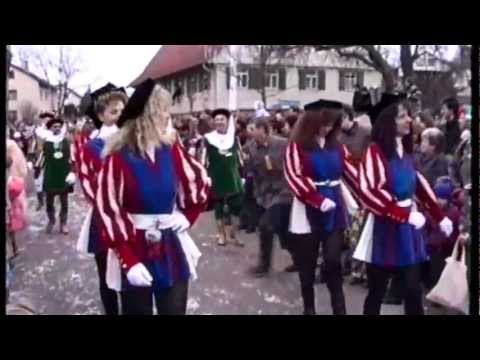 Elvirahh62’s upload preserves an older Narrentreffen recording from an 8 mm tape, with little editing. It offers an archival glimpse of a local carnival gathering and adds a community-tradition angle to the guide. The video was uploaded in 2011, but the recording’s event date is not firmly established here; it should not be used as a current calendar or schedule.