Diessenhofen stands on the Swiss bank of the High Rhine, between Stein am Rhein and Schaffhausen, with Germany directly across the water. Its scale is small, but its position explains much of its character: the town grew at a river crossing, and the covered bridge still makes the border feel like part of an everyday walk. The historic centre keeps its medieval street pattern, while the riverfront gives the visit an open edge and a view across to Gailingen.
A town shaped by bridge, wall and river trade
Diessenhofen has held town rights since 1178. The municipality identifies the old town as the largest medieval centre in the Canton of Thurgau and notes that its streets preserve details from the Kyburg period. A bridge crossing is documented by 1292; the present covered bridge was built between 1814 and 1816 after retreating Russian troops burned its predecessor in 1799. The Siegelturm, built in 1545, guarded the eastern entrance and once stored documents and the town seal. Its clock still uses a weight-driven striking mechanism that is wound by hand each day. These are not isolated monuments: together they show how the Rhine crossing served movement, defence and civic administration.
More than an outdoor walk
The Stadtkirche has an unusually early documentary history: a priest’s gift to St Gallen Abbey in 757 is the first recorded church in Thurgau, and excavations have uncovered early foundations. For a contemporary indoor stop, Museum kunst + wissen occupies the 16th-century Oberes Amtshaus beside the river. Its exhibitions bring together art, nature, regional history and traces of the building’s former textile-dyeing and printing trades. The municipality also offers guided walks, generally lasting 75 to 90 minutes depending on the theme and group. Shops, cafés, places to eat, a harbour and public bathing areas make it possible to combine heritage with a longer riverside stay.
Arriving from Schaffhausen or by boat
The municipality recorded 4,244 residents on 1 December 2025. Diessenhofen station is about a seven-minute walk from the old town and lies on Thurbo’s S1, linking the area with Schaffhausen, Stein am Rhein and St Gallen. Passenger boats also serve the Diessenhofen–Gailingen landing several times a day, according to the local visitor information. A useful visit pairs the bridge and old town with the river promenade; those with more time can add a museum visit or a guided route. Train and boat timetables, museum hours and public tour dates change, so check the current information before travelling.
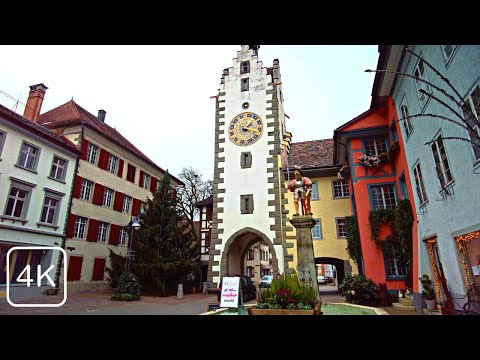 Diessenhofen on foot and across the Rhine
 Pribumi Bandung’s short film is titled as an introduction to Diessenhofen as a small Swiss town. It offers a broad visual impression to pair with the more deliberate winter walk, though the title does not establish a complete route or identify every building shown. Viewers interested in the historic core can use it as a first orientation and then consult the town’s documented descriptions of the covered bridge, towers and riverside sights.
 Simple moments focuses on the Rhine bridge between Gailingen in Germany and Diessenhofen in Switzerland. This is the most specific of the three films: the crossing itself explains why the river has long shaped movement between the two communities. The clip is a visual record, not border-crossing guidance or a live transport notice. Check the town’s arrival page for current rail and boat links and confirm any crossing or access conditions before setting out.