a medieval abbey village and experimental archaeology near Beloeil
Aubechies belongs to Beloeil municipality in Belgian Hainaut, within Wallonie picarde. A Romanesque church, brick farmhouses and grassy spaces form a loosely built village. Beside it, the Archéosite reconstructs prehistoric and ancient buildings to explain past ways of life. The two experiences complement each other when the village’s historic remains are distinguished from modern archaeological reconstructions.
| Municipality | Beloeil |
|---|---|
| Municipal registered population at 1 January 2026 | 14,338 |
National Register figure for the whole municipality, including its other settlements. It is not a count of the historic village alone.
Early occupation and a medieval abbey
Archaeological research identifies prehistoric and Gallo-Roman occupation in the area. The nearby ancient Bavay–Tongeren route provides context, without supplying an exact foundation year for the present settlement.
A precise medieval milestone is the foundation of the Trinity and Saint-Géry Abbey in 1077 by Gérard II, Bishop of Cambrai. Its independence ended with attachment to Saint-Ghislain in 1119. The planned monastic development did not produce a large completed abbey complex.
That history survives around the square. It is separate from the reconstructed Gaulish houses at the Archéosite, whose first buildings were erected in the 1980s.
Church and former abbey farmhouse
Saint-Géry retains a Romanesque character in Grandglise sandstone, contrasting with the village’s brick houses. Reused ancient materials and a hexagonal basin in the crypt reveal an older site. Early twentieth-century restoration also contributes to its appearance.
Its walls preserve clues to an unfinished expansion. Enquire about interior access through the tourism office; an old visitor sheet or exterior photograph does not establish permanent opening.
The former abbey farmhouse dwelling was rebuilt in 1778. Later used as school and municipal premises, it acquired another role as group accommodation. Successive uses connect medieval religious history with the village’s more recent social life.
Farm buildings and rural industry
Gentle terrain supports fields, orchards and pasture. Buildings form groups separated by greenery rather than continuous urban frontages. Brick and tile predominate, with stone used for bases and details.
Former farms combined homes, barns and animal accommodation, sometimes around a court. Masonry joints reveal extensions, while steep roofs recall earlier thatched coverings.
The Rue du Croquet mill was already known in the thirteenth century. Steam power was added in 1859 and electricity in 1923, supplementing its original water power. View the surviving ensemble with respect for its present property boundaries.
Reconstructing the ancient world
The open-air Archéosite draws on regional archaeological discoveries. Its first major buildings date from 1983–1984. Neolithic, Bronze Age and Iron Age houses lead to a Gallo-Roman ensemble.
The temple was built in 1996 and the villa in 1998, followed by the necropolis and colonnaded gallery. Their roofs and columns are modern interpretations, not intact ancient structures surviving on the spot.
Understanding this makes the visit more rewarding: materials, construction techniques and building volumes can be studied alongside the evidence behind them. Photo captions likewise distinguish reconstructions from historic fabric.
A museum of beliefs
Opened in 2013, Espace Léonce Demarez complements the outdoor reconstructions with a museum about ancient cults and beliefs in northern Gaul, from Celtic sanctuaries to Gallo-Roman temples.
Objects from the Blicquy religious complex in Leuze-en-Hainaut include votive material, coins and sculpture. The Blicquy mask is a notable exhibit. Its discovery location should be distinguished from its present display in Aubechies.
The collection adds archaeological context to a visit that might otherwise focus only on reconstructed houses and their visual appeal.
Planning an actual museum day
Craft demonstrations take place mainly on Sunday afternoons from April to October. Volunteer participation means that every craft cannot be guaranteed each time. Group demonstrations can be arranged by reservation.
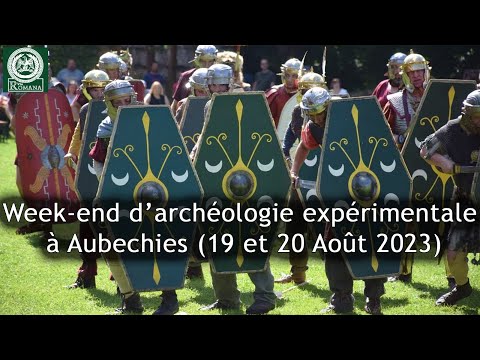
Trails, handling stations and video material provide other ways to explore. Occasional guided tours follow the operator’s conditions. Footage from an experimental archaeology weekend does not necessarily show an ordinary opening day.
The published 2026 calendar lists Saturday closure and an annual closure from 19 December 2026 through 3 January 2027. Check seasonal hours before travelling. Gravel paths may require assistance for visitors with reduced mobility.
Staying and eating in Aubechies
The municipal Gîte Ajiste, known as the Prieuré, offers group accommodation in the centre. Beloeil’s brochure describes its arrangements; it is a group property rather than a conventional hotel.
Taverne Saint-Géry on the village square occupies a former family farm. Sophie, Christophe and their daughters highlight regional produce and a wide Belgian beer selection. Its central position allows a village walk and meal without moving to another locality.
Confirm current service days and menu with the establishment. This is the Aubechies address in Beloeil, rather than a similarly named restaurant in France.
Beloeil and cross-border approaches
Beloeil Castle lies outside the village, approximately five kilometres away. The residence of the Princes of Ligne adds collections and gardens to a wider outing, with opening arrangements separate from the Archéosite.
Tournai and Mons are regional urban gateways, while Lille in France is also a relevant major-city approach. From Brussels, the E429 reaches the Ath area before the final local roads.
The Archéosite identifies Leuze station about six kilometres away and Ath about eleven kilometres away. It states that the museum is not served by a bus. Arrange a transfer or bicycle for the last section; buses to central Beloeil do not establish a museum connection.
For a longer stay or a possible move, assess access to shops, services and employment from the specific address. The table’s figures cover Beloeil municipality as a whole, not Aubechies alone.
Sources
- Parcours patrimonial : occupation ancienne, abbaye, fermes et moulin
- Archéosite : reconstitutions et dates de construction modernes
- Musée : cultes antiques et découvertes de Blicquy
- Visite, ateliers et caractère saisonnier des démonstrations
- Accès, gares proches et accessibilité
- Attractions & Tourisme : calendrier 2026 et fermeture annuelle
- Commune de Beloeil : gîte Ajiste dit du Prieuré
- Taverne Saint-Géry : table villageoise et produits locaux
- Château de Beloeil, hors d’Aubechies : conditions de visite
- Office de tourisme : accès à la commune et informations locales
- Belgian National Register: municipal figures, 1 January 2026