Tourcoing is a substantial city in the Lille metropolitan area, with 98,772 residents in the commune in 2023, according to France’s national statistics office. Its appeal lies in the way an industrial past remains visible while old factories, civic buildings and cultural venues continue to serve everyday urban life. A visit can move from a historic central street to a former hospice garden, then outward to a district where image-making and textile innovation share space.
A city shaped by textile work
Tourcoing’s municipal history describes a town whose growth became closely tied to textile manufacturing. Along rue de Tournai, one of the older routes through the centre, the Hospice d’Havré, Saint-Christophe church and the Grand Place mark successive layers of civic and religious life. By the early twentieth century, the city had acquired buildings that expressed industrial prosperity, including its town hall, railway station and chamber of commerce. The story is not a simple rise-and-fall narrative: local records also describe how industrial buildings later found cultural, residential and business uses.
From hospice courtyard to museum rooms
The Hospice d’Havré gives the centre a quieter scale. The city traces the site’s history to 1260; after municipal acquisition in 1998, it was restored in 2003–04 and adapted as a Maison Folie cultural venue. Its garden, inspired by Renaissance layouts, is arranged along perpendicular paths, with water basins and an old calvary among the features. Nearby, the MUba Eugène Leroy presents fine art and temporary exhibitions, while the Centre d’Histoire Locale interprets Tourcoing’s industrial, social and architectural past. Check opening days before planning a museum visit, since gardens and indoor venues have different schedules.
Work continues in new forms
The city’s present economy is broader than its former mills. Insee counted 2,133 employer establishments in late 2024; commerce, transport and other services accounted for 66.4 percent of them, while industry represented 6.5 percent. Tourcoing also promotes the Imaginarium, in a rehabilitated former spinning mill, as a home for companies and projects in image, sound and immersive technologies. The Union district links this creative activity with textile innovation, housing and public space. These changes are best understood on foot: the landscape still carries the proportions and materials of factory-era Tourcoing, even where the work inside has changed.
A practical route from Lille
From Lille, the Lille–Tourcoing tram starts at Gare Lille Flandres and ends near Tourcoing Centre; metro line 2 also connects the cities and continues through Roubaix. These routes make it possible to build a compact itinerary around the centre, then take local transit toward the Union district. Start near the Grand Place, walk along rue de Tournai to the hospice garden, and allow extra time for a museum or exhibition. Tourcoing has the shops, cafés and public services of a large metropolitan city, while visitor information and cultural programming help plan a longer stay. Confirm current tram, metro and venue schedules before departure.
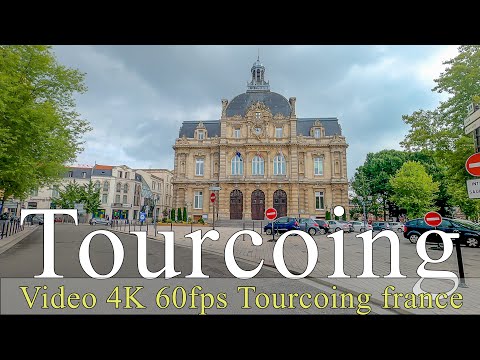 Tourcoing in three films: streets, hospice and textile innovation
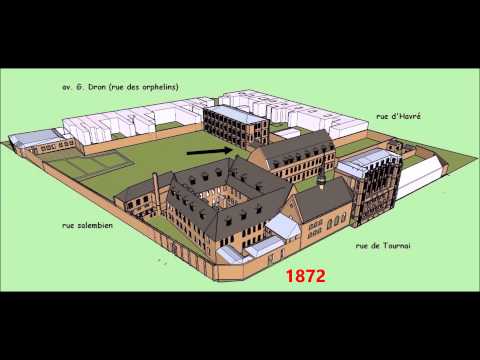 The first chapter of a history of the Hospice d’Havré focuses on the site itself. Its subject is a specific institution rather than the whole city, making it a useful complement to a walk through the centre and the hospice garden. The video is an older historical feature; check the venue’s current visitor information separately.
 BFM Grand Lille reports on the opening of the European Centre for Innovative Textiles in Tourcoing. The film connects the city’s textile tradition with research and newer materials, but records the centre at an earlier moment. It offers industrial context, not current opening details or a guarantee of public access.