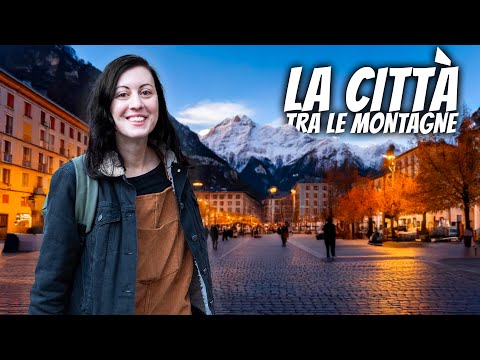
Aosta is the regional capital in a high Alpine valley, but its historic centre follows a Roman grid. The city was founded as Augusta Praetoria in 25 BCE after Rome's campaign against the Salassi. That clear date applies to the colony, not to the beginning of human occupation in the valley. Roman gates, a theatre and the forum's cryptoporticus stand near medieval churches, while mountain transport and regional services shape the modern town.
Population and Alpine position
ISTAT counted 33,096 residents in the comune of Aosta on 1 January 2025. This municipal figure is separate from the population of the entire autonomous region. Aosta lies where the Dora Baltea and Buthier waterways meet, between Alpine routes leading towards France and Switzerland. Turin is the main larger Italian city to the southeast; Milan and Geneva are further major approaches, depending on the journey. The mountains are close, yet the centre itself is a place of shops, offices, schools and ordinary neighbourhoods as well as monuments.
Before Rome and the foundation of Augusta Praetoria
The Salassi lived in the region before Roman conquest. Valle d'Aosta's cultural authority describes the 25 BCE foundation of Augusta Praetoria after the military campaign and the arrival of veterans. The colony's orthogonal streets were laid out between the mountain slope, the Buthier and the Dora Baltea. This was a strategic urban foundation at the approaches to Alpine passes, not a generic “Roman village”. The earlier population and landscape must remain part of the story, even though the Roman grid is the most visible ancient layer.
The town plan placed the forum at the crossing of its main axes. The regional archaeology office explains that a terraced arrangement created an upper sacred area with temples and a cryptoporticus and a lower space for civic and commercial functions. The Porta Praetoria, Arch of Augustus, walls and Roman theatre offer other stops. The theatre's surviving façade is especially striking; the amphitheatre occupied the same northeastern district. Rather than rushing between isolated monuments, walking the street axes helps show how the colony worked as a whole.
Christian and medieval Aosta
After antiquity, the city did not cease to exist. Its cathedral and the collegiate church of Sant'Orso became major centres of Christian art and worship. The regional visitor authority highlights eleventh-century wall paintings associated with both. The buildings have undergone later changes, so a visitor encounters a long sequence of construction, not a frozen Roman town with two medieval additions. The Roman remains below the streets and the medieval church complexes make Aosta unusually good for comparing how the same urban space was reused.
The Regional Archaeological Museum offers a structured introduction before visiting the open-air sites. The regional ticket information groups the Roman theatre, forum cryptoporticus, early Christian church of San Lorenzo, museum and megalithic area in a combined admission. Check current access, conservation works and opening times for each component. A full day devoted to archaeology and churches is more realistic than fitting every site into a brief transit stop.
Mountain activities and nearby journeys
A cable car links Aosta with the Pila area above the city. The regional transport authority lists the Aosta–Les Fleurs–Plan Praz–Pila route, while operating periods and hours depend on season and maintenance. In summer, walking and cycling options differ from winter skiing. This is a mountain excursion with changing weather, not an extension of the Roman city walk in ordinary shoes. Castles along the valley and the routes towards the Gran Paradiso area offer other separate days out.
The city itself supports a slower visit: markets, cafés and an evening meal between the main archaeological sites. The valley's bilingual Italian and French character is visible in regional institutions and signs. It is part of contemporary life, not merely an antiquarian detail. Cultural events and mountain tourism bring visitors, but regional administration and daily services also sustain the economy.
Getting to Aosta in late 2026
Travel information needs particular care at present. The regional transport authority says the Ivrea–Aosta railway has been closed since January 2024 for electrification, with replacement buses, and reports a transition toward renewed train service around the end of 2026 or early 2027. A traveller in November 2026 must not assume an uninterrupted train from Turin. Check the current combined rail-and-bus journey via Ivrea or Chivasso and any direct coach option. The authority also describes bus links towards Turin and Milan. Road access follows the valley motorway and connects with Alpine routes, but weather and tunnel conditions matter on longer cross-border trips.
For a prospective resident, the capital's services and jobs are more substantial than those of a small mountain resort. At the same time, housing decisions depend on neighbourhood, winter conditions and an actual commute. The sources reviewed do not provide a reliable current municipal average rent, so no precise amount is asserted.
Accommodation and food
Aosta has hotels and restaurants in the city. The regional tourism office lists Hotel Duca d'Aosta near the historic centre and identifies a restaurant open to non-guests; it also lists the HB Aosta Hotel. Its restaurant directory describes Aldente in the old centre. These are verifiable examples, not a ranking of “best” establishments. Bookings should reflect seasonal demand, access requirements and the actual day of operation. Staying in town supports an evening walk among the monuments; accommodation closer to a specific ski or hiking destination may be better for an early mountain start.
Sources
- ISTAT: municipal resident population, 1 January 2025
- Valle d'Aosta Region: Augusta Praetoria and its plan
- Valle d'Aosta Region: Roman forum
- Valle d'Aosta Region: Roman theatre
- Valle d'Aosta Region: archaeological museum collections
- Valle d'Aosta Region: archaeological site admission
- Valle d'Aosta transport authority: rail electrification and replacement
- Valle d'Aosta transport authority: 2026 rail update
- Valle d'Aosta tourism office: town map and hotels
- Valle d'Aosta tourism office: Duca d'Aosta hotel
- Valle d'Aosta tourism office: city restaurants