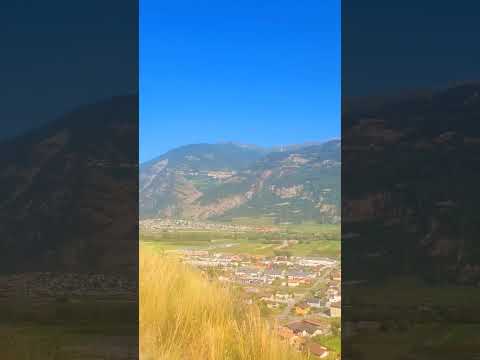
Saillon rises above the Rhône plain in the Swiss canton of Valais, where a medieval hilltop bourg sits beside newer neighbourhoods, vineyards and thermal facilities. The commune counted 3,226 residents on 31 December 2025. Agriculture remains visible in the landscape: the wider municipal territory includes about 200 hectares of vines and is known for white asparagus as well as wine. Saillon’s appeal comes from this close meeting of working countryside, fortified streets, a warm-water destination and a dramatic gorge—not from a single monument alone.
Walls, gates and the Tour Bayart
The tourist office describes the walled bourg as built around the year 1000, while the landmark Tour Bayart has a more precise date: it was built in 1260 and rises 19 metres above the settlement. The four gates and perimeter walls define a small network of lanes, courtyards and historic buildings. The old school, the Maison du marbre and the church of Sainte-Catherine give the walk texture beyond the tower; the church includes Saillon marble altars, and a medieval-inspired garden presents plants used in the period. Guided visits cover the bourg, garden, marble and local history. The medieval setting also hosts stories of Guigone and Anselme, which belong to local legend and festival culture rather than documented biography.
Farinet: a real person and a local legend
Joseph-Samuel Farinet was a nineteenth-century counterfeiter who became part of Saillon’s public identity. The town’s money museum examines genuine and counterfeit currency and presents Farinet’s story, including the contrast between the historical fugitive and the generous folk hero imagined in later retellings. The suspension footbridge named for him opened in 2001 across the Salentse gorge; it is 92 metres long and 136 metres above the gorge. A marked loop from the village is listed at 7.9 kilometres, about two and a half hours and 440 metres of ascent. Views extend across the Rhône plain and vineyards. This route is exposed and moderately demanding, so check weather and access notices.
Thermal baths, wine and getting there
Saillon’s thermal complex has used local warm waters since 1983, adding pools and wellness services to a destination otherwise centred on heritage and walking. The marble quarry west of the village was worked industrially for more than a century until the mid-1970s; visits and the Maison du marbre offer context when available. For the medieval centre, take PostBus route 311 from Sion, Martigny or Riddes station to Saillon Collombeyres, then walk roughly 10–15 minutes uphill. The Farinet bridge trail can also be approached by bus 311 toward Leytron and route 312 toward Ovronnaz, followed by a short level walk from Les Places bifurcation. Verify connections, museum hours, thermal opening times and trail conditions. Cafés, restaurants, a wine cellar and visitor services make it easy to turn a short stop into a fuller day.
 Saillon in three views: Tour Bayart, the medieval lanes and Farinet bridge
 Suisujin’s 4K walk connects the medieval town with the surrounding vineyard landscape in its title and subject. That wider view is useful because Saillon is both a historic settlement and an agricultural community, known for vines and asparagus. Treat the creator’s framing as a travel impression, not a historical source, and check the marked trail conditions and local business hours separately.
 Olivier Staiger’s film focuses specifically on the Farinet footbridge in Valais. The bridge is a distinct excursion from the old town and spans the Salentse gorge; the tourism office gives its length, height and walking route. A recorded crossing is not a live safety or access update, so check weather, closures and the current route information before setting out.