Rossinière lies in the Pays-d’Enhaut, where the Sarine valley opens between forested slopes and high pastures. The municipality counted 504 permanent residents on 31 December 2025 and covers about 22 square kilometres; roughly half its territory is forest. Its small scale should not obscure a layered economy: alpine farming and cheese production shaped the village, while tourism, local crafts, services and cultural activity sustain it today. Timber houses cluster near the station and the river, with hamlets at La Tine and La Chaudanne extending the municipality along the valley.
A documented settlement and a remarkable house
Rossinière is first mentioned in writing in 1115 and belonged to the County of Gruyère before passing under Bernese rule. The built landscape records later changes: the Hôtel de Ville dates to the seventeenth century, and the village was struck by fires in 1600, 1776 and 1855. After the last fire, stone houses replaced some destroyed chalets, while many timber buildings from the seventeenth and eighteenth centuries survived. The Grand Chalet was built between 1752 and 1756 for Jean David Henchoz. Its large cellars were designed to store hundreds of cheeses from local farms, linking its extraordinary size to the valley’s dairy trade rather than to aristocratic display. It became an inn in 1852 and was bought by the painter Balthus in 1976; he settled in Rossinière the following year and lived there until 2001.
Woodcraft, living culture and visitor access
The Grand Chalet is privately owned, so visitors can admire its carved and inscribed façade from the public road but cannot enter. Public cultural places connected with Balthus include the Chapelle Balthus and the Atelier, managed by the local association; check opening arrangements before visiting. The municipality’s architectural route also draws attention to the Maison de la Place, the Hôtel de Ville and traditional homes whose timber frames, broad roofs and decorated façades reveal skilled regional building. Agriculture remains visible in the alpine pastures, and local artisans and businesses work in construction, wood, repairs, food and services. The village bakery-grocery and Hôtel de Ville restaurant provide practical stops; seasonal exhibitions, markets and cultural events add reasons to stay longer.
Arriving by rail and walking the valley
Rossinière is served by the MOB railway through the Pays-d’Enhaut. From Montreux, the scenic rail route reaches the village via Montbovon; Château-d’Oex is the next nearby centre along the valley. Check the MOB timetable and service notices, since works can shift stops or substitute buses. From the station, the village and Grand Chalet are reached on foot. A longer walk follows the Sarine and local paths toward Lake Vernex or the surrounding alpine pastures. Switzerland Tourism lists the Grand Tour des Vanils from Rossinière to Allières as a 13-kilometre, 4½-hour hike with 820 metres of ascent; it is a mountain outing, not a casual village stroll, and conditions should be checked. Rossinière works well as a half-day heritage stop or as a base for exploring neighbouring Château-d’Oex and Rougemont.
 Rossinière in three films: the Grand Chalet, village walks and local traditions
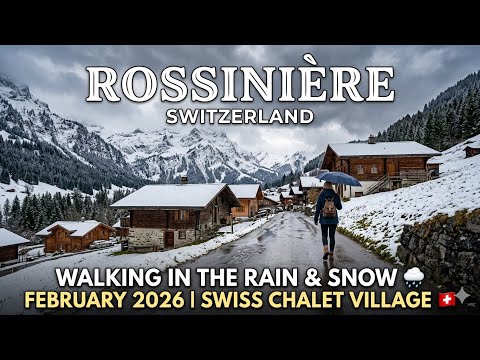 Urban Walking 4K sets its walk through Rossinière in rain and snow, showing the village under different weather rather than presenting a polished summer-only postcard. That seasonal atmosphere can help a viewer imagine how the timber streets feel, but a recorded walk cannot report current road, trail or rail conditions. Check local notices and the MOB timetable before travelling.
 Ô!delà Films presents a wider Pays-d’Enhaut frame that includes Rossinière, Château-d’Oex and Rougemont, with tradition and craft in the title. It is useful for seeing the village as part of a connected regional landscape rather than an isolated chalet attraction. For the exact opening arrangements of Balthus-related sites and current local services, consult the municipality and destination office.