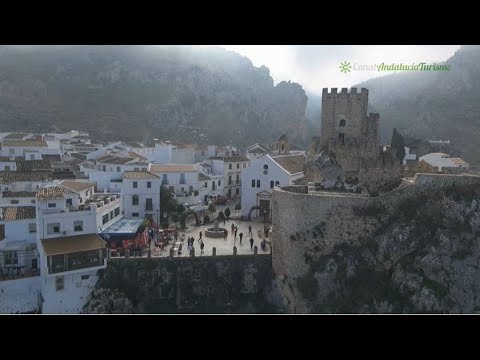
Zuheros sits in the southeastern part of Córdoba province, where whitewashed houses meet the limestone of the Sierras Subbéticas. Its castle rises above the village, while the rocky landscape leads towards the Bat Cave and the Bailón river canyon. The place is more than one viewpoint: a visit brings together prehistoric archaeology, Islamic-period history, rural streets and a protected natural landscape beginning almost at the edge of town.
Before the medieval village: the cave
The Cueva de los Murciélagos, or Bat Cave, is about four kilometres from the village on the hill of the same name. Andalusia's tourism authority describes it as an important Neolithic site and notes Upper Palaeolithic art there. Zuheros Archaeological Museum displays finds from the cave and the wider municipality, including decorated Neolithic pottery, ornaments, stone and bone tools, and material from the Copper and Bronze Ages. Roman-period objects include a sculpture of a figure in a toga and a carved stone sarcophagus. Such finds document ancient occupation of the area, but do not establish that Romans or Greeks founded the village visitors see today.
Guided visits cover only part of the underground system. The tour involves many steps, and the air inside can feel markedly cooler than outside. Regional visitor information recommends a reservation because group sizes are limited, together with suitable shoes and a warm layer. A nearby ecomuseum explains the karst landscape, the bats and the significance of the archaeological remains. The cave is fragile heritage: follow the guide and leave its formations and paintings untouched.
The castle and mountain village
The present village centre has roots in the Islamic period. The regional tourism account identifies the rocky castle as its defining landmark and connects the later lordship to the House of Aguilar and the Fernández de Córdoba family. The fortification follows a natural outcrop, giving it an irregular silhouette. Life subsequently spread into the lanes and around religious buildings. A historical text hosted by the town council says the lords left the castle after the war of Granada and built a palace house on the slope. That narrative does not justify assigning an exact construction date to every surviving wall without archaeological evidence.
Begin a walk near the castle and Archaeological Museum, then follow the narrow streets of white houses and flowerpots to the viewpoints. The settlement is small, but slopes reward a slower pace. Limestone, white façades and olive groves form the characteristic view. According to Andalusia's tourism administration, the entire municipal territory lies within the Sierras Subbéticas Natural Park. The connection between village and countryside is therefore more than scenery: it shapes the paths, agricultural work and approach roads.
Walking routes and views
On the road towards the cave, the Bailón Canyon viewpoint looks across limestone cliffs and the valley cut by the watercourse. An Andalusian hiking guide describes a Bailón route of roughly twelve kilometres, of medium difficulty, between the Cabra area and Zuheros. It notes that permission may be required and that the trail crosses private land; check current conditions before setting out. This is a separate outing from the village stroll or cave tour and calls for time, drinking water and proper walking shoes.
The Subbética greenway offers another way to see the landscape on foot or by bicycle along a former railway corridor. It connects places in the district and gives access towards Zuheros, although the climbs to the village and cave need separate planning. On a shorter visit, one morning can be devoted to the village and museum, with another period reserved for the cave or a stretch of greenway. Check opening times for each attraction, particularly outside the busiest season.
Staying, eating and reaching Zuheros
Accommodation is available in Zuheros itself. The Andalusian tourism directory lists Hotel Rural Zuhayra on Calle Mirador, which has a restaurant, as well as rural holiday lodging. Travellers need not stay in Córdoba or another town. Los Balanchares restaurant operates in Zuheros beside a cheese dairy of the Sierra Subbética; the local goat cheese offers a specific taste of the district. As small businesses can change their hours, confirm a table and a room before travelling.
Córdoba city is a useful access point, about 76 kilometres away according to the regional tourist authority. Cabra, Baena and Doña Mencía are nearby places for a wider district itinerary. A visitor arriving from another country will generally first reach a larger Andalusian city, then check onward connections or drive to Zuheros. Distinguish parking in the village from access to the cave, several kilometres uphill. Its population is small: a 2024 regional tourism piece described a little over 700 residents. This dated approximation should not be mistaken for a current official population count.