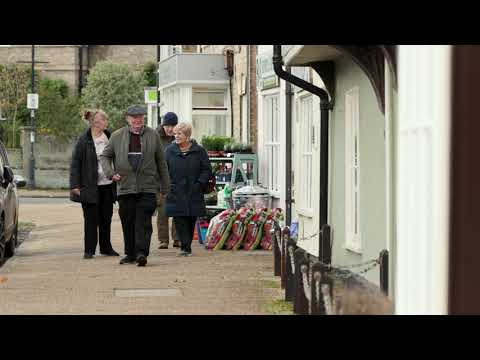
Wickham Market gathers shops, old houses and a tall church spire around The Hill, its historic market place. Although its name and trading past suggest a town, it is a large Suffolk village with a compact centre and countryside close at hand. Its history also reaches beyond rural commerce: nineteenth-century engineers manufactured machinery here for customers far away. A visit can combine those industrial traces with independent shops, the restored George pub and walks towards the River Deben.
| Residents | 2,232 |
|---|---|
| Area counted | Wickham Market civil parish — civil parish census area |
A market on the road through Suffolk
The settlement appears as Wikham in Domesday Book in 1086. Its documented medieval growth belongs to the network of roads, manors and markets serving this part of Suffolk. Henry VI granted a weekly market and two fairs in 1440, strengthening an established meeting place on routes towards Framlingham and the coast.
The historic centre developed beside a road that later became the A12. Through traffic continued to pass its houses until the bypass opened in 1975. This explains why a village now visited for a leisurely walk contains so many former commercial buildings. The Hill and adjoining High Street preserve the relationship between a market, passing travellers and the businesses that served them.
All Saints and a walk around The Hill
All Saints rises above the centre with an unusually slender tower and spire. The medieval church includes work from the fourteenth and fifteenth centuries, and its silhouette helps orient a walk through the surrounding streets. Look at the stonework, openings and changes in construction as well as the distant view: the building developed over time.
The Hill provides a convenient starting point before following High Street and the smaller connecting lanes. Timber-framed buildings, later fronts and former inns reward close attention. Published heritage trails give a more coherent route than simply driving through. Church visits should fit around services and current access arrangements; an old building can remain a working place of worship with a changing interior.
An engineering village
Whitmore & Binyon made Wickham Market an important centre of agricultural and milling engineering in the nineteenth century. Their products included steam engines and machinery for windmills, watermills and flour mills. The works employed a substantial workforce and ceased trading in 1901, leaving an industrial chapter that is easy to overlook among the village’s older houses.
The local pocket guide identifies surviving buildings and details associated with the business, including former offices, workers’ housing and ornamental ironwork. Following its engineering trail adds substance to a walk: these are traces of manufacturing and skilled employment, rather than decorations without a story. The converted mill buildings are private properties, so appreciate them from public routes.
The George and village life
A fire in 2013 closed The George, the village’s last remaining pub at that time. A community-led campaign secured its future, and the restored building reopened in 2025 with support that included the National Lottery Heritage Fund. Its recovery brought an important meeting place back into use instead of leaving another historic frontage without its former social role.
Today The George operates a bar and kitchen alongside an activity room. It is a useful place for a meal, while its programme offers another way to meet the village beyond sightseeing. The centre also has essential shops and a supermarket. For a prospective resident, spending time here during an ordinary weekday reveals how those services work together around the market place.
Walks, neighbouring villages and overnight stays
County walking guides provide routes through the Deben valley and towards Pettistree. Footpaths introduce river meadows, former mills and a different perspective on the settlement. Choose a published route suited to the weather and your mobility rather than assuming every riverside stretch is a continuous public path. Woodbridge and Framlingham extend a longer stay with another riverside centre and a medieval castle respectively.
The official accommodation directory lists self-catering properties within Wickham Market, including Olive Cottage on High Street and the converted Sampson’s Mill on Mill Lane. The Orchard Campsite is another local option. For a stay closer to the railway, The Old Rectory B&B is in Campsea Ashe, outside the village centre. These locations offer quite different arrivals and evening routines, so check the address before booking.
Arriving by rail and understanding its scale
Wickham Market railway station is actually in Campsea Ashe, roughly two miles east of the village. East Suffolk Line trains link it with Ipswich and Lowestoft; London journeys normally involve a connection at Ipswich. Plan the final stage separately. The community rail guide lists onward transport, and current county information is the place to check local bus or demand-responsive services before relying on them.
Drivers approach from the A12, which links this part of Suffolk with Ipswich and the wider road network. The 2021 census counted 2,232 usual residents in Wickham Market civil parish. That is a parish population rather than a count of people around The Hill, and the parish includes land beyond the compact historic centre. It gives the village’s everyday facilities and social organisations a useful sense of scale.
Sources
- Wickham Market Parish Council: market charter and village heritage
- Historic England: All Saints church
- Local pocket guide: engineering history and walking trails
- National Lottery Heritage Fund: restoration and reopening of The George
- The George: current food, drink and community activities
- Discover Suffolk: Deben valley and village walks
- Official visitor directory: accommodation and exact locations
- The Old Rectory: accommodation at Campsea Ashe
- East Suffolk Lines: station location and onward travel
- Greater Anglia: Wickham Market station
- Office for National Statistics via Nomis: Census 2021 usual residents, civil parishes