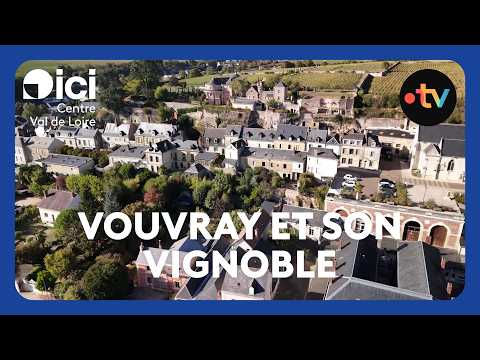
chenin blanc, cave dwellings and vineyard hills near Tours
East of Tours, Vouvray rises through valleys and slopes on the Loire’s right bank. Its name travels far beyond Touraine on wine labels, but the settlement itself offers a more intimate visit: streets below limestone rock, underground cellars, a hilltop church and paths towards the vineyards. Nearby Tours makes it possible to combine a stay in wine country with the facilities and sights of a substantial city.
| Municipal population, 2023 reference | 3,420 |
|---|---|
| Area of the commune | ≈ 23.09 km² |
Population at 1 January 2023, within municipal boundaries at 1 January 2025; official figure in force from 1 January 2026. The area covers the whole commune, not only the built-up centre.
St Martin’s estates and a long winegrowing history
Vouvray’s development is connected with religious institutions in Tours. In the eighth century, much of its territory belonged to the collegiate church of St Martin. Nearby Marmoutier Abbey also played a part in the region’s vineyard history. These connections explain more than a single founding date, which the available evidence does not establish here.
Stories credit St Martin with introducing grape varieties or pruning methods. They are local traditions rather than proof that he personally created today’s vineyard. Winegrowing developed over a much longer period through the work of religious communities, owners and growers.
In the early modern period, trade carried the wines to wider markets, including northern Europe. The Loire connected production areas with broader commercial networks. Houses, estates and cellars recall an activity that began long before the twentieth-century appellation system.
Chenin blanc and four styles of wine
The Vouvray controlled appellation was recognised in 1936; INAO therefore marks its ninetieth anniversary in 2026. Its grape is chenin blanc, also known as pineau de la Loire. Wines include dry, demi-sec, sweet and sparkling styles. The village name does not indicate one identical flavour or sweetness level across every bottle.
A tasting can begin with this range rather than a list of famous estates. Ask about the style and vintage, then compare the producer’s choices. Growing conditions and winemaking matter, and each vintage does not necessarily produce the same range in the same proportions.
The appellation extends outside Vouvray’s municipal boundary. An estate selling vouvray may be in a neighbouring village, so check the appointment address before planning to walk from the centre. Cellar visits also depend on opening days and work taking place at the winery.
Limestone, underground spaces and the church viewpoint
Tuffeau limestone supplies both building stone and the setting for underground spaces. Quarrying left chambers subsequently reused as cellars, workplaces and cave dwellings. The relationship between rock face, façade and underground room is a distinctive feature of the landscape. A doorway in the rock may nevertheless lead to private property rather than an attraction.
Notre-Dame-et-Saint-Jean-Baptiste church retains an eleventh-century tower base, although much of its present appearance dates from the nineteenth century. Higher viewpoints help explain how the valleys, settlement and vineyard slopes fit together. Walking involves changes of level even where distances look short on a map.
The centre and the wine estates offer different experiences. Keep time for streets and viewpoints between cellar appointments. Respect farming access and private land on country walks; rain can considerably change underfoot conditions.
Balzac and a connection with wartime Picardy
Vouvray appears in Honoré de Balzac’s L’Illustre Gaudissart, a story about a travelling salesman. The fictional character is also remembered in the village’s public space. This literary connection reflects the importance of Touraine’s landscapes and people to the writer, who was born in Tours.
Another connection reaches Holnon in Aisne. At the end of the First World War, two wounded soldiers, one from Vouvray and one from Holnon, became friends. Their encounter brought the destruction in Picardy to the Touraine municipality’s attention. Vouvray contributed financially to reconstruction and became Holnon’s sponsoring commune, adding a story of solidarity to the wine heritage.
The surrounding Loire Valley offers further outings to Tours, nearby winegrowing villages and routes proposed by the tourist office. Water activities and cycling require suitable operators and maps; the entire riverbank should not be assumed to form one continuous prepared path.
Accommodation, a cave restaurant and longer stays
Accommodation is available within the commune. Château des Bidaudières offers five guest rooms on an estate with grounds. Check its position against the centre and your planned visits: staying on an estate differs from having a room above the town’s shops. Confirm arrival arrangements and the journey from a bus stop.
Les Gueules Noires restaurant is at 66 Rue de la Vallée-Coquette in Vouvray. It serves regional cooking in a troglodytic setting. Reserve and check service days; the commune’s separate valleys make the precise address relevant even for a meal described simply as being in Vouvray.
For a possible move, assess the proximity of Tours through real journeys. A home on the plateau, in a side valley or near the centre will offer different access to shops and transport. Try the journeys at useful times and investigate the particular building, especially accommodation associated with a rock face or underground space.
Travel through Tours and Saint-Pierre-des-Corps
Tours and Saint-Pierre-des-Corps are the principal rail gateways. From Paris or other major cities, plan that stage first and then the local journey to Vouvray. Fil Bleu route 54 serves Vouvray and Vernou-sur-Brenne; the tourist office and intermunicipal mobility guide provide information for organising connections.
Journey time depends on the stop, the day’s service and the position of the estate or accommodation. A photographed former station building does not establish that passenger trains currently receive visitors there. For a car-free outing, start with a realistic route between the bus stop, village centre and a booked cellar visit.
Sources
- Office de tourisme : histoire et promenade de Vouvray
- Commune de Vouvray : histoire et liens avec Holnon
- Commune : histoire de la vigne et styles de vin
- Commune : église, coteaux et vallées
- INAO : quatre-vingt-dix ans de reconnaissance de Vouvray en 2026
- Pays d’art et d’histoire Loire Touraine : Vouvray et Balzac
- Commune : promenades et itinéraires
- Château des Bidaudières : chambres d’hôtes à Vouvray
- Les Gueules Noires : restaurant troglodytique à Vouvray
- Office de tourisme : accès à Vouvray et ligne Fil Bleu 54
- Touraine-Est Vallées : guide actuel des mobilités
- INSEE: official 2023 reference population
- French administrative API: municipal geography and area