a transformed medieval castle, carnival traditions and limestone hills
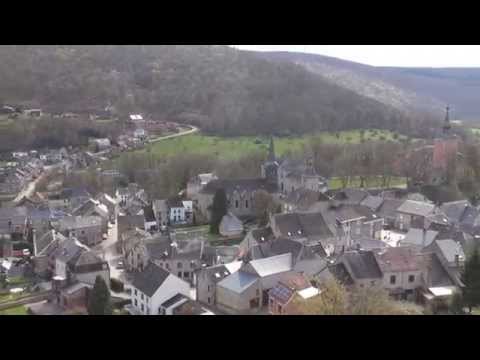
Vierves-sur-Viroin occupies a hillside above the Viroin in Viroinval municipality, in southern Namur province. Stone houses step down the slope below a castle, while meadows, river bends and the heritage railway open out below. The French border is close enough for the village to be approached from the French Ardennes as well as from Charleroi.
| Municipality | Viroinval |
|---|---|
| Municipal registered population at 1 January 2026 | 5,580 |
| Municipal area, WalStat revision of 22 May 2026 | 121.22 km² |
National Register figure for the whole municipality, including its other settlements. It is not a count of the historic village alone.
A medieval lordship and a trading village
Municipal research traces the lordship through the Middle Ages without establishing an exact village foundation date. Around 1246, some land belonged to the Barbençon family. In 1314, Robert de Vierves held the castle while other land belonged to the lord of Oignies; their rights and territories were intertwined.
A market hall is documented from 1461, showing a commercial role beyond the castle and farming. Seigneurial justice also shaped local life. The municipal historical assessment records successive witchcraft prosecutions between 1624 and 1662, a troubling part of the community’s history.
Revolutionary upheaval later brought emigration and sequestration of owners’ property, followed by partial restitution. The present castle reflects changing uses of a former seat of power.
The Counts of Hamal’s castle
The Hamal family held the estate from 1567 to 1852 according to the heritage association. They reshaped a medieval fortress and farm into a residence, progressively reducing its defensive role.
The municipal account records a fire in 1762 followed by rebuilding. Large classical windows contrast with the fortified base. The bulbous roof of the tower known as Attila’s Tower makes the silhouette distinctive; the name does not establish a connection with the historical Hun ruler.
Nineteenth-century work combined two courts into a terrace overlooking the valley. Gardens, trees and an orchard extended the landscaped setting. The castle is private and closed to visitors, but public streets and viewpoints on either side of the river reveal its different elevations.
Church, washhouse and mausoleum
Saints Rufin and Valère Church and the nineteenth-century covered washhouse provide further stops in the centre. The latter preserves evidence of shared domestic labour before household washing facilities.
An interpretation circuit starts opposite the church. It extends for about 1.5 kilometres with thirteen stops in French and Dutch. Historical photographs displayed around the village help reveal how buildings and everyday uses have changed.
The cemetery contains an octagonal mausoleum built in 1906 for the Thomaz de Stave and Mesnil de Volkrange families, castle owners. Its copper-coloured dome and commanding position on the main avenue make it conspicuous. The monument expresses the social hierarchy of its period as much as architectural ambition.
Carnival as living heritage
Vierves carnival belongs to the Viroin valley traditions documented by the French-speaking Community’s cultural heritage service. Roles, collections and gatherings connect local participants over several weeks leading to Shrove Tuesday.
Johan Simon is a figure in the festival’s folklore. Popular accounts should be read as traditions rather than as a verified biography or a substitute for documented history.
Visitors need the relevant year’s local programme. An old film or a former Shrove Tuesday date is useful background, not a current event listing.
Grasslands and hillside walks
The settlement lies where the limestone Calestienne meets Ardennes landscapes. Hillside paths reveal roofs, castle and river bends. Calcareous grasslands support distinctive plants and wildlife.
Sheep once maintained these open areas. Following abandonment and early twentieth-century scrub growth, restoration projects sought to conserve their habitats. The scenery therefore reflects changing land management as well as geology.
Use marked routes and suitable footwear for slopes and wet surfaces. Protected habitats and private parcels require attention to access signs; an attractive viewpoint does not make the entire hillside freely accessible.
Heritage railway and nearby museums
The Three Valleys Steam Railway runs from Mariembourg to Treignes through Vierves. Check the operator’s published running days to combine a village visit with a journey through the valley. It is a tourist railway, rather than a daily public transport connection.
Outside Vierves, Treignes offers museums covering prehistory, rural crafts, Arthur Masson’s literary world and railway heritage. Nismes provides further walks and the Fondry des Chiens landscape. Each excursion has separate opening arrangements.
These attractions, holiday accommodation and restaurants contribute to the visitor economy alongside the territory’s agricultural and woodland uses.
Accommodation and dining in the village
Le Petit Mesnil on Rue de la Chapelle combines a village hotel with a restaurant. It advertises rooms with private facilities and homemade French cooking, including trout dishes and local game in season. Staying and dining here does not require travelling to another settlement.
Pa-d’zous is a family holiday house renovated in 2021, with four bedrooms and equipped living areas. La Porte du Paradis provides a group holiday rental. Compare capacity, minimum stay and included services when choosing between an entire property and a hotel room.
Confirm current rates and service days with the establishment. Older tourism brochures remain useful historical guides, but their prices should not be treated as current quotations.
Access and a longer stay
From Charleroi, the road approach follows the N5 corridor towards Couvin, then Nismes and the Viroin valley. Charleville-Mézières in France offers another major-city approach through the Meuse valley and cross-border roads. Compare the actual route from the chosen starting point.
Rail arrivals require an onward road connection: scheduled passenger services and the heritage railway are different systems. Arrange the final transfer in advance, particularly for evenings and weekends.
Anyone considering a move should assess journeys to shops, schools and employment centres, and the circumstances of a particular riverside or hillside property. The population in the table covers all of Viroinval municipality, rather than Vierves alone.
Sources
- Commune de Viroinval : diagnostic historique et économique du PCDR
- Patrimoine, circuit d’interprétation et pelouses calcaires
- Château des Comtes de Hamal : histoire et propriété privée
- Mausolée de 1906 et familles propriétaires
- Fédération Wallonie-Bruxelles : dossier des carnavals du Viroin
- CFV3V : chemin de fer touristique de la vallée
- Le Petit Mesnil : hôtel et restaurant dans le village
- Pa-d’zous : maison de vacances à Vierves
- La Porte du Paradis : gîte de groupe
- Office de tourisme : guide patrimonial 2021–2022, sans reprise des anciens tarifs
- Belgian National Register: municipal figures, 1 January 2026
- IWEPS / WalStat: superficies communales (2026)