a Roman villa, four museums and the Viroin valley beside France
Treignes belongs to Viroinval municipality in Namur province, between the Calestienne and the Ardennes. Archaeology, rural crafts, literature and railway heritage provide an unusual concentration of visits. They are separate institutions linked by lived-in streets and the bridge over the Viroin, while the surrounding farmland preserves the remains of a genuine Gallo-Roman estate.
| Municipality | Viroinval |
|---|---|
| Municipal registered population at 1 January 2026 | 5,580 |
| Municipal area, WalStat revision of 22 May 2026 | 121.22 km² |
National Register figure for the whole municipality, including its other settlements. It is not a count of the historic village alone.
An ancient agricultural estate
About three hundred metres from the centre, the Bruyères villa and its outbuildings occupied an estate of more than six hectares between the first and fourth centuries AD. Here “villa” means an agricultural establishment with a residence.
Excavations between 1980 and 1987 revealed the complex; later investigation, conservation and interpretation involved the Cédarc. The remains establish Gallo-Roman occupation nearby, rather than an exact foundation year for Treignes or uninterrupted survival of its present streets.
The museums’ association describes the site as freely accessible. Respect surviving masonry and the surrounding farmland. A guided visit helps explain remains that are less immediately legible than a reconstructed building.
From seigneurial tower to farm and museum
The Écomusée occupies authentic historic buildings. Its early sixteenth-century core was a tower asserting seigneurial power. Seventeenth- and eighteenth-century additions strengthened the agricultural role with stables, housing and a dairy.
An arson attack destroyed the main barn in 1979. The Université libre de Bruxelles purchased the site in 1983, followed by lengthy restoration for its museum role. Buildings and surrounding green spaces received heritage protection.
The farm therefore forms part of the collection’s context, showing adaptation, loss and reuse rather than supplying an invented historical backdrop.
Rural work at the Écomusée
The museum explores rural society in Entre-Sambre-et-Meuse from the eighteenth to twentieth centuries. Tools, furniture and agricultural machinery connect working practices with wider social change.
Mechanical clog-making equipment, a forge, an old bread oven and agricultural machinery offer tangible subjects for families. Demonstrations depend on the programme; displayed machines are not necessarily running continuously.
Landscape interpretation links the buildings to fields, woodland and valley uses. The museum also contributes to discovering the Entre-Sambre-et-Meuse National Park.
The Malgré-Tout archaeological museum
Musée du Malgré-Tout on Rue de la Gare covers regional archaeology from Neanderthals to the end of the Gallo-Roman period. Collections and exhibitions help place local remains in a wider context.
Educational workshops, family activities and archaeology events follow the museum’s programme. Cédarc research and publications connect its displays with ongoing investigation.
Some exhibits come from other regional sites. Their display in Treignes does not mean that every object was discovered within the village.
Arthur Masson’s literary world
Espace Arthur Masson occupies the former village schools. Its sound-and-light route evokes the writer’s world and Toine Culot through Ardennes life between 1930 and 1960. Trignolles is a fictional setting, rather than a documentary account of every Treignes resident.
The École d’Autrefois recreates a classroom atmosphere from 1932 as a participatory experience. It has its own booking and activity arrangements, separate from a street walk. Other games and group activities extend the programme.
Seasonality matters: the guided vintage-car Rétroberlines excursions announce a winter break before resuming in spring 2027. Consult the centre’s winter 2026–2027 timetable for a visit during this period.
Railway museum and tourist trains
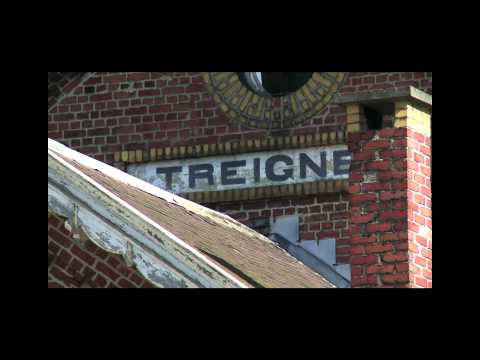
The Three Valleys Steam Railway museum preserves rolling stock beside the former station. Locomotives, carriages and installations explain a railway landscape once linked with wider and cross-border traffic.
Tourist trains run between Mariembourg and Treignes through the valley. Running days and museum opening are separate matters; check both to combine them.
The village association currently promotes four institutions: Malgré-Tout, Écomusée, Espace Arthur Masson and the railway museum. Musée du Petit Format is in Nismes, outside Treignes, rather than a fifth museum in the village.
Combining museums with the village
Choose museums according to interests and allow time for the bridge, streets and countryside. Do not assume that one ticket automatically includes every institution.
The Écomusée currently closes on Mondays and uses shorter afternoon hours in winter. Malgré-Tout has its own calendar and year-end closures. Accessibility also differs: only the Écomusée’s ground floor is accessible to visitors with reduced mobility.
Walking and cycling extend the experience into the valley. Consult the exact route and any seasonal restrictions before leaving the village roads.
Where to stay and eat
Les Murmures du Viroin is a self-catering property on Rue du Ternia in Treignes, with living spaces and a garden beside the river. Confirm equipment and capacity with its owners.
Chez Toine at Espace Arthur Masson offers drinks, regional products and light meals within the village. Check service days and hours separately from museum activities.
For a combined hotel and restaurant, Le Petit Mesnil is in neighbouring Vierves-sur-Viroin. It is in the same valley but outside Treignes, so dinner or a late arrival requires an onward journey.
Belgian and French approaches
From Charleroi, the N5 corridor reaches the Couvin area before roads through the valley lead to Treignes. Charleville-Mézières provides a relevant French approach through the Meuse valley and Vireux area.
The Écomusée identifies a public transport combination of the Charleroi–Couvin railway and a local bus. Confirm current connections, particularly evenings and weekends. Treignes’ preserved station does not indicate an ordinary scheduled passenger train serving the village.
For a possible move, compare shopping, school and work journeys with the advantages of the riverside setting. The statistical table covers Viroinval municipality. Undated village estimates in tourism publicity are not presented as a current census.
Sources
- Treignes, Village des Musées : les quatre institutions du village
- Villa des Bruyères : datation, fouilles et accès
- Cédarc / Musée du Malgré-Tout : recherches archéologiques
- Musée du Malgré-Tout : collections et horaires actuels
- Écomusée : tour seigneuriale, ferme et restauration
- Écomusée du Viroin : métiers et paysages ruraux
- Écomusée : accès, horaires et accessibilité
- Espace Arthur Masson : littérature, école et activités
- Chez Toine : taverne et produits régionaux
- CFV3V : musée ferroviaire de Treignes
- Les Murmures du Viroin : gîte rue du Ternia
- Le Petit Mesnil : hôtel-restaurant dans le village voisin de Vierves
- Belgian National Register: municipal figures, 1 January 2026
- IWEPS / WalStat: superficies communales (2026)