A city centre with water close at hand
Växjö is a regional capital in southern Småland where a compact centre, a university district and a necklace of lakes sit close together. The cathedral’s twin spires rise above the central streets; within a short walk are the main square, small parks, museums and the shore of Växjösjön. Statistics Sweden counted 74,052 people in Växjö tätort in 2023, using its mapped urban-locality boundary and a reference date of 31 December. This is the built-up locality, not the much larger municipality, which also contains villages, forests and farmland.
The town is often introduced through St Sigfrid, the English missionary associated with the Christianisation of this part of Sweden. The story belongs to local religious tradition: the Church of Sweden itself cautions that the legend is uncertain. More securely documented, Växjö had become a bishop’s centre by around 1170, when the diocese was established and the parish appears in written records. King Magnus Eriksson granted city privileges in 1342. Medieval fairs helped draw people to the trading town; the municipality records two annual markets from 1473. Växjö later became a county seat and a long-standing centre for education and administration.
A town rebuilt in layers
Växjö’s historic streets are not a frozen medieval quarter. Fires repeatedly changed the wooden town, and the destructive blaze of 1843 led to a new plan the following year. The enlarged main square and straighter streets gave the centre a more open, ordered form; later nineteenth-century esplanades and civic buildings added another layer. The railway reached Växjö in 1865, linking it with Alvesta and routes toward Karlshamn and Kalmar and helping the town grow. Today, shops, cafés and public services occupy a centre that still centres on the cathedral and square, while the university and newer neighbourhoods extend south and east.
The cathedral is the most visible landmark, but its present appearance reflects many centuries of rebuilding. A wooden church may have stood on the site in the eleventh century; archaeological clues make that plausible, but they do not verify the Sigfrid story. A stone cathedral followed after the diocese was founded. Fires, conflict and successive restorations altered the building. Inside, one striking modern work is Bertil Vallien’s three-part glass altarpiece, installed at the beginning of the 2000s. Nearby Karolinerhuset, built between 1697 and 1715, connects the cathedral quarter to Växjö’s school history; the municipal guide associates it with Carl Linnaeus’s time as a pupil in the town.
Regional collections and a living economy
A few blocks away, Smålands Museum combines regional history with Sveriges glasmuseum, where Swedish glass is presented through both historical objects and contemporary design. The museum was founded in 1867 and is described by the municipality as Sweden’s oldest county museum. Utvandrarnas hus opened in 1968 and examines the large nineteenth- and twentieth-century migration from Sweden to North America through exhibitions and research collections. These institutions make a useful pairing: one looks closely at local materials and craft, the other at the journeys that connected Småland families to a wider world. Check each institution’s own site for current exhibitions, access and opening hours.
Växjö also works as a practical service and employment centre, not only a heritage stop. The municipality’s business portal describes a diverse regional economy, with manufacturing, IT, forestry and wood-related activity, together with research and business links around Linnaeus University and Linnæus Science Park. Those descriptions apply to the wider municipality rather than a town-only industry count. In daily life, the university, hospitals and public services sit alongside retail, cafés and small firms. At the main station, regional and intercity trains meet local and regional buses; ongoing station-area works can shift bus bays, so consult the operator’s live journey planner rather than relying on an old platform number.
Walk from the square to the lakes
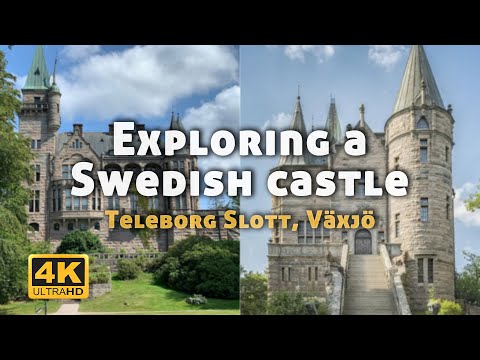
One of Växjö’s pleasures is how quickly the built centre gives way to water and greenery. The municipal walking guide describes a roughly five-kilometre circuit around Växjösjön, passing recreation areas and public art. Växjö Runt is a much longer marked walking and cycling circuit of just over 40 kilometres that links six lakes and eight nature reserves around the city; it can be approached in shorter sections. To the south, Teleborg Castle was completed in 1900 beside Lake Trummen. Its park, established in 1931, mixes formal planting with wooded paths and connects naturally to the university area and lake loops. Check current maps, surface conditions and seasonal facilities before setting out.
For a longer outing, Kronoberg Castle ruin stands on an island in Helgasjön north of the centre. It began as a fortified bishop’s residence and later became involved in the Dacke uprising. The official visitor guide says the ruin has been closed to entry since 2022–23 because of collapse risk; later plans to preserve and develop the site do not by themselves mean that it has reopened. Treat it as a landscape and history stop only after checking the current access notice. Around town, the best introduction is a modest one: cathedral and square, a museum visit, then a walk by the lake.