Värnamo has a practical, workaday feel, yet its centre is never far from green space or water. The Lagan runs through the town, and the railway station remains a second organising point: between the river, streets of shops and the station district, Värnamo has grown as a regional service town rather than a preserved stage set. Its furniture and design history adds a distinctive cultural thread, while parks and lakeside paths make a slower visit easy to arrange.
Statistics Sweden counted 20,273 residents in Värnamo tätort on 31 December 2023, over 1,245 hectares of land. This is SCB’s mapped, continuous built-up locality, not the population of Värnamo municipality, which also includes several other towns and extensive countryside. Keeping that boundary clear matters when reading local economic statistics: the municipality reports that manufacturing accounts for just over 34 percent of jobs and lists roughly 400 manufacturing businesses across its territory, but that is not a town-only count.
A market settlement becomes a railway town
The municipality’s documented timeline places the name Wernamo in written sources in 1236–1238. In 1620 Värnamo became a lydköping, a dependent trading settlement with limited market rights under Jönköping’s influence. A new civic phase followed in 1871, when Värnamo became an independent köping, and town rights came in 1920. These are recorded administrative milestones; they tell a more useful story than an unsupported foundation legend.
The river and old routes shaped the early settlement, but the railway altered the scale and direction of growth. Municipal heritage material describes a town plan laid out in 1862 and later factories and railway-related buildings extending west of the earlier core. The station district eventually pulled the centre in that direction. At the same time, furniture-making developed from craft into industry. Municipal records note that Wernamo Möbelfabrik attracted attention at the 1894 Antwerp exhibition and that, at its height, the town had around forty furniture businesses of different sizes. Workshop, rubber and machine industries also became part of the region’s story. The municipality-wide present-day mix remains manufacturing, trade and services; its published statistics should not be mistaken for a precise census of jobs inside the tätort.
Craft, design and a park in the middle of town
Apladalen offers a particularly generous introduction to Värnamo. This 22-hectare nature and local-history park sits in the centre, where paths and old oaks frame buildings from the eighteenth and nineteenth centuries. Municipal interpretation links the relocated cottages to trades including shoemaking, brass casting, wire drawing and pottery. The former parsonage preserves the interior of a nineteenth-century clerical home and operates as a small museum; seasonal events, a café, craft sales and animal enclosures give the park a community use as well as a heritage role. The figures of Per and Kersti nearby belong to Carl Snoilsky’s poem about the Värnamo market, so they are best understood as literary memory, not documented historical residents.
Next to the park, the Bruno Mathsson Center connects local making to modern design. Mathsson was born in Värnamo in 1907; the municipality describes the exhibition hall as his own design and notes the preserved office, studio and outdoor bed, alongside furniture such as the Eva and Pernilla series. The centre’s associated buildings are protected heritage. Just outside the central streets, Vandalorum adds a museum devoted to contemporary art and design, with changing exhibitions, a design shop and restaurant. Check current programmes and opening hours before setting out: exhibitions and seasonal schedules change.
Gummifabriken is another useful stop, particularly on a rainy day. A former industrial name now belongs to a shared cultural and civic house with the city library, cinema, restaurant, education and public events. The reuse of an industrial setting fits Värnamo’s character: manufacturing history is visible, but the town continues to adapt buildings for everyday life.
Follow the Lagan to the lake
For a walk, follow the municipal Osuddenrundan from the town along the Lagan, through Apladalen and onward past allotments and open fields to Osudden on Vidöstern’s northern shore. The lake-side destination has a long, shallow sandy beach. Closer to the centre, Prostsjön has another bathing area near the campsite. The town cycle map also marks a route linking Ljusseveka, the centre, Apladalen and Osudden. Check the municipality’s current map or Naturkartan for the precise line, surfaces and any closures; construction and trail conditions can change.
Rail and bus stations stand beside one another at Järnvägsplan. Municipal travel information lists rail corridors linking Göteborg with Karlskrona/Kalmar and Halmstad with Nässjö/Jönköping, as well as regional buses. For visitors, this makes Värnamo a convenient base for exploring western Småland, but exact connections should always be checked with the current operator timetable. Allow time to walk the centre rather than treating it as only a transfer point: the short distances between the station, Gummifabriken, Apladalen and the river are part of the town’s appeal.
 Three Värnamo films: Gummifabriken, Vandalorum and Apladalen
 Invigning av Rastplats Vandalorum is a 2-minute-48-second film from Värnamo municipality, uploaded on 13 September 2019. The title concerns the inauguration of the Vandalorum rest area, a public-facing stop associated with the Värnamo destination; it should not be confused with a full guide to the art and design museum. Vandalorum’s own visitor information describes the museum’s exhibitions, shop and restaurant, while the municipal video supplies a separate local-place reference. The upload is distinct from the Gummifabriken vision film and the longer Apladalen walk. Check the current museum and route information separately before visiting.
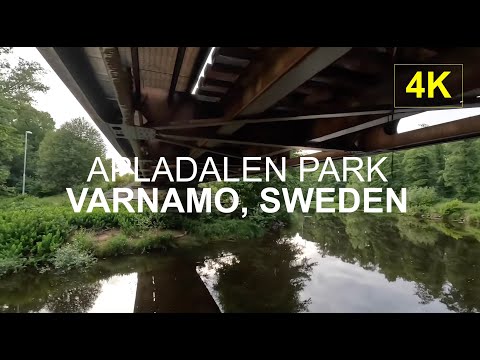 The Scenic Route’s VARNAMO, SWEDEN | Apladalen Nature and Homestead Park l 4K Walk runs 26:34 and was uploaded on 23 August 2023. Its verified title makes Apladalen—the central nature and local-history park—the subject, giving this selection a slower, outdoor focus quite different from the two municipal place-and-development films. Värnamo municipality documents the park’s old trees, paths, historic buildings and summer visitor facilities, which helps situate the film without making claims about specific shots. Because it is an independent channel’s upload, use municipal visitor information for access, seasonal services and opening details.