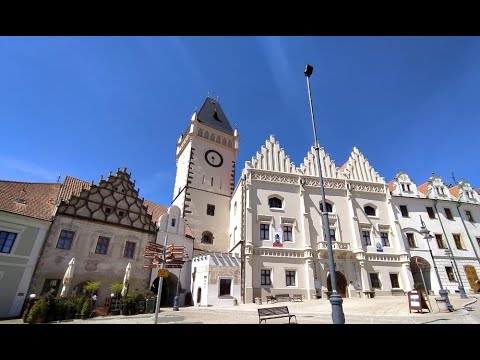
Tábor rises above the Lužnice River in South Bohemia. Its name is closely tied to the Hussite movement, yet the history of the site did not begin in 1420. The municipal visitor website reports archaeological evidence of more sustained settlement in the Hallstatt period, in the sixth and fifth centuries BCE. A long gap separates that occupation from the later medieval town. It is therefore fair to describe pre-Roman settlement on the site, but not an uninterrupted Celtic or Roman city called Tábor. The identity of the town visitors encounter today took shape in the Hussite period and the centuries that followed.
Hradiště and the Hussite foundation
Around 1270, during the reign of Přemysl Otakar II, a settlement called Hradiště was founded on the plateau above the river, with a castle at Kotnov. According to the city's history, it was probably destroyed during the Vítkovci revolt in 1276. The remains of the castle and the defensible position endured. In 1420 Hussites arriving from nearby Ústí established a community here and gave it the biblical name Tábor. Looking back at the old centre from across the river makes the relationship between fortress, landscape and the new settlement particularly clear.
Hussite campaigns went out from Tábor under captains including Jan Žižka and Prokop Holý. After the defeat of the radical Hussites at Lipany, the town reached an accommodation with Sigismund and received royal-town status in 1437. Another turning point came in 1452, when Tábor surrendered to the army of George of Poděbrady. The military base gradually became a more ordinary, if still strongly defended, town. These events shaped not just monuments and street names, but the civic institutions and later memory of the place.
A stone town above underground cellars
The centre saw substantial construction in the late fifteenth and early sixteenth centuries. The city dates completion of the town hall to 1521. Fires in 1532 and 1559 destroyed many houses, often still wooden, and rebuilding brought more stone structures and sgraffito decoration. Beneath homes, residents had begun digging cellars in the fifteenth century. Later generations connected some of them into a network. The Hussite Museum now opens a section beneath Žižka Square. The spaces stored food and beer and could provide shelter in an emergency. They should not all be presented as one secret military tunnel dug at the moment of the 1420 foundation.
A visit can begin on Žižka Square at the old town hall and Hussite Museum. Its displays cover both the early movement and the way subsequent generations interpreted it. The underground route adds a physical sense of the town's depth. Above ground, continue to the Church of the Transfiguration, old houses, surviving walls, Bechyně Gate and the Kotnov area. The municipal walking map connects these sites. Access to towers and underground tours changes with the season; the tourist office on the square can confirm what is open on the day.
Jordán and the layers beyond 1420
The Jordán reservoir was created in 1492 and is described by the city as one of the oldest of its kind in Central Europe. Its shore offers a quieter walk and a view back towards the old centre. Tábor is more than a preserved Hussite scene. Baroque buildings, museums and later districts record further chapters. The municipal history also recalls Nazi occupation, the destruction of the Jewish cemetery and persecution of Jewish residents. A memorial in the Prague Suburb commemorates victims of the Heydrich period. Including this history makes a visit more truthful than focusing only on the town's most famous century.
Accommodation is available in the town itself, including Boutique Hotel Nautilus on Žižka Square, Pension Modrá růže with a restaurant and other hotels and guesthouses in the municipal directory. The city's food listings offer more choices. Tábor sits on a principal road and railway axis between Prague and České Budějovice. From the station, visitors can walk or use local transport towards Žižka Square; check the current timetable and any disruptions. The Czech Statistical Office recorded 34,339 residents in the municipality on 1 January 2026. That is the city, not the much larger Tábor district. Allow most of a day for the old centre and museum, then more time for Jordán and the riverside.