Subiaco is a mountain town shaped by a striking pairing: a close-set historic centre and a Benedictine landscape that climbs into the Monti Simbruini. The Aniene runs through the valley below, while the road toward Monte Livata leads into beech woods and high pastures. In the municipality’s tourist map, the local character emerges through layers rather than a single monument: Roman leisure, monastic life, papal power, printing and outdoor pursuits all leave visible traces.
A town between river and ridge
The resident population of the whole Comune was estimated at 8,533 on 1 January 2024 in a regional document drawing on an ISTAT extraction made on 16 July 2024; that is a dated municipal figure, not a current count of the old town alone. Subiaco’s visitor economy is closely tied to the abbeys, the Rocca, river-valley activities and mountain recreation. The municipality’s map also lists places to stay, food businesses and visitor information, while the Aniene and park trails support walking and other outdoor activities. This is a useful picture of the town’s offer, not an employment survey.
What the records show—and what tradition says
The municipal map dates the remains of Nero’s villa to around AD 60, in the wooded territory between Mounts Taleo and Francollano and the Aniene. The later Benedictine story belongs to a different historical layer. Monastic tradition places Benedict’s solitary retreat in a cave here and dates the foundation of Santa Scolastica to the early sixth century; the dramatic setting of the Sacro Speco grew through centuries of building and devotion. The cave episode is hagiographic tradition, not a claim established by the Roman remains. Santa Scolastica’s surviving cloisters, church and manuscript collections convey the long institutional history. The municipal heritage map also identifies 1465 as the year of Subiaco’s early printing activity and the production of a book with movable type in Italy.
Above the town, the Rocca Abbaziale began as an eleventh-century defensive stronghold associated with Abbot Giovanni V. The map records earthquake damage in 1349, restoration from 1476 under Cardinal Rodrigo Borgia and a residential conversion ordered by Pius VI in 1778. In town, Santa Maria della Valle and the fourteenth-century Ponte di San Francesco add quieter civic and religious landmarks. A local account links the bridge’s construction to ransom after a conflict; it is best treated as tradition rather than settled proof.
Walks, services and day planning
Leave time for both monasteries: Santa Scolastica spreads across a broader complex, while the Sacro Speco is built against the rock face of Mount Taleo. The official monastic site posts visiting information, and schedules can change. The Parco Naturale Regionale dei Monti Simbruini describes a demanding route from Subiaco toward Livata, as well as loop walks around Monte Livata; these are real mountain itineraries, so check current trail conditions, weather and difficulty before setting out. The Roman villa remains and Laghetto di San Benedetto lie in the same valley, but access to riverside paths may be seasonal or subject to local rules. The municipal tourist map identifies the visitor information point and bus terminal; Cotral’s live search is the place to check connections and return services. Confirm all opening times, transport timetables and access arrangements shortly before travel.
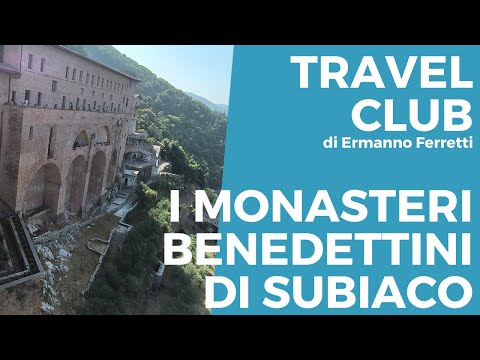 Three Subiaco films: Benedictine monasteries and a Lazio itinerary
 Vania Cavicchioli published this 5-minute-59-second item on 5 September 2017 under the title Sacro Speco e Monastero di Santa Scolastica a Subiaco. The listing presents a walk through spirituality, art and nature and names the two Benedictine complexes. Its short length suits a quick introduction to their different settings: one built against a cliff, the other a wider abbey ensemble. The description is the basis for this review; it does not justify claims about individual works shown. Use the monasteries’ own visitor information to check access and schedule details.
 Viaggia e Scopri published this 4-minute-27-second regional feature on 24 November 2019. The title, Sermoneta Anagni Subiaco, itinerario di scoperte fuori Roma, signals a multi-town trip rather than a film devoted solely to Subiaco; the description and chapter markers place Subiaco and the Sacro Speco near the end. It is therefore the most useful of these three for seeing the abbey within a broader Lazio itinerary. The review sticks to the listed route and does not infer unlisted stops or current transport connections.