Spilimbergo is easiest to understand as a town built in layers. Its medieval streets gather around the castle and the Duomo, later quarters extend the old walled centre, and the working school of mosaic has made a craft into a living part of the place. Beyond the last streets, the Tagliamento’s broad gravel bed sets a quieter edge to the visit. The result is neither an open-air museum nor a single monument: it is a compact, inhabited town whose art, commerce and landscape still meet in everyday spaces.
A town by the Tagliamento
The municipality counted 11,816 residents on 31 December 2024. That figure covers the whole Comune, including the hamlets of Barbeano, Baseglia, Gaio, Gradisca, Istrago, Tauriano and Vacile; the municipal centre itself had 7,967 residents in the same register. Spilimbergo stands on the river’s right bank in the province of Pordenone. The official historical account places the site near an older road linking Sacile with Gemona across the Tagliamento. A fortified settlement on the hill of Gradisca del Cosa points to habitation long before the medieval town, but it does not establish a Roman foundation for Spilimbergo itself.
The first written record naming the castrum de Spengenberg dates to 1120. The municipality associates the name with counts from Carinthia who settled here around the eleventh century. Their position as regional lords and ministers of the Patriarchate of Aquileia helped shape a castle-centred settlement. Medieval Spilimbergo also became a place of passage and exchange. As the population grew, three successive circuits of walls enclosed the Borgo Vecchio, Valbruna and newer quarters. That expansion remains legible on foot: the old lanes tighten near the castle, then open toward the broad, straight streets and gates of later additions.
Castle, square and Duomo
The castle is a group of historic residences around a central courtyard rather than a single untouched fortress. It was altered repeatedly; a popular rising in 1511 set it on fire, and the south wing was not rebuilt. The surviving Palazzo Dipinto, with its painted façade, is among the most distinctive parts of the complex. Reconstructed in the late fourteenth century, it later hosted Emperor Charles V in 1532. The buildings’ different façades and dates reward looking slowly from the courtyard and surrounding lanes, while access to individual interiors depends on their present use.
At the town’s civic and religious centre, the Duomo of Santa Maria Maggiore was begun on 4 October 1284 at the order of Walterpertoldo II. Its Romanesque-Gothic fabric and medieval decoration anchor the square, where the municipal loggia and the former customs building recall the town’s commercial life. The engraved macia on a loggia pillar is a local measure once used for cloth, a small mark of how trade was regulated in public. The municipal cultural itinerary also points visitors to the towers, Borgo Valbruna, Palazzo di Sopra, the churches of San Giovanni and San Rocco, and the palaces along the old streets. Treat these as an outdoor route through lived neighbourhoods: religious buildings may not be open whenever you arrive.
Mosaic as a working tradition
Spilimbergo’s title, “City of Mosaic,” has a practical foundation. The Scuola Mosaicisti del Friuli opened here in January 1922 through an agreement involving the municipality and the Società Umanitaria of Milan; its first lesson was attended by 38 pupils. The institution moved to its purpose-built Via Corridoni premises in 1932. Today its teaching rooms and gallery connect traditional techniques with contemporary work, and the visitor route can include an exhibition as well as views of students’ workshops, subject to the school’s schedule and booking rules.
The art continues outside the school. In Corte Europa, a project conceived by Giulio Candussio in 2001 places 26 mosaic pilasters around a central column. At piazzetta Walterpertoldo, the former dairy carries a mosaic sign made by the school in 1931 and restored in 2005. These works make a useful walking thread through the centre: notice how a durable craft appears not only in a gallery but in courtyards, façades and civic markers. The school and the town’s historic market role support cultural visits and local craft activity; available sources do not provide a current employment breakdown, so they should not be mistaken for a full account of the modern economy.
Memory, language and the river edge
The town’s history includes the Venetian period from 1420, the Austrian transition after the Treaty of Campoformido in 1797, and annexation to the Kingdom of Italy in 1866. The 1976 Friuli earthquake caused severe damage in Spilimbergo and one death. Rapid shoring helped save much of the historic centre before later shocks, and the town was awarded the Gold Medal for Civil Merit for the work of reconstruction. The restored buildings therefore carry a recent history of care as well as older architectural layers.
Italian is the language used for this edition and for the municipality’s main written visitor information. Friulian is also part of local cultural life: the municipality has stated a commitment to promoting its use. Near the town, walking itineraries such as the Cammino di San Cristoforo’s Spilimbergo–Maniago stage and the Magredi route toward Vivaro connect the centre with hamlets, churches and the open river plain. They are planned walks, not casual riverside promenades; check the current route notes, weather and river conditions before setting out. The Tagliamento’s gravel bed changes with water and season, so use marked access points and local advice.
Planning a visit
Start in the old centre and leave time for the school’s exhibition and the mosaics along the streets. The town’s tourist information office is at Piazza Duomo 1 and offers visitor support, including locally led discovery visits by arrangement. The municipal map also marks a coach stop and a camper area. ATAP lists the P18R bus corridor linking Pordenone, Zoppola, San Giorgio della Richinvelda and Spilimbergo; the service was revised in September 2026, so check the operator’s current timetable for the day, school calendar and return journey. Confirm Duomo access, school opening, guided visits and event dates before travel.
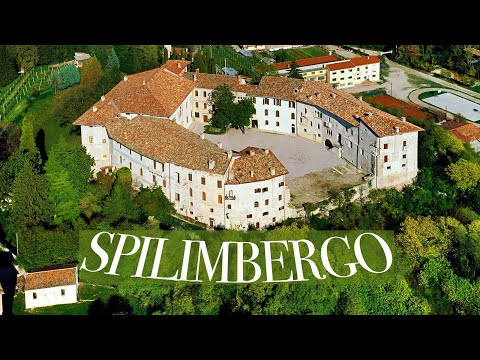 Three Spilimbergo views: town, pilgrimage route and mosaic school
 The Cammino di San Cristoforo channel published this 1-hour-3-minute-38-second film, titled Cammino di San Cristoforo - Percorso Pedemontano, on 18 June 2026. Its description calls it the most loved route of the Cammino. The route organizer separately identifies a Spilimbergo–Maniago stage and outlines villages and churches along the way. This is a useful companion for visitors considering a slower, regional-scale approach to the town, although the short video description does not enumerate stops. Consult current stage notes and maps for directions, access and conditions; the film is not a substitute for route planning.
 ScuolaMosaicisti published this 12-minute-15-second Geo&Geo segment on 3 January 2013. The listing describes it as a television feature dedicated to the Scuola Mosaicisti del Friuli in Spilimbergo. It is the most focused of this selection: rather than presenting the whole town or a walking itinerary, its stated subject is the institution that anchors Spilimbergo’s mosaic identity. The listing gives no shot-by-shot summary, so this review does not infer which techniques or works appear. Treat it as an introduction to the school’s role, then consult the school’s official visitor information for present access and schedules.