Gobertange stone, historic farms and Genville watermill
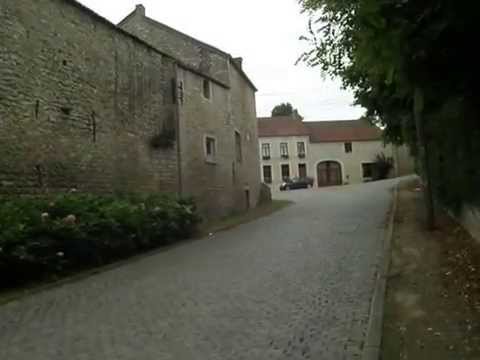
Saint-Remy-Geest is a village in Jodoigne municipality, in Walloon Brabant. Pale stone houses and cobbled streets rise towards a church overlooking the valley. Below, Genville’s former mill stands among wetter meadows and trees. Nearby Mélin and the neighbouring Dutch-speaking towns make it possible to combine a village stay with a wider exploration across Belgium’s linguistic boundary.
| Municipality | Jodoigne |
|---|---|
| Municipal registered population at 1 January 2026 | 15,015 |
| Municipal area, WalStat revision of 22 May 2026 | 73.73 km² |
National Register figure for the whole municipality, including its other settlements. It is not a count of the historic village alone.
A medieval community
The place appears as Gest in a record of 1034. Its history became closely linked with Saint-Laurent Abbey in Liège, which held an important landed lordship here. Saints’ names were subsequently used to distinguish the different Geest settlements.
Seigneurial rights, dues and mills organised local life within the history of Brabant, long before the present municipal boundaries. Recognition among Wallonia’s most beautiful villages in 2022 acknowledges that heritage; it is not a date of foundation.
The village now belongs to Jodoigne. The population and area figures above consequently include the municipality’s other settlements and should not be read as measurements of Saint-Remy-Geest alone.
Stone connecting village and city
Gobertange stone is the local limestone that shaped the valley’s buildings and working life. Quarried since medieval times, it supplied major buildings in Brussels and Leuven as well as houses for local workers, farmers and stonemasons.
Regional red brick became more prominent in the nineteenth century. Raised walls, altered frontages and contrasting materials show how homes changed. Some stone buildings were formerly limewashed, with coverings removed during later renovations.
The White Valley is therefore a landscape of materials and labour, rather than a perfectly preserved medieval stage set. Walking slowly reveals the decisions of several different periods.
Saint-Remy Church and its phases
The church occupies high ground, with views from its cemetery. The revised 2026 heritage guide describes rebuilding between 1760 and 1798; the often-quoted date 1768 marks an important enlargement phase. Gobertange stone gives the classical building a coherent exterior.
Its furnishings span several eras: a painting of Saint Remy baptising Clovis, a late-sixteenth-century Virgin and Child, and Gabriel Taeymans’s ceramic Stations of the Cross. The church’s dedication does not mean that Clovis was baptised in this village.
Open Churches currently lists winter access from 9am to 5pm, excluding services and closure during freezing weather or strong winds. Outside, the Renaissance memorial of Raes de Fonteny and Jeanne de Raul provides another significant stop.
The square and farm buildings
The paved square occupies a flatter space on the slope. Its lime tree was planted in 1980 to commemorate 150 years of Belgian independence, rather than surviving from medieval times.
Below the church, Cense Bivort retains a late-seventeenth-century core with subsequent alterations. Dwelling, bakehouse, stables, barn and pigsties explain the working arrangement. Its name also recalls Alexandre Bivort and nineteenth-century nursery cultivation.
Chemin des Carriers and Basse Voie present varied layouts, with gables, small yards and differently aligned farm ranges. The dovecote gateway on Rue de la Vanne dates from the 1980s within an older property. Traditional appearance alone does not establish an eighteenth-century date.
Genville’s changing mill
The mill stands lower in the valley, in Genville hamlet. Associated with the lords of Mélin, it formerly operated under seigneurial obligations, with inhabitants required to use it and pay the owner’s due.
After periods of damage and abandonment, its functions changed. An oil mill became a flour mill in 1843. The visible buildings chiefly belong to the second half of the eighteenth century; milling ended in 1947.
Water channels, meadow and garden form a protected setting with the structures. Their present uses and interior access should not be confused with an always-open working-mill museum.
Walks and nearby places
The discovery circuit connects church, farms and the descent towards Genville. Cobbles and slopes are part of its character, while the lower section has wetter ground and a different vegetation pattern.
Mélin makes a nearby companion visit around the same stone-building tradition. Regional routes combine the villages on selected walking or longer cycling circuits. Allow for the actual chosen route rather than treating every mapped connection as a short stroll.
Jodoigne adds monuments and municipal-centre services. Hoegaarden and Tienen, on the Dutch-speaking side, also offer onward possibilities. The nearby language boundary broadens the itinerary beyond an exclusive focus on Brussels.
Staying and finding a meal
La Maison en Pierre on Basse Voie provides village guest rooms, with names recalling quarry workers, stonemasons and Gobertange. It is a small guesthouse arrangement rather than a large hotel with round-the-clock reception.
Au Moulin des Délices advertises a ground-floor guest room opening towards the garden, alongside a summer café serving drinks and light food. The seasonal nature of that café matters for a November or winter stay.
La Villa du Hautsart in neighbouring Mélin supplies a restaurant option beyond this lighter offer. The tourism office lists French cooking there. It is outside Saint-Remy-Geest, so organise the reservation and evening journey together.
Approaches and year-round practicalities
Leuven, Brussels and Liège are relevant major arrival cities. The E40 approaches the Tienen and Hoegaarden area, followed by local roads towards Jodoigne and its villages. The final section matters more than straight-line proximity.
Tienen is a useful rail gateway to compare with onward connections towards Jodoigne and the village. Saint-Remy-Geest has no station in its centre, so both the last connection and return journey need planning.
For a possible move, assess shopping and services with those in Jodoigne and neighbouring centres. Attractive stone houses and quiet streets are only part of the decision; the precise address determines ordinary work, school and shopping journeys.
Sources
- Commune de Jodoigne : histoire du village
- Association villageoise : textes historiques et moulins
- Parcours patrimonial révisé en janvier 2026 : pierre, dates et bâtiments
- Patrimoine bâti et promenades autour du village
- Églises Ouvertes : mobilier et ouverture de Saint-Remy
- Circuit de découverte et hameau de Genville
- La Maison en Pierre : chambres d’hôtes au village
- Au Moulin des Délices : chambre d’hôtes et café d’été
- Maison du Tourisme : restaurant La Villa du Hautsart à Mélin
- Brabant wallon à pied : excursions dans la région
- Destination Brabant wallon : accès et transport
- Belgian National Register: municipal figures, 1 January 2026
- IWEPS / WalStat: superficies communales (2026)