Outines is a very small commune in the Marne, where a village of farm buildings sits close to the ponds and broad water landscapes of the Lac du Der. INSEE counted 130 residents for the whole commune in its 2023 reference population, published in June 2026; the density was 8.4 people per square kilometre. Those are commune-wide figures, not just a count of houses around the church. Outines is best approached as a quiet rural place whose strongest visitor experiences are specific: an extraordinary timber church and a nearby protected wetland landscape.
Saint-Nicolas: architecture shaped in wood
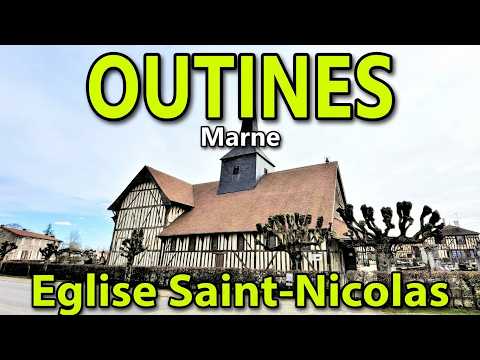
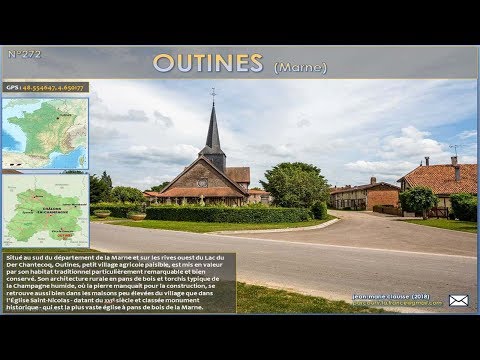
The church of Saint-Nicolas is the village’s most distinctive landmark. The Lac du Der tourism office calls it the largest and most monumental timber-framed church in Champagne. It dates to the sixteenth century, and the oldest timbers have been dated to 1512. Its structure draws on the building traditions of the region’s large covered market halls. The exterior wears overlapping wooden scales; a rose window marks the west front. The office’s heritage notes say the glazing was created in 1936 and restored in 2010. Inside, heavy posts and beams make the frame legible rather than concealing it; the listed features include Louis XV-style panelling, a polychrome wooden Saint Gond from the sixteenth century and a fourteenth-century Christ on the Cross. The church is identified as a protected Historic Monument in the tourism listing.
Outines also belongs to the wider Pays du Der landscape of timber-framed buildings. Here wood is not decorative trim added to a stone monument: it is the structural system. The Lac du Der office’s regional route explains the local oak supply and the relative speed and economy of building in timber. The village’s houses and its church therefore make sense together, as part of a regional construction tradition rather than as isolated curiosities.
From the church square to protected ponds
Beyond the village, the Étangs d’Outines and Arrigny are an important wetland area. The official visitor information says Cistercian monks created the ponds in the Middle Ages and describes them as a protected biodiversity site. Several observation points look across the water and marsh habitat, including the Landres and Grand Coulon observatories; seasonal wildlife is the focus, so bring binoculars and keep to marked paths. The site information names the French biodiversity office, the League for the Protection of Birds, the National Forests Office and the Lac du Der syndicate among its managers. These are working protected spaces, not a wildlife park where sightings are guaranteed.
The official “Les étangs d’Outines” walk is a 7.8-kilometre loop, listed as easy and about two hours, with 81 metres of ascent. One important planning detail: its published starting point is Giffaumont-Champaubert, not Outines church square. Its points of interest include the Chantecoq, Landres and Grand Coulon bird observatories. Check the route sheet and track, access notices, weather and any hunting notices before departure; the tourism office specifically advises caution during hunting periods.
A small working community and useful planning
Outines remains a lived-in agricultural village, not a service centre. INSEE’s 2023 business table lists 13 economically active non-agricultural market-producing legal units, including five in real estate, three in specialist or administrative services and two in industry; the table excludes agriculture and is not a count of jobs. For practical help, the state directory lists the mairie at 4 place de l’Église, telephone 03 26 72 57 60. The Saint-Nicolas association offers audio-guided visits and community events; the tourism office currently lists an audio guide, but warns that displayed hours are not guaranteed. Confirm access, the current price and opening arrangements directly before travelling, and follow all signs at the ponds.