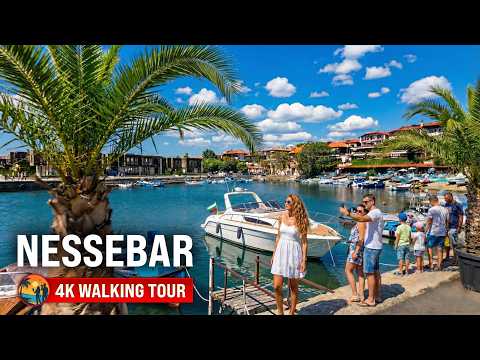
Nesebar occupies a small peninsula on Bulgaria’s Black Sea coast, about 35 kilometres northeast of Burgas. A narrow neck of land joins its old town to newer neighbourhoods on the mainland. This geography explains much of the place: the sea protected a harbour, brought traders and conquerors, and still shapes the walk between stone churches, wooden houses and the waterfront. Nearby Sunny Beach has a different rhythm, with large-scale resort development; the old town repays a slower visit on foot.
A port with many histories
UNESCO identifies the earliest settlement as Thracian Menebria. Greek colonists established a trading town here in the sixth century BCE, known as Mesambria. The surviving archaeological layers and the street pattern record later Roman, Byzantine and medieval periods. That long sequence matters more than assigning the whole town to any single empire: Nesebar changed political hands while retaining its value as a maritime point on the western Black Sea.
The Bulgarian-language account traces repeated shifts between Byzantine and Bulgarian authority in the Middle Ages. It names churches associated with the thirteenth and fourteenth centuries, including St Paraskeva and the Church of the Holy Archangels Michael and Gabriel, and describes commercial links with Constantinople and Mediterranean ports. The Ottoman period did not erase the town’s religious or trading life. Later houses built in the nineteenth-century Bulgarian Revival style, often with stone lower levels and projecting timber upper floors, now stand beside much older masonry. UNESCO recognises this unusual accumulation of periods in its World Heritage listing.
Reading the old town on foot
Begin at the approach to the peninsula and follow the lanes rather than trying to see every church in a single circuit. The remains of fortification walls mark the old defensive edge. Within them, St Sophia survives as an open ruin, making the scale of an early Christian basilica visible without a roof. St John Aliturgetos, near the southern side of the old town, draws attention through its patterned brick and stone exterior. Other churches are smaller and easily missed among shops and houses; check which interiors or museum spaces are open on the day you visit.
Turn away from the busiest streets to see how the nineteenth-century houses sit above the older ground plan. From several points on the perimeter, views extend over the sea toward the newer town and Sunny Beach. The contrast is part of Nesebar’s story: a protected historic centre and a modern coastal resort economy share the same small area. The Bulgarian-language source describes the old peninsula as roughly 850 metres long and 350 metres wide, a useful sense of scale for a walk, though a full visit takes longer once churches and museums are included.
Planning a useful visit
Nesebar has accommodation, restaurants and beach tourism, but seasonal opening hours and transport services should be checked for the travel date. Burgas is the nearest large city identified in the local account; Sunny Beach lies immediately to the north. If arriving from either, confirm the current bus or road connection rather than relying on an old timetable. Wear comfortable shoes for the uneven lanes and leave time for both the architectural details and the sea views. The best historical route is not a checklist of monuments: it is the short walk from the mainland into a town where Thracian, Greek, medieval and nineteenth-century traces remain close together.