Muurame occupies the narrow land between Lake Muuratjärvi and Lake Päijänne, about 13 kilometres from Jyväskylä. The regional city is close enough for an easy outing, but Muurame has a character of its own: a compact centre, wooded ridges, lakeside neighbourhoods and the separate settlement of Kinkomaa. Statistics Finland counted 10,646 people in the whole municipality on 31 December 2025; that total includes villages and rural areas, not just the centre. Municipal figures recorded 1,834 residents in Kinkomaa in 2024.
A village older than the municipality
Muurame became an independent municipality in 1921, separating from Korpilahti. Its settlement history is older. A municipal heritage inventory reports four prehistoric pottery fragments found during sports-field construction in 1929 and identifies them with early Comb Ceramic culture. The find indicates prehistoric human presence, but it does not establish an unbroken settlement. The inventory describes settlement becoming established in the 16th century, when the area belonged to the Suur-Jämsä parish. The old Laukaa road already appears on maps from 1696 and 1752, evidence of a route linking communities before modern roads.
The landmark is Muurame Church, designed by Alvar Aalto in 1926–29 and completed in 1929. Its tall campanile and rounded chancel recall Italian church forms that had impressed Aalto on his first Italian trip. Inside, a barrel-vaulted ceiling and restrained fittings bring Nordic Classicism into contact with the architect’s developing modernism. His original plan included a walled rose garden. The church remains an active parish building, so interior visits depend on seasonal opening and parish arrangements.
River paths, ridge country and Riihivuori
Muuramenjoki flows from Muuratjärvi towards Päijänne through the centre. Its nature trail makes river ecology and local history part of a short town walk: the municipality lists a roughly 1.5-kilometre route and an accessible 800-metre Lippolenkki. A notice dated 25 September 2026 announced repairs to the long bridge from 28 September, with work expected to take one or two weeks. It does not confirm that the bridge has reopened, so check the current route status before going. Signs along the river discuss fish, birds, wetland plants and the river valley’s past.
Muuratharju offers woodland paths and views over both lakes. In Isolahti, the 2.5-kilometre Mehtola trail crosses forest, rocky ground, fields and wetlands on boardwalks; there is a lean-to shelter and fire site. Riihivuori is the high viewpoint above Päijänne and the municipality’s main seasonal visitor hub. Depending on the time of year, its facilities include skiing, a restaurant, summer theatre and events, cabins and other accommodation. Not every self-guided path on the hill is an officially marked trail, and services change seasonally; check current conditions and carry a map.
Work, services and getting around
Muurame is also an employment centre, not simply a residential satellite of Jyväskylä. The municipality estimates about 550 companies and 1,500 jobs, with job self-sufficiency of 67%. Services are the largest employment sector, followed by industry and construction. Harvia began locally as an artistic smithy in 1950 and grew into an internationally known sauna-heater manufacturer. In the centre, visitors find grocery shops, cafés and everyday services; the Aallotar swimming hall and gym offer an indoor option throughout the year. Municipal visitor listings collect places to eat and stay, though opening times and bookings vary.
From Jyväskylä’s railway and coach station, continue by Linkki local bus or a long-distance coach; Muurame has no passenger railway station. The municipality lists local routes 13, 14, 14M, 21 and 113, but timetables change by season. Highway 9/E63 is the direct road corridor south from Jyväskylä, and Jämsä is 42 kilometres away according to municipal information. A first visit can combine the church and river walk with Riihivuori; a longer regional trip can include Säynätsalo and another major Aalto work. A car or bicycle helps connect outlying paths, while bus users should plan around the current timetable.
Check church access, trail conditions, seasonal businesses and bus departures shortly before travelling.
 Muurame en tres videos: identidad local, el sanatorio de Kinkomaa y Riihivuori
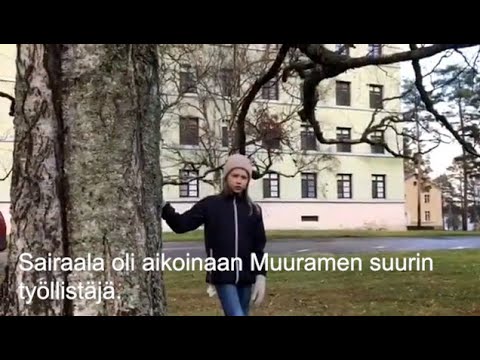 In this 100-second municipal archive clip, Kinkomaa’s sanatorium is presented as an important part of local history. The description says the tuberculosis sanatorium was built in the 1930s, later served as a military and general hospital, and was once among Muurame’s largest employers. Municipal records date the main building to 1930. The clip was published in 2021 and does not describe the site’s present condition: later municipal notices concern demolition plans and a permit extension. Treat it as historical context, not an invitation to enter the property.
 This 119-second municipal short introduces the Riihivuori skiing phenomenon through the hill’s mogul-skiing tradition and the experiences of local children. It gives a glimpse of how winter sport has shaped community life, rather than a current report on snow, lift operation or events. The clip dates from 2021; check the resort’s current season dates, services and access before travelling.